
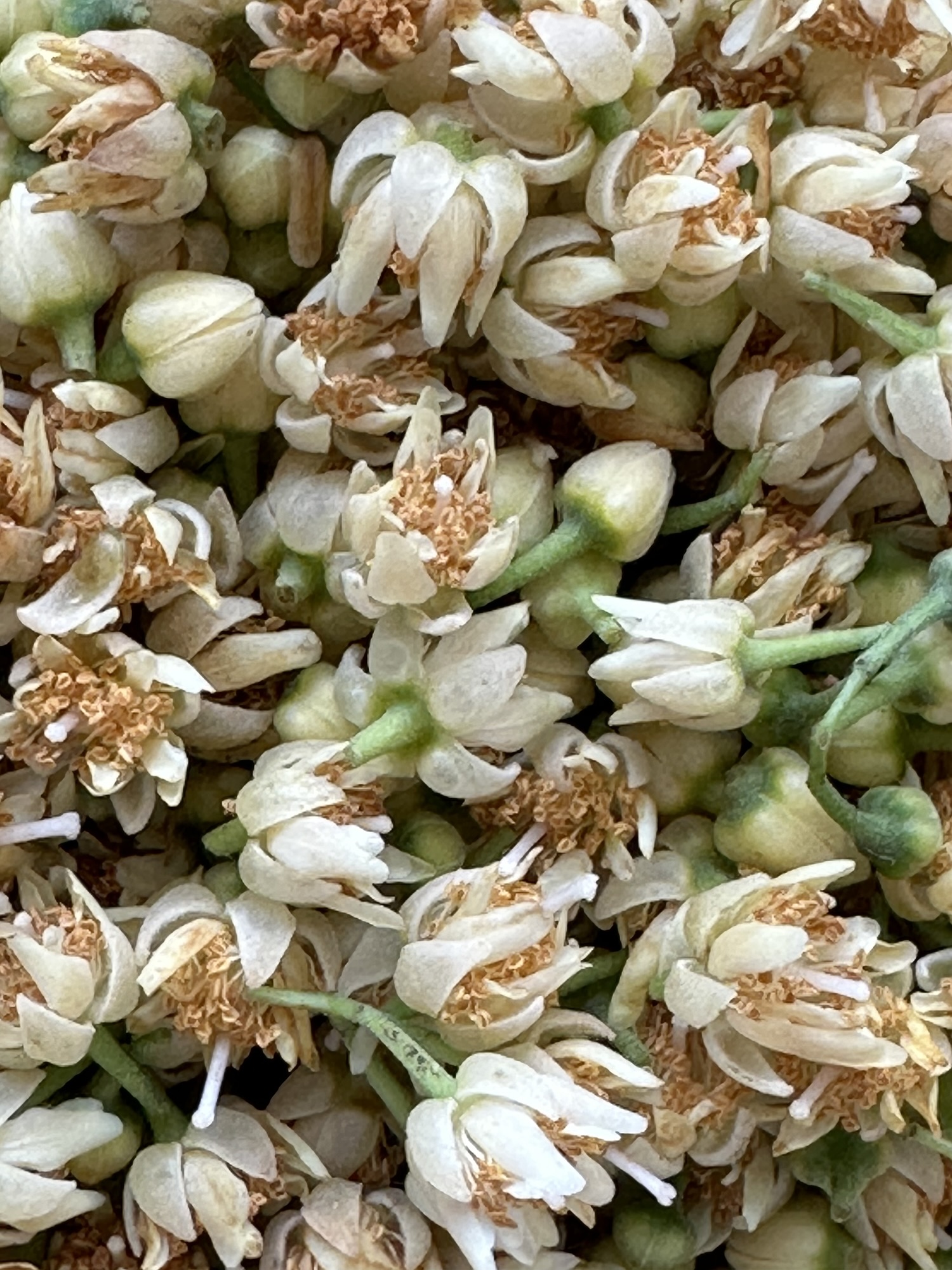
American basswood, American linden, Bee-tree, Lime-tree
During my brother’s visit we had several other adventures and I ended up with a sack full of linden blossoms! We toured the iconic Miller Brewery.


Note the six pointed ‘bierstern‘ (beer star) or ‘brauerstern‘ (brewer’s star) on the outside of this historic Miller building.
This symbol was the official insignia of the Brewer’s Guild since the 1500s, but has an even older alchemical history.
We also went to the House on the Rock, a unique mid-century architectural wonder containing a myriad of eclectic collections. It’s a bit overstimulating and fairly psychedelic feeling.


Had an unplanned stop to tour the C-97 Stratofreighter that’s been parked outside the Don Q Inn since 1977. Another quirky Wisconsin treasure that had we not been in the camper, I wish we had stayed at.

Cave of the Mounds was the last stop.


BOTANICAL DESCRIPTION
The nectar-rich scent of the linden tree was the first thing I noticed. This large deciduous tree native to eastern and central North America, typically grows between 60 and 120 feet tall, forming a broad, rounded crown with a straight, sturdy trunk.

The bark is smooth and gray in young trees, becoming furrowed with age.

The leaves are alternately arranged, heart-shaped, and coarsely serrated, measuring 5 to 10 inches long. They are dark green and smooth on the upper surface, with a paler, often slightly hairy underside on long, slender petioles.

In early to mid-summer, sweetly scented clusters of creamy-white to pale yellow flowers appear.


These fragrant flowers have a honey-like aroma and are grouped in clusters of 5 to 10, each cluster includes a narrow, leaf-like bract that aids in wind dispersal of the small, hard, nut-like fruits that follow.

The blossoms are beloved by bees, providing one of its popular names.
Another common name “lime” comes not from the citrus fruit, but rather a corruption of the older name “lind” or “linde,” which was used for the tree in Old English and other Germanic languages. The other colloquial name “basswood” comes from one of its indigenous applications.
NATIVE AMERICAN TRADITIONAL USES
The sap, which contains moderate amounts of sugar, was consumed as a refreshing drink or boiled down into a syrup. The inner bark was sometimes dried and ground into flour for soups and breads. The Chippewa ate the young twigs and buds, either raw or cooked as greens.
Medicinally, extracts from the leaves and bark were used to treat a variety of ailments.
Algonquin
- Leaf infusion as an eyewash
Cherokee
- Created a compound from the inner bark to treat dysentery
- Used jelly made from the plant as a remedy for coughs and tuberculosis
- Applied a decoction of bark mixed with cornmeal as a poultice for boils
- Consumed inner bark and twigs during pregnancy to relieve gastrointestinal issues
- Chewed bark (specifically from a tree struck by lightning) to apply to snakebites
Iroquois
- Decoctions were brewed for numerous disorders and uses including:
- Internal hemorrhage
- Stimulant
- Prior to childbirth
- Poultice for burns, scalds, broken bones, and swelling, and
- Diuretic
Malecite
- Used an infusion of roots or bark as an anthelmintic (to expel intestinal worms)
Meskwaki
- Employed the plant as a pulmonary aid
Micmac
- To treat infected wounds and used it as an anthelmintic
All of the tribes listed above, as well as the Lakota, Menominee, Ojibwa, Omaha, Pawnee, Ponca and Potawatomi, used the fibrous inner bark, known as bast, which was stripped from the tree in long ribbons and processed into durable fibers for making rope, baskets, clothing, etc. This utility is reflected in the tree’s common name, “basswood,” derived from “bastwood.”
The wood was also valued for being lightweight, soft, and easy to carve, making it ideal for crafting items such as bowls, masks, and ceremonial objects.
MYTHOLOGY & MAGICK
In Europe, there are several related linden species that hold deep symbolic meaning. During pre-Christian times, the linden was sacred and cutting it down was taboo. It symbolized loyalty and healing, and people held weddings and healing rituals beneath its branches. Linden blossoms were believed to attract love and protect against nightmares and evil spirits.
Ancient Greece & Rome

The linden tree symbolized marital unity, fidelity, and wisdom, often associated with Aphrodite in ancient Greece, and then Venus and Juno in Rome.
There are two ancient Greek myths that specifically feature the linden tree. In the first, the nymph Philyra was seduced by Cronos, the god of time, who had taken the form of a horse.

From this union, she gave birth to Chiron, the centaur. Overwhelmed by sorrow and shame at bearing a half-human, half-horse child, Philyra begged the gods to release her from her human existence. In response to her plea, the gods transformed her into a linden tree.
Chiron was raised in the shade of this tree, where Philyra, now in her arboreal form, instilled in him the values of wisdom, compassion, and love.

In the myth of Philemon and Baucis, the elderly couple were the only ones in the town to give shelter to Zeus and Hermes in disguise, despite their own poverty.
In return, one of the couple’s requests was to die at the same moment so neither would have to live without the other.
When their time came, the gods honored their wish and they were transformed into two trees, Philemon into an oak and Baucis into a linden, their trunks intertwined so they could remain together even in death. This myth has made the linden tree a lasting symbol of devotion, unity, and enduring love.

Slavic Traditions

The linden, called lipa in Slavic languages, was linked to Lada, the goddess of love, fertility, and childbirth. It was believed she took the form of the tree to comfort and protect women during childbirth.
The linden tree was so revered in this region that it gave its name to months (e.g., lipiec in Polish for July) and even currencies (e.g., lipa in Croatia).
Baltic Mythology

In Baltic traditions, the linden tree was sacred to Laima, the goddess of fate and childbirth, who determined the length of a lifespan as well as one’s destiny.
One of Laima’s most important duties is prophesying and she was believed to dwell in a linden making her judgments in the form of a cuckoo.
Germanic Beliefs
Among Germanic peoples, the linden tree was a symbol of justice and truth. Communities gathered under linden trees for judicial assemblies known as things, believing the tree would help reveal the truth. This tradition persisted even after Christianization, with verdicts often delivered sub tilia (under the linden).

The Linden tree is also associated with Freyja, the goddess of fertility, love, and war. It was said that lightning would not strike a linden tree because of Freya’s marriage to Odin.
CONTEMPORARY EDIBLE USES

The blossoms are edible and can be dried for tea or infused into a simple syrup or liquors.
Young buds or tender, translucent and unfurling leaves are both great additions to salads. The cambium layer of the bark is said to have a sweet, cucumber-like flavor. Additionally, the tree produces tiny nuts that are reportedly similar in flavor to sunflower seeds, though the nutmeat is quite small and encased in a thick shell.
Since it was summer, there were no seeds and only blossoms. However, my curiosity about these were piqued when I read this fascinating account Linden Chocolate – Forager | Chef
RECIPE
Sun Cake w/ Linden Blossom Syrup
One of my absolute favorite blogs is Gather Victoria by Danielle Prohom Olson, where delightful recipes and lush photography take the reader “on a culinary pilgrimage through the seasonal celebrations of the wheel of the year. ” I had to make her Semolina Sun Cake w/ Linden Blossom Syrup.

The key to this cake is obviously the linden blossom syrup which has a honey-like but faintly floral taste. I did substitute farina for semolina, orange for the lemon peel and sour cream for the yogurt because it’s what was in my pantry.

This lovely syrup-drenched cake is reminiscent of namoura from Lebanon. It was delicious and I will definitely be making it again while experimenting with the syrup.
References
Art of the Root. (2023, February 7). The magic of Linden: Recipes for love, fidelity & marriage. https://artoftheroot.com/blogs/spells-and-rituals/linden-blossom?srsltid=AfmBOoprM0Bjapj9FrBpptHj3Uwkuq02EGEvBSS8mADJS_GRZaifwJ1d
Bergo, A. (2025, May 10). American Basswood leaves / Linden tree. Forager Chef. https://foragerchef.com/american-basswood/
Heminghaus, M. (2023, Dec). American Basswood. Rowan University Arboretum. https://arboretum.rowan.edu/trees/american-basswood/
Lime tree in culture. (2025, March 23). In Wikipedia. https://en.wikipedia.org/wiki/Lime_tree_in_culture
Native American Ethnobotany Database. (n.d.). Tilia americana L. http://naeb.brit.org/uses/species/3959/
Rachel of the Woods. (2020, July 17). Basswood – Tilia Americana: Edible & medicinal uses of the bee tree of wild plants. https://www.songofthewoods.com/basswood-tilia-americana/
Tilia. (2025, June 28). In Wikipedia. https://en.wikipedia.org/wiki/Tilia
USDA. (n.d.). Tilia americana. Natural Resources Conservation Services. https://plants.usda.gov/DocumentLibrary/plantguide/pdf/pg_tiama.pdf
Willow. (2021, April 5). Magical and medicinal use of linden. Flying the Hedge. https://www.flyingthehedge.com/2021/04/magical-and-medicinal-use-of-linden.html
Leave a Reply