
Fox grape
On our journey back to Florida we detoured through Ontario, Canada to take in the breathtaking views at Niagara Falls.


This grape is native to eastern North America from Ontario and Nova Scotia south to Louisiana and Florida.
The common name “fox grape” does not refer to the animal, but rather to this fruit’s unique sweet, earthy muskiness. The Vitis labrusca varieties are the most aromatic among the wine grape varieties, outside of the Vitis vinifera “Muscat” family.
Of the eight species of grapes in the Vitis genus, six are native to North America, while only vinifera is native to Europe and amurensis to Asia.

Vitis labrusca is notable because its famous 1849 cultivar, Concord, is used to make common commercial grape juice and jelly.
In another cautionary tale of exporting plant species to new areas, in the 19th century Vitis labrusca was one of the American grape species carrying phylloxera, a sap-sucking insect, that when transported to Europe resulted in an epidemic that almost destroyed the European vineyards planted with native Vitis vinifera.

But since Vitis labrusca was resistant to phylloxera, grafting the new world Vitis vinifera onto old world Vitis labrusca eventually became one of the strategies to overcome this insect plague.
BOTANICAL DESCRIPTION
Woody, deciduous vine that can grow up to 40’ long. The stems create one leaf per node, with tendrils or flowers stationed across from each leaf. Generating tendrils from the nodes is one of this species defining characteristics.
Leaves are dark green, heavily textured, oval-cordate with 3 palmate lobes, and span 4-6” long. The second defining characteristic is the fuzzy brown-grey hairs on the underside of the leaves.

In May through July, clusters of small (approximately 1/8” across) yellowish-green flowers appear. The flowers are said to have a sweet, musky fragrance.
As fall approaches, the flowers transition into drooping clusters of green medium-sized grapes approximately 3/4” diameter.
These fruits will ripen to a blue-black or dark purple and have 4-5 small seeds in the center. They also have a skin that easily slips off when squeezed, leaving the pulp intact as a ball. This “slip skin” is the third defining characteristic of grapes of this species.

NOT SO ALIKE LOOK-ALIKES
Both poison ivy and Virginia creeper produce blue berries. When foraging, look at the leaves and the size of the fruit to verify the plant’s identity.
HERBAL AND TRADITIONAL USES
Like all indigenous grapes, the fruit has a long history of culinary use by a variety of Native American tribes. This included simply eating the fruit raw, drying them into raisins, or processing the fruit to make juice and dumplings. The leaves and tendrils are also edible, and produce a yellow dye.
Medicinally, the leaves have been used as an external poultice used to ease pain associated breasts, rheumatic joints, headaches and sore breasts from breastfeeding. A leaf infusion has been ingested to treat diarrhea, liver ailments, stomach aches, fevers, headaches and thrush. A bark infusion was used to treat urinary issues.
In a variety of cultures, grape wine has been used as a medicinal beverage and there is contemporary research into its phenolic antioxidants, including resveratrol known for is cardiovascular benefits, to support this. Herbal tinctures were created with wine to be later diluted with honey and water for medicinal use.
MAGICKAL USES
Grapes are associated with abundance, prosperity, fertility and transformation. They can also be used in love magic and for binding.
Grapes are sacred to the Greek god of wine, revelry, agriculture, and fertility, Dionysus and his Roman counterpart, Bacchus.
In the African American Hoodoo tradition, grape is used for curse lifting and adultery revealing spells.
RECIPE
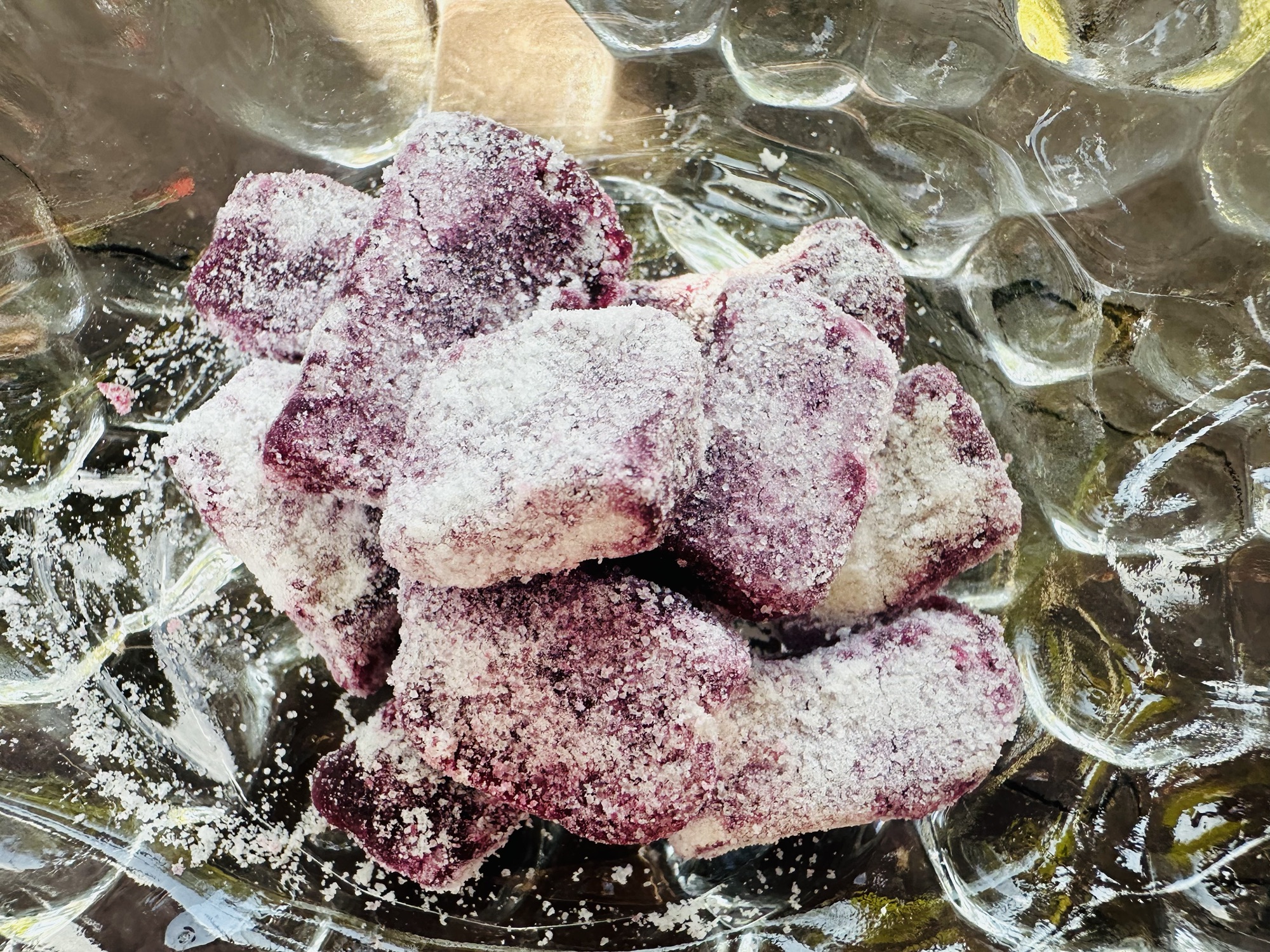
I wanted to try something different than a jam, jelly or juice. I had some time because I had thrown my harvest in the freezer. I finally decided to try to make a grape jelly candy, or Pate de Fruit.

I used Thomas Keller’s recipe from A Woman Cooks in Asheville but adjusted the measurements based on the amount of fruit harvested. Delicious!

References
Brown, D.M. (n.d.) Indigenous American grape varieties, A primer. Palate press. https://www.palatepress.com/wine-indigenous-american-grape-varieties-a-primer/
Missouri Botanical Garden. (n.d.). Vitis labrusca. https://www.missouribotanicalgarden.org/PlantFinder/PlantFinderDetails.aspx?taxonid=301151
O’Driscoll. D. (2022, April 16). Sacred tree profile: Wild grape (Vitis labrusca) mythology, medicine, and meanings. The Druid’s garden.https://thedruidsgarden.com/2021/01/17/sacred-tree-profile-wild-grape-vitis-labrusca-mythology-medicine-and-meanings/
Plants for a Future. (n.d.). Vitis labrusca – L.https://pfaf.org/user/Plant.aspx?LatinName=Vitis+labrusca
Vitis labrusca. (2024, July 28). In Wikipedia. https://en.wikipedia.org/wiki/Vitis_labrusca
Subscribe and get wild foods . . .
Straight to your inbox!
Disclaimer: Information contained on this website should not be considered as a recommendation or an endorsement. This information is intended for educational purposes only, and is strictly and categorically intended as a reference to be used in conjunction with plant experts in your area. Roaming Roots accepts no liability for the use or misuse of information contained in this website. Consumption of plants and fungi is at the reader’s own risk and discretion.
Leave a Reply