

Cranberrybush viburnum, American cranberrybush, high bush cranberry, highbush cranberry
PUBLICATION OF THIS POST WAS DELAYED BY THE 2024 HURRICANE SEASON.
After a week in the north woods of Wisconsin, we traveled east across Michigan. At our first stop we discovered highbush cranberries when wandering through a local park with a beautiful lake.


High-bush cranberry is not a true cranberry, it is actually a member of the honeysuckle family native to wetlands, lake margins and other moist landscapes across Canada and the Northeastern and Midwestern United States.
There are actually three different bushes given the common name highbush cranberry.
| Species | Native Range | Defining Characteristics | Fruit |
| Viburnum opulus | Not native – introduced from Europe | Has flat or sunken glands near the base of the leaf | Inedible; also called “Guelder rose” |
| Viburnum edule | Native to Canada & northern U.S. | Has convex, or rounded glands near the base of the leaf | Said to be the most flavorful variety; also called “squashberry,” “mooseberry,” “lowbush cranberry” |
| Viburnum trilobum (or Viburnum opulus var. Americanum) | Native to Canada & northeastern United States | Has convex, or rounded glands near the base of the leaf | Tart like cranberries (but with one large seed instead of many small ones) |

Then we traveled onward towards St. Ignace and Mackinac Island.


BOTANICAL DESCRIPTION
Multi-stemmed deciduous shrub with arching stems and a very dense, rounded form that can grow up to 13-15 feet.
Twigs are reddish-brown before maturing to gray-brown bark with large lenticels (pores that allow gas exchange).
Leaves are in an opposite arrangement, have a three-lobed shape with a broad rounded base and serrated margins, and can range in size from 2-4 inches long and 2-3 inches wide. Similar in shape to a maple leaf, highbush cranberry leaves are distinguished by a wrinkled surface and visible impressed veins. In the summer the leaves are dark green before turning yellow-red or reddish-purple in autumn.


Large showy white corymbs (a flattish inflorescence with the outer flowers on longer pedicels than the inner) bloom in late spring to early summer. These are comprised of a ring of sterile five petaled blooms that surround small, fertile lace-cap flowers
In the fall, in attractive pendulous clusters of bright red berry drupes containing a single flat, white seed develop.
TRADITIONAL USES & HERBAL BENEFITS
The fruit is rich in vitamin C and was an important food to Native Americans. Today, the fruit is typically cooked into jelly or sauce (because of its large seed).

The bark of the highbush cranberry, called crampbark, is also used medicinally. Crampbark was noted in the 1894 U.S. Pharmacopeia and then again in the 1916 National Formulary. The bark of all species contains viburnine, a vasodilator with antispasmodic properties that relaxes both skeletal and smooth muscles.
Used for the following applications:
- Reduce menstrual cramps or prevent miscarriage (relaxes the uterus)
- Muscle spasms & backaches
- Tension headaches
- Spastic constipation & IBS
- Raynaud’s syndrome
- Restless leg
- Rheumatic pain
- Hypertension
- Poor circulation in the extremities
To harvest the bark, it is purported that small branches can be shaved with a potato peeler to expose the inner cambium. This can either be used in a tea, dried for future use or preserved as an oral tincture or a topical infused oil.
RECIPE
I froze the fruit while on the road and upon returning home had planned to make Alan Bergo’s Highbush Cranberry Sauce to accompany a roast chicken.


However, the day after I started the sauce, Hurricane Helene hit the gulf side of Florida. We didn’t evacuate because it wasn’t predicted to be any worse than Debby in August.
The wind damage wasn’t as bad as Ian, but two rooms in our house did flood. According to neighbors, there had never been flooding like this in the two decades they lived there.


It was spooky to be trapped in the house with the water continuing to rise with the tide throughout the night.
Ten days after cleaning up from Helene, Hurricane Milton barreled across the gulf towards us and we evacuated with our critters to Georgia.

For the second time this year, unprecedented flooding occurred – this time our entire house flooded 4-6 inches.
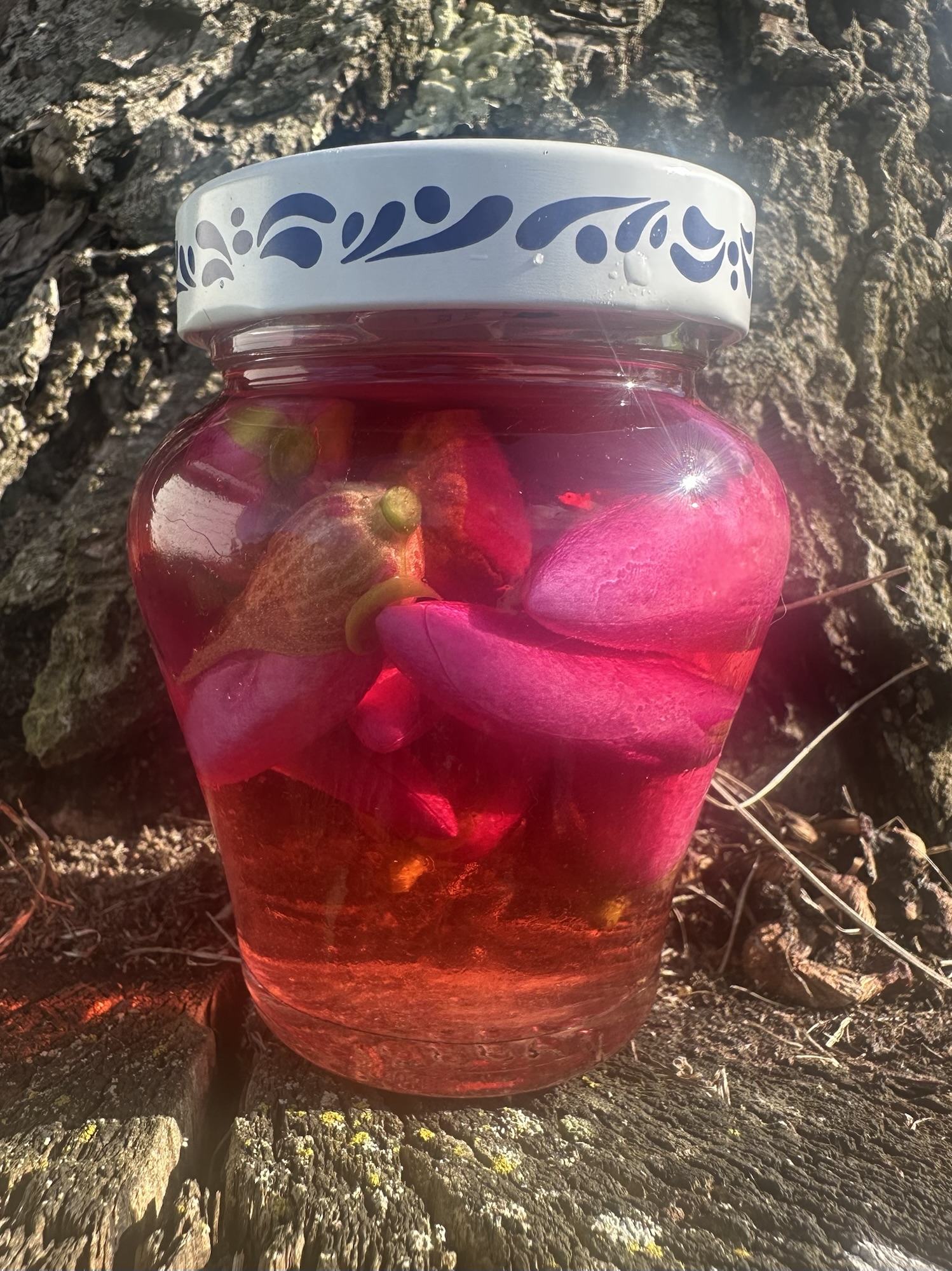
After our return, the house only had partial power for a week and, needless to say, the high-bush cranberry sauce was forgotten and began to ferment.
References
Adamant, A. (2018, September 5). Foraging highbush cranberry for food & medicine. Practical self-reliance. https://practicalselfreliance.com/highbush-cranberry/
Small, E. & Catling, P.M. (2005). Poorly known economic plants of Canada–47: American cranberry bush (Viburnum opulus var. americanum). The Canadian Botanical Association Bulletin, 38(4), 48-54. https://www.cba-abc.ca/wp-content/uploads/2023/12/2005_38_4_Viburnum-opulus.pdf
University of Maine. (n.d.). Highbush cranberry (not a true cranberry). Cooperative extension. https://extension.umaine.edu/cranberries/highbush-cranberry/
University of Minnesota. (2024). High-bush cranberry – Viburnum opulus var. Americanum. Urban forestry outreach & research. https://trees.umn.edu/highbush-cranberry-viburnum-opulus
V., Sherra. (2021, October 29). Cramp bark. The lost herbs. https://thelostherbs.com/cramp-bark/
Viburnum trilobum. (2024, August 16). In Wikipedia. https://en.wikipedia.org/wiki/Viburnum_trilobum
Subscribe and get wild foods . . .
Straight to your inbox!
Disclaimer: Information contained on this website should not be considered as a recommendation or an endorsement. This information is intended for educational purposes only, and is strictly and categorically intended as a reference to be used in conjunction with plant experts in your area. Roaming Roots accepts no liability for the use or misuse of information contained in this website. Consumption of plants and fungi is at the reader’s own risk and discretion.


Leave a Reply