
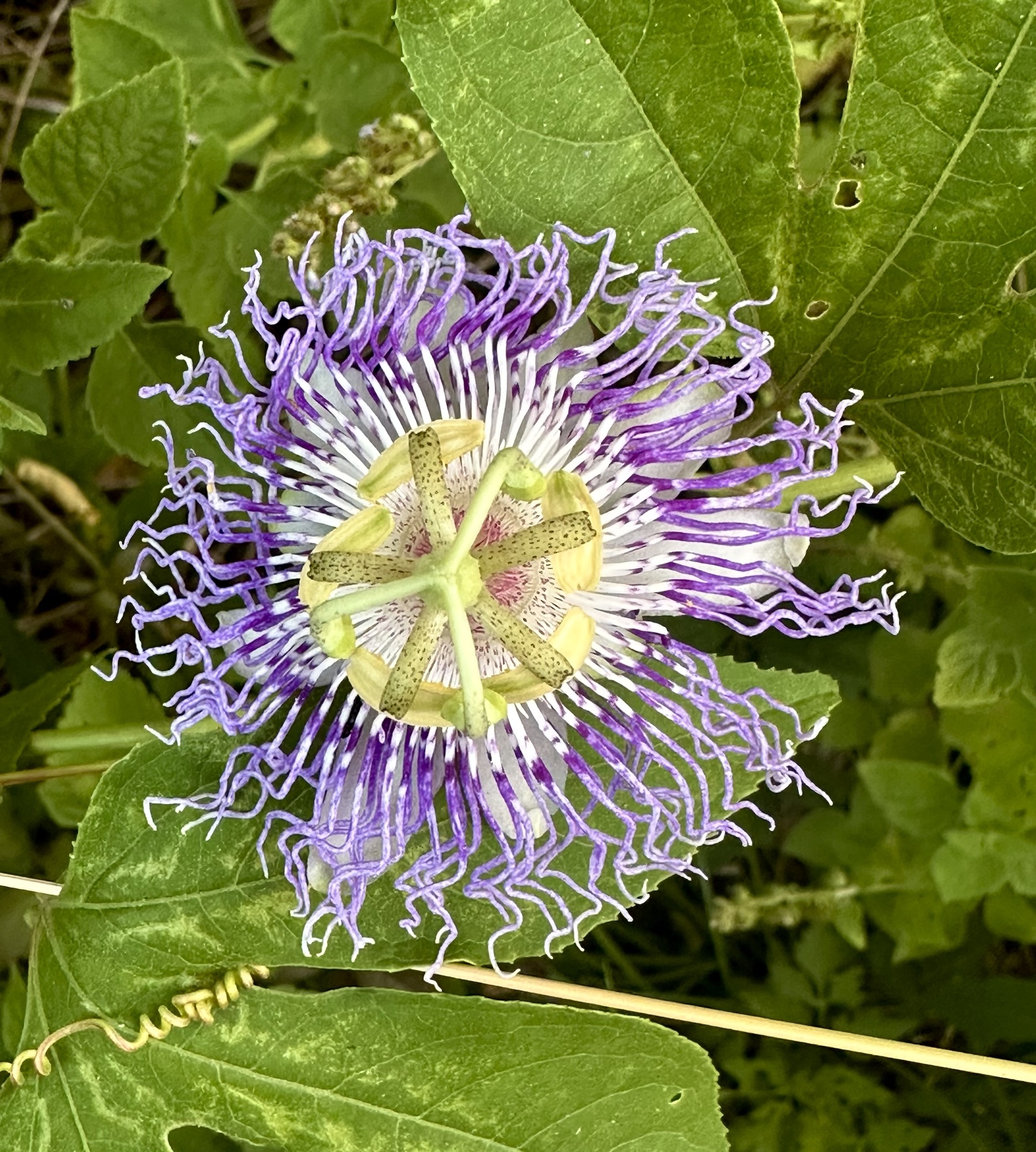
Maypop, purple passionflower, true passionflower, wild apricot, wild passion vine, old field apricot
We had yet to visit the Florida Panhandle so on this August when we took our annual trip to Wisconsin to visit Joe’s family, we made a deliberate detour west to Marianna . . .


We visited Florida Caverns State Park and were thrilled to spot a tiny tricolored bat (Perimyotis subflavus) resting in a dark hole in the ceiling . . .


Hiked the Bellamy Bridge Heritage Trail and spotted the very large tail of a what we think might be a non-venomous brown watersnake (Nerodia taxispilota). . .


And took a lovely day trip to Panama City Beach.
While out driving on the backroads, I spotted a remarkable collection of maypop blooms, a non-tropical species of passion fruit native to the Southeastern U.S.

BOTANICAL DESCRIPTION
Fast-growing perennial vine with long, trailing stems with numerous tendrils. Stems can be smooth or pubescent (hairy).

The dark green, alternate leaves are between 2.5-6 inches across and palmately three-lobed (occasionally five-lobed). The lightly serrated lobes terminate in points. The leaves have two nectar-secreting glands at the base of the blade on the petiole that attract beneficial ants that help protect the leaves from caterpillars.

Large (2-3” diameter), distinctive and showy flowers appear in the summer. A central corona of pinkish-purple filaments erupts from a bed of ten bluish-white petals and sepals. Pale-yellow, fleshy reproductive parts sit upright in the center of this frilly crown.
The fleshy, egg-shaped fruits appear in July and mature to a from green to a yellowish color in fall. Technically a berry, an edible, gelatinous pulp surrounds numerous black seeds. The pulp begins white and then becomes a dull yellow as it ripens.
ETYMOLOGY
The plant acquired its genus name Passiflora (passio is Latin for “passion” and flos means “flower”) from 16th century Spanish colonizers attributing Christian crucifixion symbology to its flowers. In the context of the Passion of Christ, the flower’s filaments come to represent his crown of thorns, the styles the nails, the stamens his five wounds, and the five sepals and five petals his loyal Apostles (excluding Judas, who betrayed Jesus, and Peter, who denied Jesus three times on the night of his trial).

The common name “maypop” is said to originate from the loud popping sound made when fruits are stepped on. However, Daniel Austin writes in his book Florida Ethnobotany: “The names maricock and maracocks gave rise to maracoc, maycock, maypop (Alabama, North Carolina), mollypop (Alabama, North Carolina) ……All of these names are supposedly derived from mahcawq (Powhatan), akin to machkak (Menomini)…”

TRADITIONAL USES & HERBAL BENEFITS
Archeological evidence indicates that the maypop was a common food and medicinal plant for indigenous Americans for centuries. A colonist’s account of Algonquian life in Virginia during the 17th century states that:
“they plant also the field apple, the maracock, a wyld fruict like a kind of pomegranett, which increaseth infinitlye, and ripens in August …”
Major, 1849 as cited in Miroddi, Calapai, Navarra, Minciullo & Gangemi, 2023, p. 793
This USDA NRCS plant guide states:
“The Houma, Cherokee and other Native American tribes used purple passionflower for food, drink, and medicinal purposes. Captain Smith, in 1612, reported that Native Americans in Virginia planted the vines for the fruits. The fruits were eaten either raw or boiled to make syrup. A beverage was made from the fruits by crushing and straining the juice. Sometimes the juice was thickened by mixing it with flour or cornmeal. The young shoots and leaves were eaten, cooked with other greens. The roots were used in an infusion to treat boils, and to “draw out inflammation” of wounds from briers or locusts. Babies were given a tea made from the roots to aid in weaning. The roots were beaten with warm water and used as ear drops to treat earaches. Root infusions were used to treat liver problems. Soaking the crushed roots in drinking water made a “blood tonic.” The plant was also used as a sedative to treat nervous conditions and hysteria.”
Modern herbal therapeutic uses of Passiflora continue to be for the nervous system as an antispasmodic and to treat anxiety and insomnia. It is believed that plant’s sedating and anxiolytic activity is from modulation of the Gamma-Aminobutyric Acid (GABA) system via an affinity for GABA(A) and GABA(B) receptors, and effects on GABA uptake.
Other newer applications are treatment of ADHD, menopausal symptoms, and opiate withdrawal.
Contraindications: Bradycardia, hypotension, simultaneous use of pharmaceutical sedatives
CULINARY USES
All parts of the plants are edible but since passionflower leaves are the only food source for gulf fritillary caterpillars, I opted to harvest a handful of flowers for tea.

Ripened maypop fruit is said to have a mildly sweet-tart taste and can be eaten fresh off the vine or made into juice, jams, jellies and desserts.
I only found a single fruit (they are said to be very popular with wildlife). Since the fruit was green and still on the vine I was concerned that it was not fully ripe yet so I set it on a bunch of bananas. Bananas are known to help ripen other fruits because they release ethylene gas which facilitates ripening by breaking down cell walls, converting starches to sugars, and reducing acidity. After two days, the fruit softened, became wrinkled and slightly more yellow. I thought it might be time but, alas, when I cut it open I found the fruit, including the seeds, undeveloped.

RECIPE
I dried the blossoms and used them in a floral herbal moon milk inspired by Renee Byrd’s Pink Moon Milk. Moon milk a warm Ayurvedic beverage that consists of herbs steeped in milk consumed before bed for restful sleep.
I combined equal parts of passionflower, rose petals, chamomile (from our farm Vintage Acres), and jasmine blossoms.

In a saucepan I brought the flowers and whole milk to a simmer, stirring frequently to prevent scorching. I covered it and let it steep for 10 minutes.
I strained the plant material out and then added honey, vanilla and ube purple yam concentrate.

The result was a pale purple, creamy concoction with a faintly herb flavor that definitely made me sleepy!
References
Blankespoor, J. (2023, November 14). Passionflower: Ecology, cultivation, botany, and medicinal and edible uses. Chestnut School of Herbal Medicine. https://chestnutherbs.com/passionflower-ecology-cultivation-botany-and-medicinal-and-edible-uses/#_edn2
Janda, K., Wojtkowska, K., Jakubczyk, K., Antoniewicz J. & Skonieczna-Zydecka, K. (2020, December 19). Passiflora incarnata in neuropsychiatric disorders—A systematic review. Nutrients, 12, 3894. doi:10.3390/nu12123894
Miroddi, M., Calapai, G., Navarra, M., Minciullo, P.L. & Gangemi, S. (2023). Passiflora incarnata L.: Ethnopharmacology, clinical application, safety and evaluation of clinical trials. Journal of Ethnopharmacology, 150(3), 791-804. https://doi.org/10.1016/j.jep.2013.09.047
Passiflora incarnata. (2024, June 14). In Wikipedia. https://en.wikipedia.org/wiki/Passiflora_incarnata
Traub, M. (n.d.). Passionflower: An overview of the research and clinical indications. Gaia Herbs. Retrieved August 17, 2024 from http://cdn.naturaldispensary.com/downloads/A%20Research%20Review%20of%20Passionflower.pdf
Tyrant Farms. (2023, May 4). Native passion fruit (Passiflora incarnata): How to grow, forage & eat. https://www.tyrantfarms.com/find-id-harvest-grow-eat-passion-fruit-maypop-passiflora-incarnata/
Subscribe and get wild foods . . .
Straight to your inbox!
Disclaimer: Information contained on this website should not be considered as a recommendation or an endorsement. This information is intended for educational purposes only, and is strictly and categorically intended as a reference to be used in conjunction with plant experts in your area. Roaming Roots accepts no liability for the use or misuse of information contained in this website. Consumption of plants and fungi is at the reader’s own risk and discretion.



Leave a Reply