
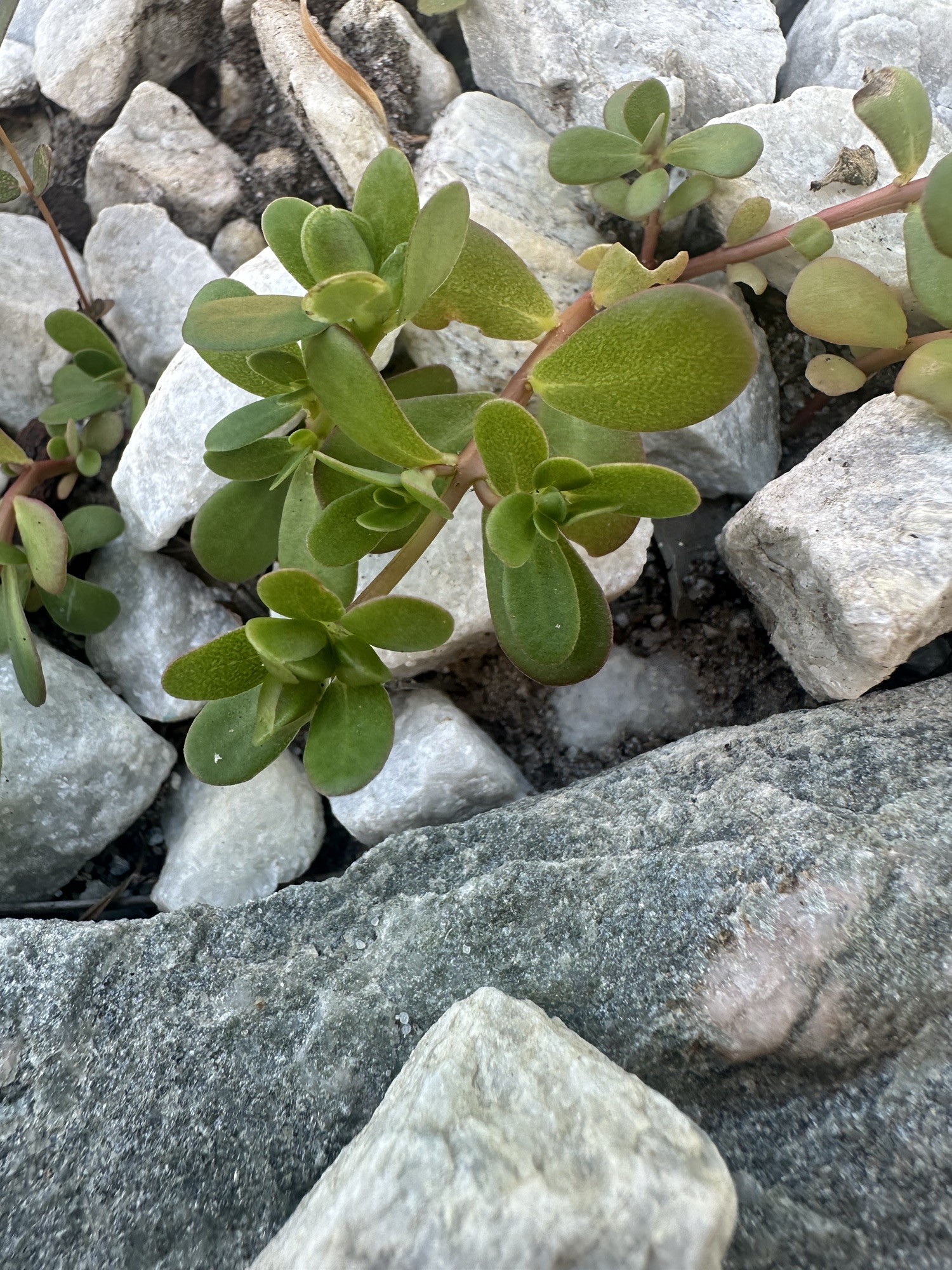
Purslane, garden purslane, common purslane, little hogweed, pursley, wild portulaca
Experts are divided as to whether this plant, now naturalized in much of the world, originated in South America, or is native to North Africa, the Middle East, and the Indian subcontinent. However, there is archeological evidence that it was present in pre-Columbian North America. Today it is commonly thought of as a weed but is still a cultivated crop in some regions.
BOTANICAL DESCRIPTION

Fleshy, succulent annual with multiple thick, smooth, reddish stems that sprawl across the ground in a trailing habit to form a mat up to 3 feet in diameter.

The fleshy leaves are smooth, waxy, and green or green with a red margin. Leaf shape can possess slight variations, but are generally oval to spoon-like, either alternate or opposite, and cluster towards the stem joints and ends.
Yellow flowers are small, ranging from ¼ – ½ inches, have five notched petals and numerous yellow stamens in the center. Each flower becomes a seed capsule containing several small, black seeds.
Alert! Purslane has a poisonous look-a-like called Hairy-Stemmed Spurge, or Euphorbia vermiculata. It can be distinguished from purslane by its hairy stems and the presence of a milky sap when the stem is cut and squeezed.
TRADITIONAL
USES & HERBAL BENEFITS
MEDICINAL
De Materia Medica is a five-volume compendium of medicinal plants written between 50 and 70 CE by Pedanios Dioscorides, a Greek physician in the Roman army. Within this work, purslane is described as an “astringent, and a remedy for headaches, inflammation of the eyes and other organs, burning of the stomach, erysipela, disorders of the bladder, numbness of the teeth, excessive sexual desire, burning fevers, worms, dysentery, hemorrhoids, eruptions of blood, and bites.”
Other traditional medicinal treatments include as a diuretic, an antipyretic, for insomnia, and its mucilaginous sap applied to burns and wounds. Purslane is a well-established treatment in both Ayurvedic (Lona) and Traditional Chinese Medicine (Ma Chi Xian), and the World Health Organization has listed it as one of the most used medicinal plants globally.
Contemporary research has identified and confirmed that the plant has neuroprotective, anti-hyperglycemic, antioxidant, anti-inflammatory, antihyperlipidemic, reno-protective, hepatoprotective, antiulcerogenic, anticancer and varied antimicrobial properties.
MAGICKAL
Associated with protection and sleep, in ancient and medieval Europe purslane was scattered around beds as protection against evil spirits and nightmares. Soldiers were said to tuck a sprig into their armor to keep themselves safe during battle.
Purslane is used in Africa for ritual purification. In West Africa specifically, it has also become associated with recovering money owed. There is a Yoruba folktale that recounts how all the forest plants, except purslane, refused to pay their gambling debts.
CULINARY
All parts of the plant are edible and very nutritious.
- Seven times the beta-carotene of carrots
- Six times more vitamin E than spinach
- Five times more Omega 3 fatty acids than spinach
- Significant amounts of vitamins A and C, as well as calcium, iron, magnesium,
potassium, and antioxidants
Purslane has a moist, salty and slightly sour, or lemon-like, taste.
Historically used in Greek, Italian and Indian cooking, the leaves and stems can be prepared much like spinach. It can be added raw to salads, juices, pesto and dips. Cooked, it is often added to stir fries, omelets, soups, and curry dishes.
In addition, the seeds can be added to tea or ground into a flour. It is reported that indigenous Australians added purslane seed flour to their baked goods.
WARNING: Like spinach, purslane contains high amounts of oxalates and should not be consumed in high quantities by those prone to developing kidney stones.
RECIPE
Purlsane Chimichurri
- 1/2 cup purslane leaves, stems removed and washed well
- 1/2 cup flat-leaf parsley, stems removed
- 1/2 cup fresh cilantro
- 1/4 cup Peruvian anji amarillo sauce (I got mine from the local farmer’s market but jalapenos or serrano peppers could be substituted)
- 3 cloves whole garlic, peeled
- 2 Tbsp fresh lemon or lime juice
- 1 tsp fresh lemon or lime zest
- 1/2-1 Tbsp honey
- 1 Tbsp red wine vinegar
- 1 Tbsp extra virgin olive oil
- 1 Tbsp water IF NEEDED to thin ingredients out in blender
- Salt & pepper to taste


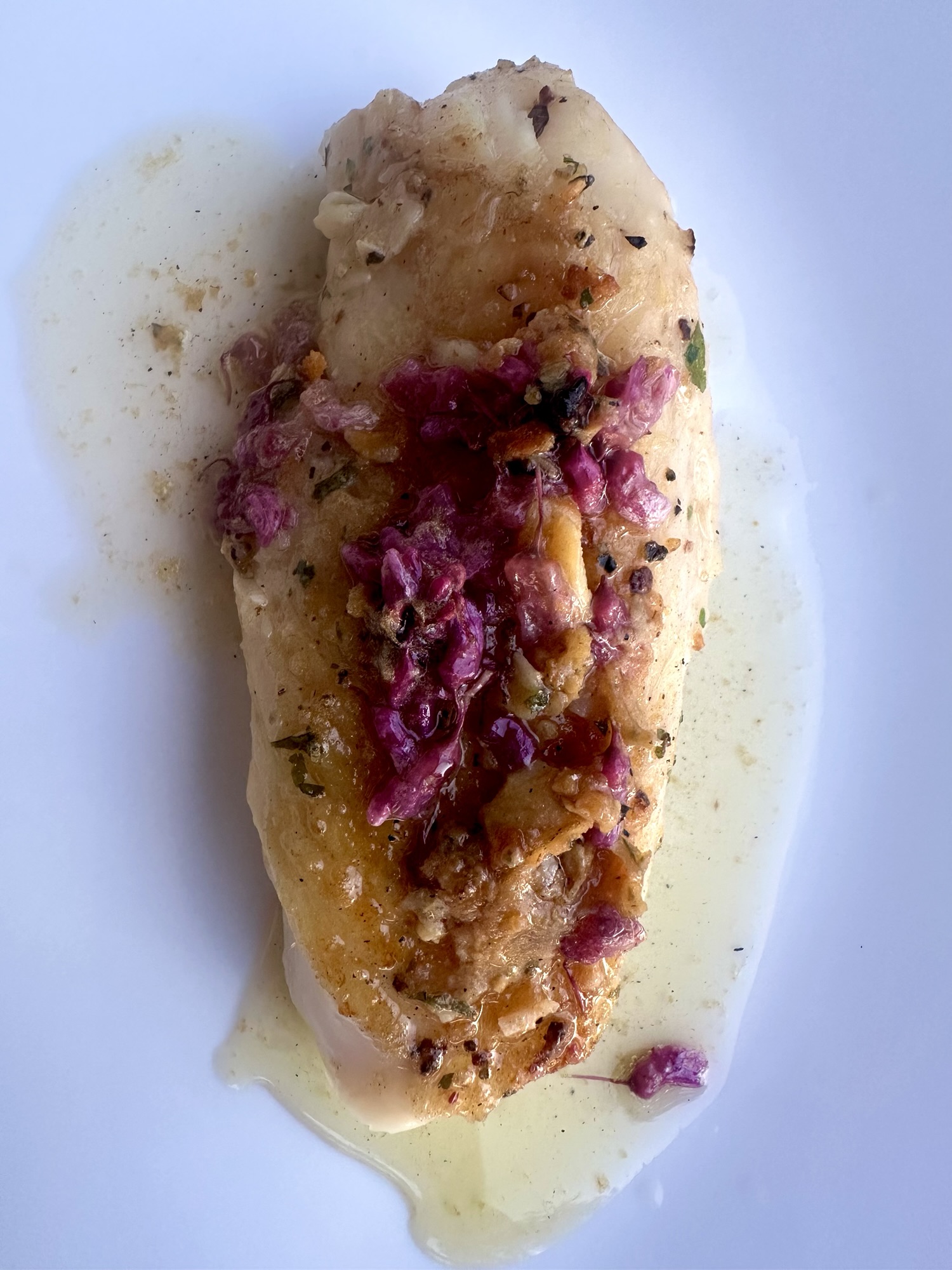
Blend all ingredients until smooth and store in refrigerator for up to 2 weeks. Previously I had made a jalapeno version of this for fish that was lovely, but tonight it accompanied a steak.
It would also be delicious with chicken, roasted vegetables or spread on rustic country bread.

References
Cornell College of Agriculture and Life Sciences. (n.d.). Common purslane.
https://cals.cornell.edu/weed-science/weed-profiles/common-purslane
Edible Wild Foods. (n.d.). Purslane: Portulaca oleracea. https://www.ediblewildfood.com/purslane.aspx
Iranshahy, M., Javadi, B., Iranshahi, M., Jahanbakhsh, S.P., Mahyari, S., Hassani, F.V. & Karimi, G. (2017). A review of traditional uses, phytochemistry and pharmacology of Portulaca oleracea L. Journal of Ethnopharmacology, 205, 158-172. https://doi.org/10.1016/j.jep.2017.05.004
Longacre, C. (2024, July 2). More than a weed! Purslane: Health benefits and recipes. Farmer’s Almanac. https://www.almanac.com/purslane-health-benefits-and-recipes
Masoodi, M.H., Ahmad, B., Mir, S.R., Zargar, B.A. & Tabasum, N. (2011). Portulaca oleracea L.: A review. Journal of Pharmacy Research, 4(9), 3044-3048.
Portulaca oleracea. (2024, July 22). In Wikipedia.
https://en.wikipedia.org/wiki/Portulaca_oleracea
Wigington, P. (2019, June 25). Magical herbal correspondences. Learn Religions.
https://www.learnreligions.com/magical-herb-correspondences-4064512
Wisconsin Master Gardener. (2011, August 22). Common purslane, Portulaca oleracea. https://mastergardener.extension.wisc.edu/files/2015/12/Portulaca_oleracea.pdf
Zhou, Y., Xin, H., Rahman, K., Wang, S., Peng, C. & Zhang, H. (2025, January 26). Portulaca oleracea L.: A review of phytochemistry and pharmacological effects. Biomed Research International. https://doi.org/10.1155/2015/925631
Subscribe and get wild foods . . .
Straight to your inbox!
Disclaimer: Information contained on this website should not be considered as a recommendation or an endorsement. This information is intended for educational purposes only, and is strictly and categorically intended as a reference to be used in conjunction with plant experts in your area. Roaming Roots accepts no liability for the use or misuse of information contained in this website. Consumption of plants and fungi is at the reader’s own risk and discretion.
Leave a Reply