

Suriname cherry, Brazilian cherry, Florida cherry, cayenne cherry, pitanga, cerisier carré, monkimonki kersie, ñangapirí, shimarucu
Native to Brazil, Portuguese colonizers transported the seed from South America’s east coast to India, then to Italy and southern Europe.
The plant was introduced to Florida as an ornamental in the early 20th century but has since been categorized as an invasive.

The fruits collected were from a small tree in the yard of our property in Arcadia, Florida near an abandoned orange grove. The house was built in 1938 and is a fine example of Florida cracker architecture.
BOTANICAL DESCRIPTION
Evergreen, multi-branched shrub or small tree that grows up to 25-30 feet in height. Young stems often have red hairs, and new foliage is bronze in color. Mature leaves are typically 1.5 inches long, a glossy dark green, ovate, opposite, and simple with short petioles. Leaves and branches that have been pruned, cut or damaged will release a “spicy resinous” aroma known to cause respiratory issues for some people.


Flowers have four white petals with a cluster of stamens in the center. From each blossom an edible fruit containing 1-3 seeds will develop. The ribbed or pumpkin-shaped fruit is botanically a berry, approximately 1-1.5 inches and transitions from green to orange, then red and maroon as it ripens.
TRADITIONAL USES & HERBAL BENEFITS
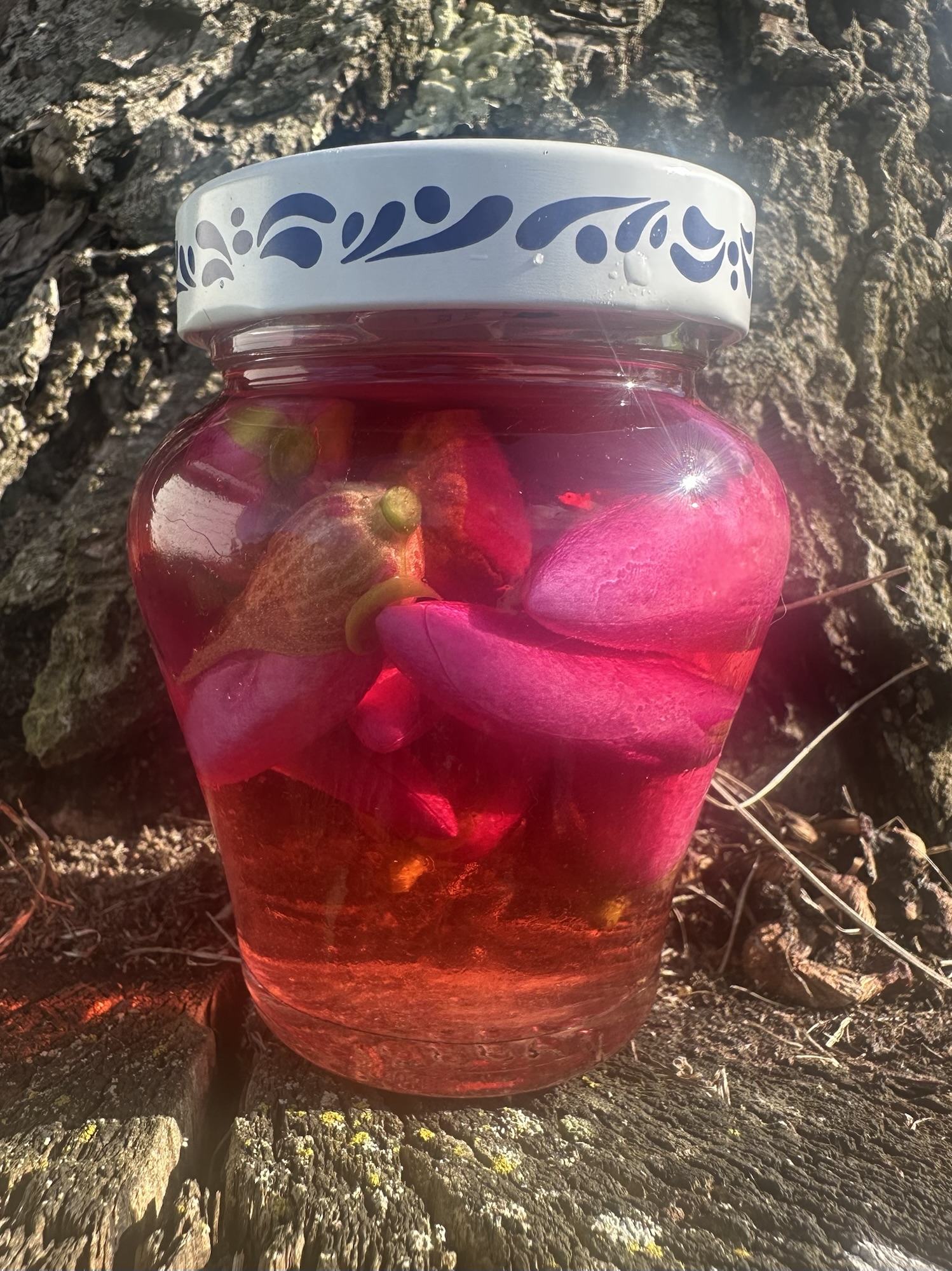
In South America, traditional culinary uses of the fruits include pies, jelly, jams, syrup, ice cream, relish and pickles. The juice is also fermented into vinegar, wine, and a liquor. In some homes, the leaves are scattered on the floor as a traditional insect repellant.
Infusions or teas brewed from the leaves have been widely used in the traditional remedies for:
- Hypertension
- Diabetes
- Gastrointestinal disorders including diarrhea
- Colic
- Arthritis
- Fevers and infections
- Cancer
The fruit is highly nutritious containing calcium, phosphorus, iron, vitamins B1, B2, and C. It is also rich in antioxidant carotenoid compounds, including beta-carotene and lycopene.
Recent research has validated that the essential oil and various leaf/fruit extracts have antibacterial, antifungal, anti-parasitic, antiviral, anti-inflammatory, anti-oxidant, anti-cancer, neuroprotective, hepatoprotective effects as well as the potential for metabolism modulation.

RECIPE
This is a really peculiar tasting fruit when fresh. The flesh is tart-sweet but the skin has an off-putting musky or bitter flavor. However, once processed into a fruit syrup, it is very pleasing on the palate.
Yet I wanted to do something more adventurous than a simple fruit syrup. so I decided to try to make Turkish Delight, or Lokum, candy with the Suriname cherry syrup.
Unfortunately, I accidentally overcooked the candy mixture and what was supposed to be a soft jelly candy turned into a (still tasty) but (very) hard candy.

References
Azevedo de Brito, W., Ferreira, M.R.A., de Sousa Dantas, D. & Soares, L.A.L. (2022). Biological activities of Eugenia uniflora L. (pitangueira) extracts in oxidative stress-induced pathologies: A systematic review and meta‐analysis of animal studies. PharmaNutrition, 20,100290. https://doi.org/10.1016/j.phanu.2022.100290
Eugenia uniflora. (2024, March 28). In Wikipedia. https://en.wikipedia.org/wiki/Eugenia_uniflora
Fidelis, E.M., Savall, A.S.P., de Oliveira Pereira, F., Quines, C.B., Ávila, D.S. & Pinton, S. (2022). Pitanga (Eugenia uniflora L.) as a source of bioactive compounds for health benefits: A review. Arabian Journal of Chemistry, 15(4), 103691. https://doi.org/10.1016/j.arabjc.2022.103691
Green Dean. (n.d.). Surinam cherry: Only ripe need apply. Eat the Weeds. https://www.eattheweeds.com/surinam-cherry-only-ripe-need-apply/
Subscribe and get wild foods . . .
Straight to your inbox!
Disclaimer: Information contained on this website should not be considered as a recommendation or an endorsement. This information is intended for educational purposes only, and is strictly and categorically intended as a reference to be used in conjunction with plant experts in your area. Roaming Roots accepts no liability for the use or misuse of information contained in this website. Consumption of plants and fungi is at the reader’s own risk and discretion.
Leave a Reply