

Sea hibiscus, beach hibiscus, coastal (or coast) hibiscus, coastal (or coast) cottonwood, green cottonwood, native hibiscus, native rosella, cottonwood hibiscus
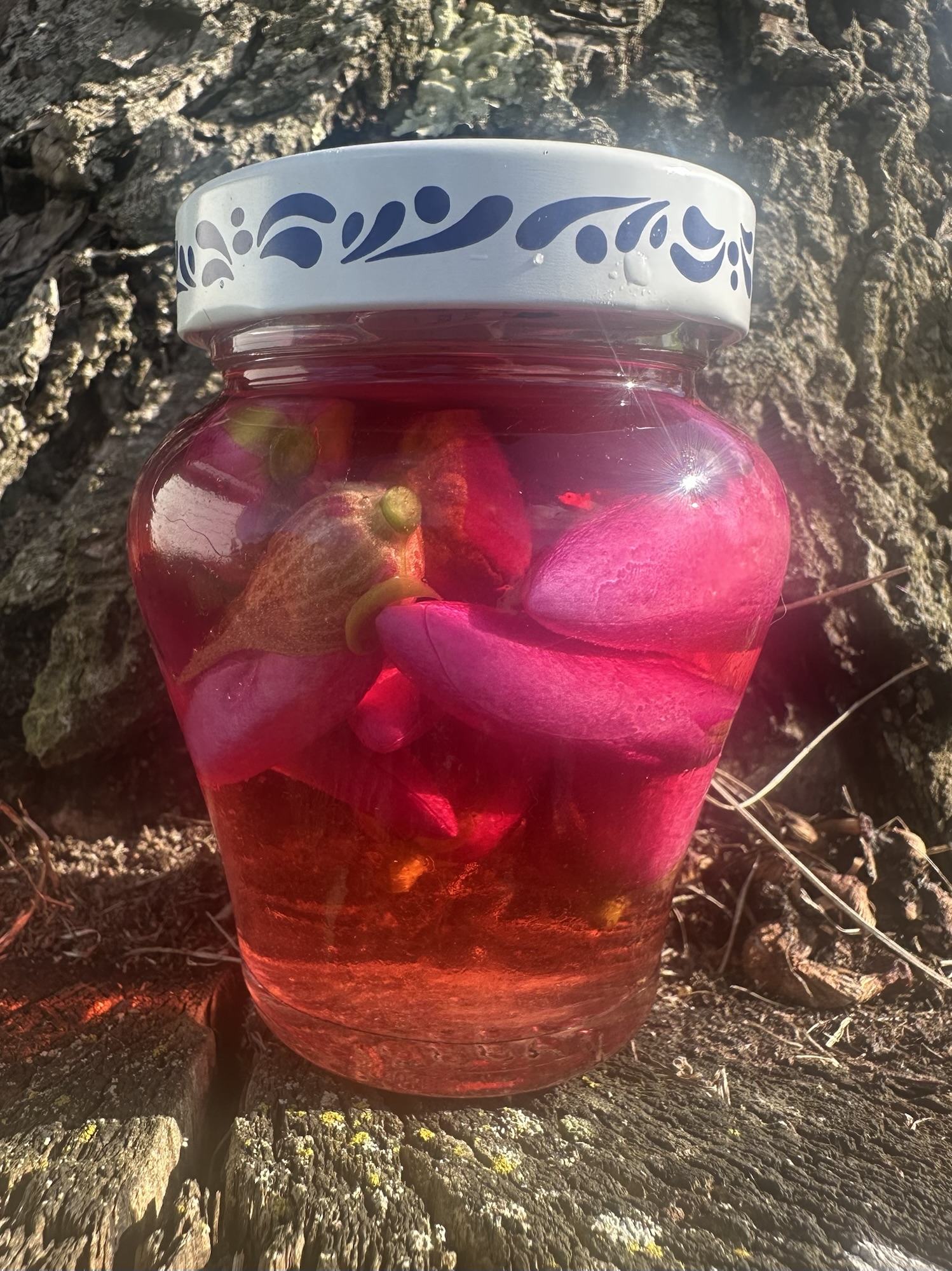
I went to a Beltane gathering a couple of weeks ago near Lake Placid. There was a beautiful, sprawling tree behind our cabin that turned out to be a sea hibiscus and I was able to gather a small bag of blossoms that had fallen to the ground.

BOTANICAL DESCRIPTION
Evergreen tree native to the shores of the Pacific and Indian oceans. This expansive tree can reach heights of 13-33 feet, and can grow just as wide.
The leaves are large, heart-shaped, and usually dark green but there are varieties with variegated or purplish foliage.

The flowers are 4″-6″ wide, bright yellow with a crimson center, and usually point down on the tree or slightly sideways. They typically last a single day, falling to the ground at the end of the day or the next morning. Like some other plants in the mallow family, the flowers change color as they age, turning dull orange or reddish by the time they fall.

Sea hibiscus is well adapted to grow in coastal environment in that it tolerates salt and waterlogging and can grow in a variety of soils.
Note: This tree is listed as invasive in Florida.
TRADITIONAL USES AND HERBAL BENEFITS
Young leaves are eaten as vegetables and the large leaves are used to wrap food for cooking. In Indonesia, the leaves are specifically used to wrap around partially cooked soybeans. The undersides of these leaves are covered in downy hairs (trichomes) to which the fungus that ferments soybeans into tempeh (Rhizopus oligosporus) has been found adhering in the wild. The leaf and soybean packages are then stored until the fermentation produces tempeh.
All parts of the tree have been used as traditional medicine. Applications include making infusions for both external application and internal consumption:
- Leaves: cool fevers, soothe coughs & dry throats
- Bark: treat chest congestion, labor pains, diarrhea and dysentery
- Flowers: bronchitis, ear infections, abscesses and other skin conditions
- Bark and Flowers: laxative
- Buds: teething
Phytochemical analysis has identified antioxidant, anti-inflammatory, anthelmintic and antimicrobial activity. A bark extract showed inhibitory effect on both Staphylococcus aureus and Staphylococcus epidermidis. Leaf and bark extract demonstrated significant analgesic activity.
In addition to its culinary and medicinal uses, the wood is used across southeast Asia and Polynesia in a variety of applications including seacraft construction, furniture, and wood carvings. The bark has also been used to seal cracks in boats, while plant fibers obtained from the stems have been used to make rope. Sea hibiscus is widely used in Asian countries for the art of bonsai.
RECIPE
Today’s recipe is from Amira’s Pantry with modifications to the simple syrup.
Basbousa (Egyptian semolina cake)
- ½ cup unsalted butter
- ¼ cup milk
- ¼ cup honey
- ¾ cup sugar
- 2 ½ cups Farina
- 1 cup unsweetened coconut flakes, finely shredded
- ½ cup pistachios, finely chopped
Sea Hibiscus Simple Syrup
- 1 cup water
- 1 cup sugar
- 5 dried sea hibiscus blooms
Preheat oven to 350F.
In a saucepan add butter, honey, and milk. Stir until butter is melted, then add sugar and stir until completely dissolved. Add coconut flakes.
Turn off heat then mix in the farina. Mix just until there is no visible dry farina, but no not overmix.
Butter a baking dish with a low rim. Spread mixture evenly into dish, dip your fingers in water so you can smooth the surface. Cut into squares or diamond shapes and decorate with nuts.
Bake in the oven for 15 minutes.

Meanwhile, prepare the simple syrup by first making heating the water and adding the sea hibiscus bloom to create an infusion.
Remove the flowers and add the sugar. Bring to a boil, then reduce heat and simmer for 10 minutes.

When the basbousa is done, remove from oven and drizzle with hot syrup immediately. Cool before serving.

References
Abdul-Awal, S.M., Nazmir, S., Nasrin, S., Nurunnabi, T.R. & Uddin, S.J. (2016, July 29) Evaluation of pharmacological activity of Hibiscus tiliaceus.Springerplus, 5(1):1209. doi: 10.1186/s40064-016-2891-0 https://www.ncbi.nlm.nih.gov/pmc/articles/PMC4967069/
Hibiscus tiliaceus. ( 2024, April 27). In Wikipedia. https://en.wikipedia.org/wiki/Hibiscus_tiliaceus#Names
Keena, C., Yanker-Hansen, K. & Capelini, M. (n.d.).Hibiscus tiliaceus. http://www.hibiscus.org/species/htiliaceus.php
Ramproshad, S., Afrozb, T., Mondala, B., Haquea, A., Araa, S., Khana, R. & Ahmedc, S. (2012, December, 30). Antioxidant and antimicrobial activities of the leaves of medicinal plant Hibiscus tiliaceus L. Pharmacology Online, 3, 82-87. https://lavierebelle.org/IMG/pdf/hibiscus_tiliaceus__antioxidant_and_antimicrobial_activities_of_leaves.pdf
Trung, V.T., Linh, K.T.P., Thu Trang, D., Thanh Binh, P., The Cuong, N., Thanh, N. V., … Thao, N. P. (2023). Antimicrobial constituents from the leaves of Hibiscus tiliaceus L. Natural Product Research, 1–8. https://doi.org/10.1080/14786419.2023.2293137
Subscribe and get wild foods . . .
Straight to your inbox!
Disclaimer: Information contained on this website should not be considered as a recommendation or an endorsement. This information is intended for educational purposes only, and is strictly and categorically intended as a reference to be used in conjunction with plant experts in your area. Roaming Roots accepts no liability for the use or misuse of information contained in this website. Consumption of plants and fungi is at the reader’s own risk and discretion.


Leave a Reply