

Wild rice, Canada rice, Indian rice, water oats, manoomen, mnomen, Psíŋ
BOTANICAL DESCRIPTION
Species of grain-producing annual grass native to shallow, slow moving waters of lakes and rivers in north-central US and southern Canada.
Flat, blade-shaped leaves are 8 to 24 inches long and 1½ inches wide with rough-textured edges. In the spring and early summer, the leaves float on the surface and by July the stalks have grown 3 to 10 feet.

This wind pollinated monoecious plant has numerous nondescript flowers on its panicles. By August the yellow or red grains appear on the end of the stalk.
TRADITIONAL USES AND HERBAL BENEFITS
Wild rice is highly nutritious, rich in protein and fiber, with a low glycemic index and low-fat content. It is a good source of thiamin, niacin, folate, vitamin E, vitamin K, iron, magnesium, phosphorus, potassium and zinc. In addition, it contains beneficial phytosterol, γ-oryzanol, γ-aminobutyric acid, and phenolic compounds.
For centuries this grain has been a traditional food for native people, including the Ojibwe, Ottawa/Odawa, Menominee, Cree, and Potawatomi.
“Ways of preparing it varied from stewing the grains with venison stock and/or maple syrup, making it into stuffings for wild birds, or even steaming it into sweets like puffed rice, or rice pudding sweetened with maple syrup.”
Traditional methods of harvesting continue today and consist of canoeing into a stand of plants, then bending the ripe grain heads with two small wooden poles/sticks called “knockers” or “flails” until the seeds fall into the canoe.
For long-term storage, the seeds must first be dry-roasted, then winnowed to remove the hull.
Wild rice seeds are thinner and longer than conventional rice (Oryza sativa) and have a glossy, black-brown seed coat around a white endosperm.

The wild rice in this recipe was harvested by the late Jerrold Eugene “Chub” McDougall and generously gifted by his daughter, Darcy Weidman, on my last trip home to Montana.
RECIPE
Wild Rice Harvest Salad
Today’s recipe comes to us from Very Vegan Val with a few minor modifications.
- 1 cup wild rice
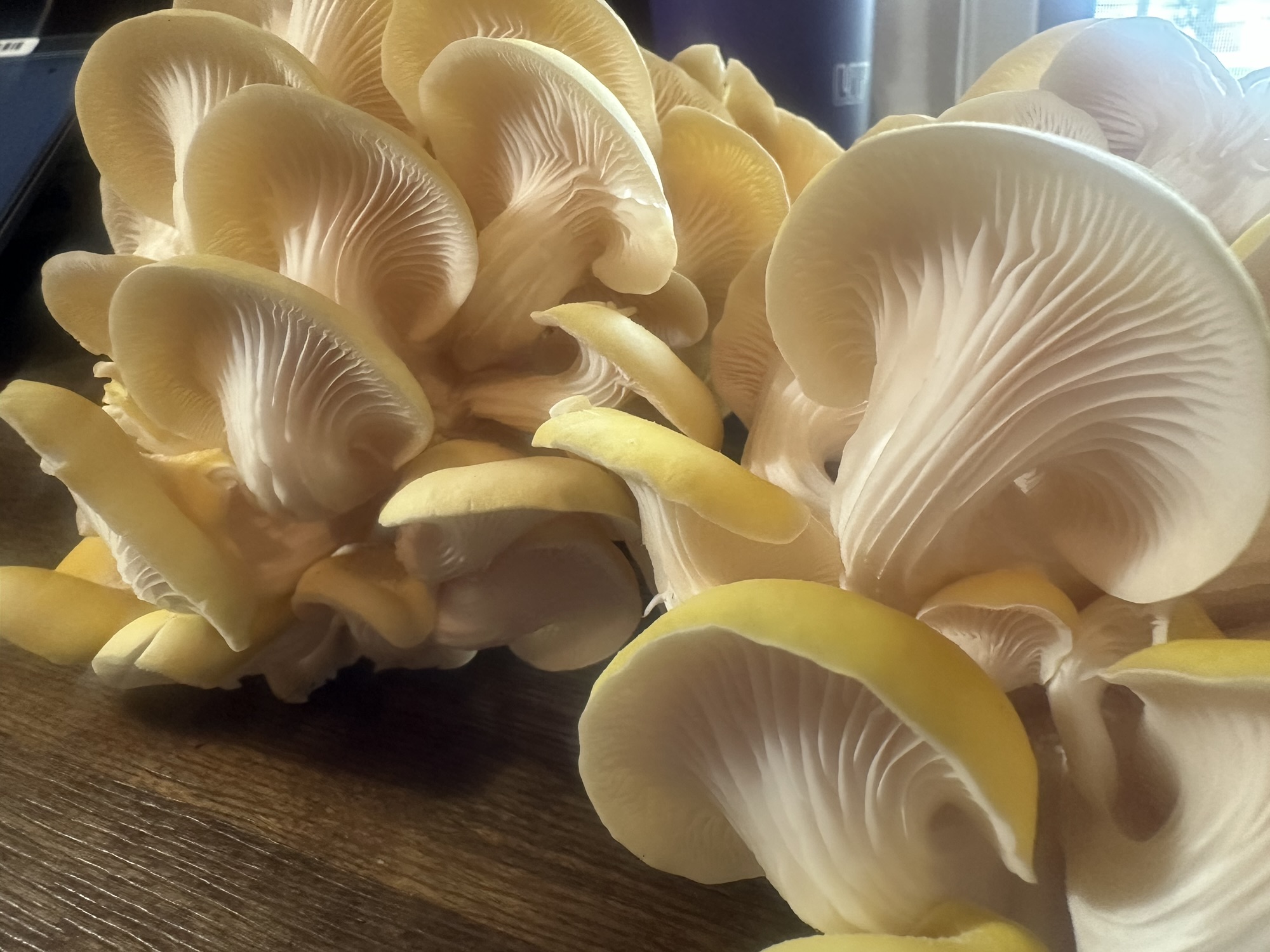
- ½ lb. fresh oyster mushroom
- 2-3 Tbsp butter
- ½ cup hazelnuts
- ½ red onion, finely chopped
- ½ pomegranate
- 1 clove garlic, minced
- ½ tsp. fresh tarragon, finely chopped
- Salt and pepper, to taste
For the Cranberry Ginger Dressing:
- 1 cup fresh cranberries
- ¼ cup olive oil
- 1 Tbsp maple syrup
- 5 grams fresh, peeled ginger
- 2-3 springs fresh tarragon
- Salt and pepper, to taste
Clean the wild rice by placing it in a bowl and rinse under cold running water. Allow it to sit in water for a few minutes so any debris can float to the surface. Discard any debris, rinse well, and drain.
Bring 3 cups of water to boil and stir in the cup of rice. Once the pot has returned to a boil, cover and reduce to a simmer for 45-60 minutes. Fluff with a fork and set aside.
Sauté mushrooms in butter until brown and crispy. Season with salt and pepper, and set aside.
Toast the hazelnuts in a dry skillet, stirring frequently, until fragrant. Set aside.
Dice onions, mince garlic, remove the pomegranate seeds, and finely chop the tarragon.
Make the dressing by blending the ingredients together until smooth. Add water, one tablespoon at a time, until the dressing has the desired thickness.
Toss all ingredients together and enjoy!

In terms of taste and texture, wild rice is pleasantly chewy with a distinctly delicious nuttiness. With all the different colors, flavors and textures, this recipe is a keeper!
References
Minnesota Wildflowers. (n.d.). Zizania palustris (wild rice). https://www.minnesotawildflowers.info/grass-sedge-rush/wild-rice
Thielen, A. (2029, August 10). The true story of wild rice, North America’s most misunderstood grain. Saveur. https://www.saveur.com/true-story-wild-rice-north-americas-most-misunderstood-grain/
Wild rice. (2024, April 20). In Wikipedia. https://en.wikipedia.org/wiki/Wild_rice
Yan-Ning, X., Qian-Qian, Q., Wan-Hong, L., Ya-Li, L., Yu, Z., Hui-Mei, W., Ya-Fen, Z. Zi-Hong, Y., De-Ping, G., Qian, Q., Zhong-Feng, Z. & Ning, Y. (2023, May 30). Domestication, breeding, omics research, and important genes of Zizania latifolia and Zizania palustris. Frontiers Plant Science, 14. https://doi.org/10.3389/fpls.2023.1183739
Subscribe and get wild foods . . .
Straight to your inbox!
Disclaimer: Information contained on this website should not be considered as a recommendation or an endorsement. This information is intended for educational purposes only, and is strictly and categorically intended as a reference to be used in conjunction with plant experts in your area. Roaming Roots accepts no liability for the use or misuse of information contained in this website. Consumption of plants and fungi is at the reader’s own risk and discretion.
Leave a Reply