

Crafting a Two Blossom Cordial
Polygonum cuspidatum
Common Names: Japanese knotweed, Fleeceflower, Himalayan fleece vine, Monkeyweed, Hu Zhang, Tiger Stick, Hancock’s curse, elephant ears, pea shooters, donkey rhubarb, sally rhubarb, Japanese/American/Mexican bamboo
Shrub-like perennial native to eastern Asia originally introduced to North America as an ornamental, it escaped cultivation and is now a problematic invasive species that aggressively reproduces by both seed and large rhizomes that can travel as far as 15-18 feet).
Like bamboo, Japanese knotweed stems are smooth, hollow and segmented. The cane-like stems are 3-9 feet high, green to reddish-purple in color, and have reddish-brown solid nodes surrounded by a papery sheath from which the leaves emerge.
Leaves are 2-3 inches wide with an alternate arrangement on the stem and are triangular to heart-shaped with age.
The flowers bloom in late summer, are small and greenish white, and grow in showy plume-like, branched clusters from leaf axils near the ends of the stems. These mature into very small, triangular winged seeds.

HERBAL & MEDICINAL USES
Research has found that Japanese knotweed has cardioprotective, antiviral, antimicrobial, anti-inflammatory, neuroprotective, and anticarcinogenic activities. The dried root, known as Hu Zhang in Traditional Chinese Medicine (TCM), is used to treat atherosclerosis, heart disease, and high cholesterol, as well as constipation, hepatitis, constipation, and gallstones.
Japanese knotweed contains a chemical called emodin which helps regulate bowel motility, and very high levels of resveratrol, an antioxidant.
NOTE: Resveratrol decreases blood clotting, which could increase the effects of aspirin, clopidogrel, and warfarin. It also has estrogenic effects which might: (1) Impact estrogen replacement therapy and birth control, (2) worsen hormone-sensitive cancers such as breast, uterine, ovarian, and (3) exacerbate endometriosis or uterine fibroids.
Lonicera japonica
Common Name: Japanese honeysuckle, Jinyinhua
Perennial trailing or climbing woody vine that spreads by seeds, underground rhizomes, and above-ground runners. Young stems are reddish brown to light brown, usually covered with short, soft hair. Older stems are smooth, hollow, with brownish bark that peels in long strips. It has simple, opposite leaves that are ovate with smooth margins.
Flowering occurs from April through October, when pairs of showy, fragrant, tubular, whitish-pink flowers develop in the axils of the leaves. The flowers turn cream-yellow as they age before developing into black berries, each containing 2-3 dark-brown/black oblong seeds that are ridged on one side and flat to concave on the other.
Japanese honeysuckle creates dense tangled thickets by a combination of stem branching, nodal rooting, and vegetative spread from rhizomes. Japanese honeysuckle is invasive and spreads by seeds, rhizomes and above-ground runners. As it can either a twining, climbing vine or prostrate and trailing groundcover, it outcompetes native species for light, space, water, and nutrients.

HERBAL & MEDICINAL USES
The honeysuckle blossoms, known as Jinyinhua in TCM, are used to treat a variety of infection diseases. In support of this ancient practice, contemporary phytochemical research has found that the plant possesses numerous pharmacological actions including antibacterial, anti-inflammatory, antiviral, antipyretic, antioxidative and hepatoprotective activities.
Additionally, due to the highly fragrant quality of the blossoms, essential oils are also extracted.

As an invasive plants, you can happily forage Japanese Knotweed and Japanese honeysuckle without any concern of over-harvesting.
CAUTION: However, they are often sprayed. Only harvest from areas that you know are free from herbicides.
RECIPE
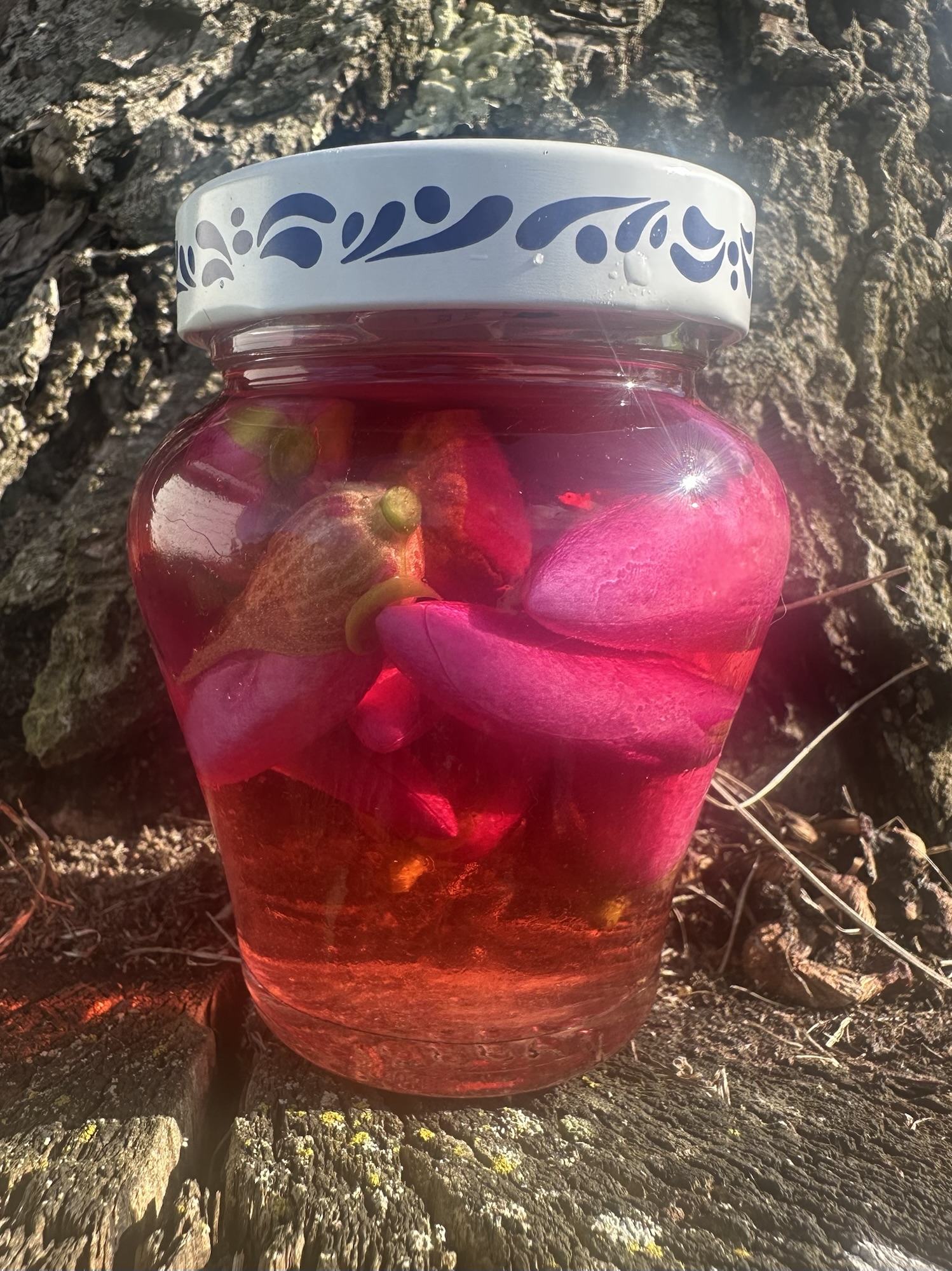
Japanese Knotweed & Honeysuckle Blossom Cordial
- 1 cup of blossoms
- Zest of 1/2 lemon
- Slices of 1/2 lemon
- Equal parts water & sugar
To make blossom syrup, bring water to a boil and add sugar, stirring until dissolved. Add other ingredients, turn off flame & cover. Let rest 20 minutes. Place mixture in a glass container & store in refrigerator 24 hours. Strain off plant material, re-bottle and chill.
To make a refreshing drink, mix blossom syrup with sparkling water.


Bonus!
MORE JAPANESE KNOTWEED CULINARY RESOURCES
Juvenile Japanese knotweed stems resemble asparagus shoots and are commonly foraged in the spring. They are said to have a sour taste reminiscent of rhubarb.
- Here’s a great Bon Appetit article with numerous innovative ways to use Japanese knotweed.
- More recipes at Totally Wild UK and Practical Self-Reliance.
References
Cornell University. (2023). Cornell weed identification: Japanese knotweed. https://blogs.cornell.edu/weedid/japanese-knotweed/
Deane. (n.d.) Japanese knotweed. Eat the Weeds. https://www.eattheweeds.com/japanese-knotweed-dreadable-edible/
Invasive Plant Species Assessment Working Group. (2006, October). Japanese Knotweed: Polygonum cuspidatum (Fallopia japonica). https://www.in.gov/dnr/files/Japanese_Knotweed.pdf
Invasive Species Center. (2023). Japanese knotweed. https://www.invasivespeciescentre.ca/invasive-species/meet-the-species/invasive-plants/japanese-knotweed/
Li, H. & Lu, C. (2015, February 19). Lonicera japonica Thunb 金银花 (Jinyinhua, Honey Suckle). Dietary Chinese Herbs, 693–702. doi: 10.1007/978-3-211-99448-1_78. https://www.ncbi.nlm.nih.gov/pmc/articles/PMC7120270/
Native Plant Trust. (n.d.). Lonicera japonica — Japanese honeysuckle. https://gobotany.nativeplanttrust.org/species/lonicera/japonica/
Nuzzo, V. (1997). Element stewardship abstract for Lonicera japonica: Japanese honeysuckle. The Nature Conservatory. https://www.invasive.org/gist/esadocs/documnts/lonijap.pdf
Shang, X., Pan, H., Li, M., Miao, X. & Ding, H. (2011, October 31). Lonicera japonica Thunb.: Ethnopharmacology, phytochemistry and pharmacology of an important traditional Chinese medicine. Journal of Ethnopharmacology, 138(1), 1-21. doi: 10.1016/j.jep.2011.08.016. https://www.ncbi.nlm.nih.gov/pmc/articles/PMC7127058/
Zhang, H., Li, C., Kwok, S.T., Zhang, Q.W. & Chan, S.W. (2023, September 30). A review of the pharmacological effects of the dried root of Polygonum cuspidatum (Hu Zhang) and its constituents. Evidenced Based Complementary and Alternative Medicine. doi: 10.1155/2013/208349. Retrieved from https://www.hindawi.com/journals/ecam/2013/208349/
Subscribe and get wild foods . . .
Straight to your inbox!
Disclaimer: Information contained on this website should not be considered as a recommendation or an endorsement. This information is intended for educational purposes only, and is strictly and categorically intended as a reference to be used in conjunction with plant experts in your area. Roaming Roots accepts no liability for the use or misuse of information contained in this website. Consumption of plants and fungi is at the reader’s own risk and discretion.


Leave a Reply