
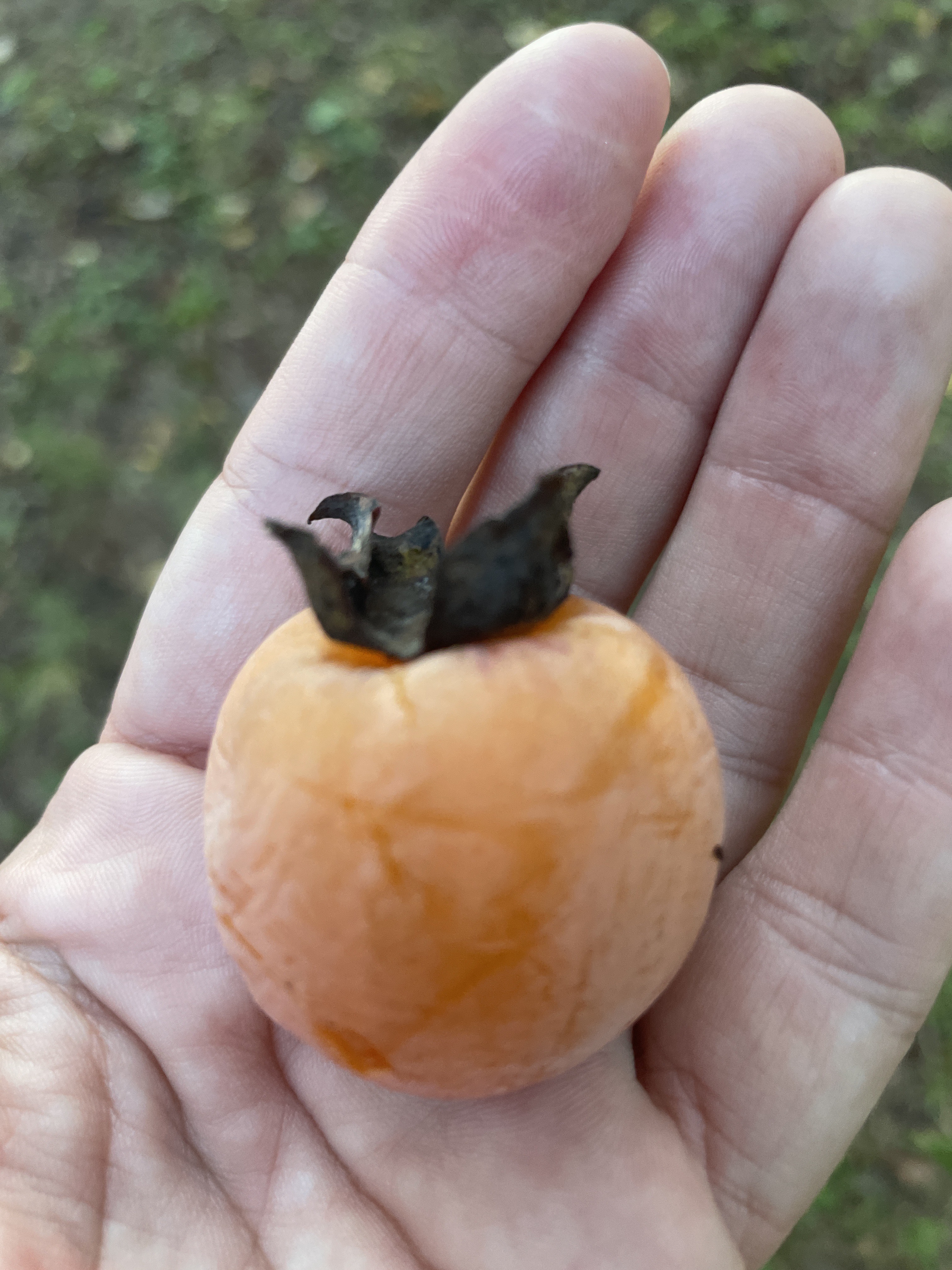
WILD PERSIMMON, AMERICAN PERSIMMON, COMMON PERSIMMON, EASTERN PERSIMMON, SIMMON, POSSUMWOOD, POSSUM APPLES, WINTER PLUM, DATE PLUM, JOVE’S FRUIT
On the way south, we stopped briefly in Winston-Salem, hiked around Quarry Park and found some wild persimmons!


BOTANICAL DESCRIPTION
Woody, deciduous tree native to the central and eastern United States whose name originates from ‘putchamin’, a phonetic rendering of the tree’s name in Algonquin. The persimmon can reach 30 to 80 feet high and 20 to 35 feet wide.
American Persimmon is also a member of the Ebony (Ebenaceae) family and its heartwood is nearly black. Mature trees will exhibit blackish gray bark that appears checkered from deep furrows that create small, flat-topped, rectangular or square-shaped scales.
The dark green leaves are simple, elliptic-oblong to ovate in shape, and smooth along their margins, while their lower surface is a paler green.
Persimmons are dioecious, meaning they require another persimmon of the opposite sex (and wind or insects) for pollination and fruit production to occur. The sex of a tree is determined by the type of flowers it bears. Bell-shaped flowers occurs in late spring to early summer and there are a few key distinguishing characteristics between the different gendered blooms.
- Female flowers are off-white or cream color, lightly larger and occur individually on very short stalks attached closer to the branch, because as fruit develops, a secure attachment to the branch is necessary
- Smaller male flowers tend to dangle in clusters of two or more and may have a pinkish tinge
Fertile female flowers are transformed into large round berries about 1½-2″ across with persistent sepals. Immature fruits are light green and very astringent. These mature into an orange-colored, sweet tasting fruit with fleshy pulp and several large, flat seeds.

Harvest the fruit only when it is soft, starting to wrinkle, and either has already fallen from the tree or detaches easily from the branches. It may look like the fruit is too far gone, or rotten, but it’s not. Persimmon is not tasty harvested early!
“Upon eating an unripe American persimmon, Captain John Smith of Jamestown Colony fame wrote, ‘[It] will draw a man’s mouth awry with much torment.’ However, when properly ripened, many think that the persimmon deserves its genus name, Disospyros, or ‘food of the gods.’”
Ames (2010, November)
TRADITIONAL USES AND HERBAL BENEFITS
Persimmon fruit is very healthy and contains many beneficial phytonutrients: B-complex vitamins, a generous amount of vitamin C, anti-oxidants such as vitamin-A, beta-carotene, and lycopene, as well as minerals like potassium, manganese, copper, and phosphorus.
The fruit, bark and wood of the American persimmon has a long history of use in its endemic region of North America; chiefly as an important part of Native American diet at the time of European contact. This culinary knowledge was shared with early colonists and Briand’s (2005) article in the reference list contains several charming first-person accounts of early settlers’ experiences cooking and eating persimmons.
Other historical uses include manufacturing buttons from the seeds during the American Civil War, and simmering green persimmons with a small amount of iron sulfate to make an indelible ink.
The plant also was used medicinally. Unripe fruit was used to treat bowel disorders and uterine hemorrhage while the seeds were used to treat dropsy, an antiquated name for heart failure. Tinctures and infusions made with the inner bark were used to treat fevers, thrush, sore throats from diphtheria, hemorrhoids, and sexually transmitted infections.
Today, current research has found the American persimmon posseses significant antibacterial and antifungal effects.

RECIPE
Persimmon Bread
This recipe is The Seasoned Mom’s adaptation of James Beard’s classic persimmon bread recipe. The only changes I needed to make were due to lack of certain ingredients:
- Rum extract in warm water was substituted for bourbon
- Chopped dates were substituted for raisins/dried cranberries


This was my first attempt at baking in a camper as our old RV didn’t have an oven. I didn’t have a loaf pan but round is beautiful too and this bread is delicious – dark, moist, and tastes like Christmas!
References
Ames, G. (2010, November). Persimmons, Asian and American. National Sustainable Agriculture Assistance Program. https://www.growables.org/information/TropicalFruit/documents/PersimmonATTRA.pdf
Briand, C.H. (2005). The common persimmon (Diospyros virginiana L.): The history of an underutilized fruit tree (16th–19th centuries). Huntia, 12(1), 71-89. http://faculty.salisbury.edu/~chbriand/pdfs/huntia05.pdf
Diospyros virginiana. (2022, September 2). In Wikipedia. https://en.wikipedia.org/wiki/Diospyros_virginiana
Johnson, T.W. (n.d.). Out my backdoor: Persimmon: the forgotten wildlife food plant. Georgia department of natural resources. https://georgiawildlife.com/out-my-backdoor-persimmon-forgotten-wildlife-food-plant
North Carolina Extension Gardener. (n.d.) American persimmon. https://plants.ces.ncsu.edu/plants/diospyros-virginiana/
Rashed, K., Ćirić, A., Glamočlija, J. & Soković, M. (2014). Antibacterial and antifungal activities of methanol extract and phenolic compounds from Diospyros virginiana L., Industrial Crops and Products, 59, 210-215. https://doi.org/10.1016/j.indcrop.2014.05.021
Thomas, L. Jr. (2012, March 28). Sex among the persimmons. National deer association. https://deerassociation.com/sex-among-persimmons/
Subscribe and get wild foods . . .
Straight to your inbox!
Disclaimer: Information contained on this website should not be considered as a recommendation or an endorsement. This information is intended for educational purposes only, and is strictly and categorically intended as a reference to be used in conjunction with plant experts in your area. Roaming Roots accepts no liability for the use or misuse of information contained in this website. Consumption of plants and fungi is at the reader’s own risk and discretion.
Leave a Reply