
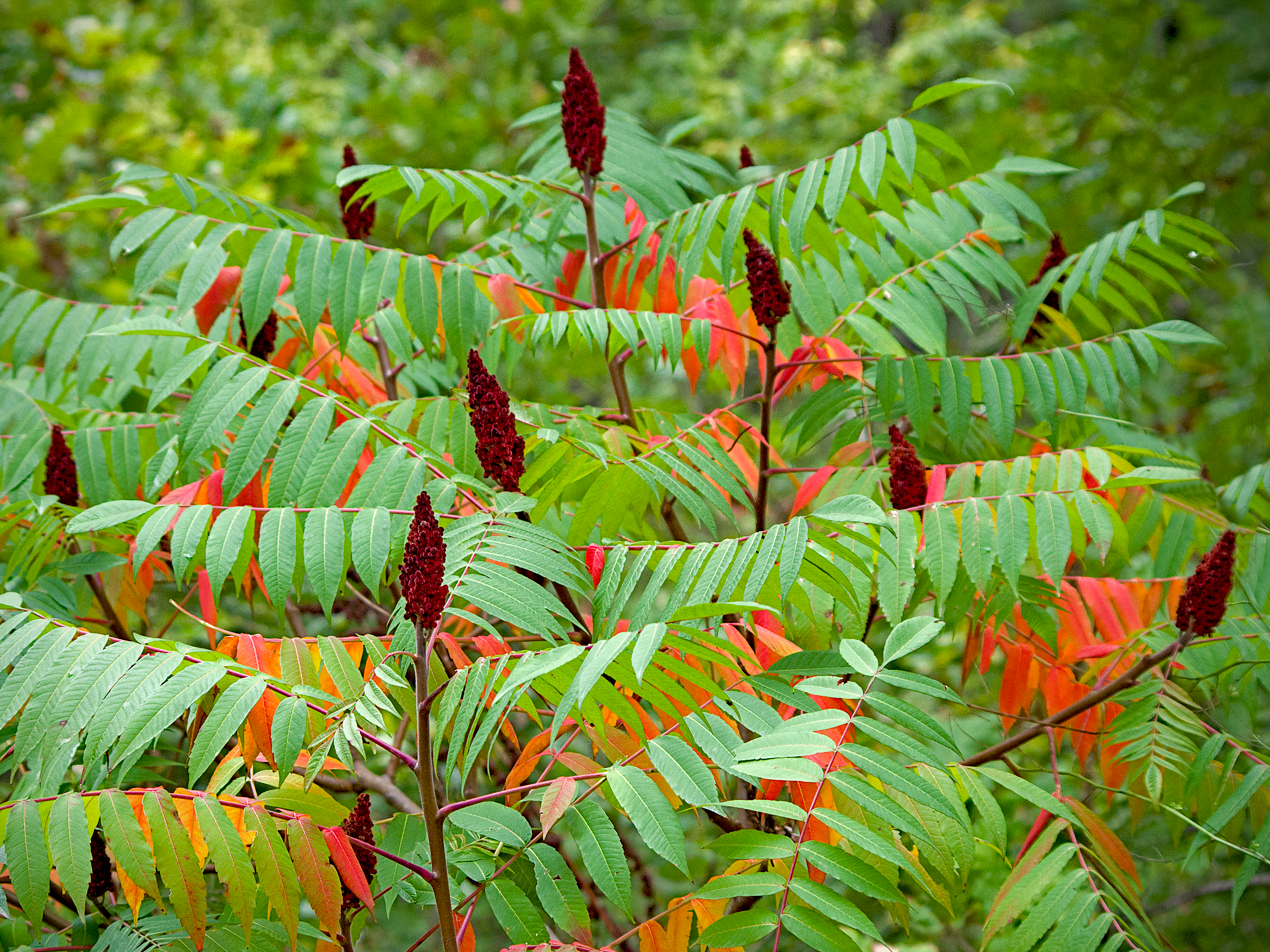
STAGHORN SUMAC
West Virginia has stolen my heart – it is so beautiful and untamed.
We did a little hiking around the New River Gorge National Park in the Appalachian Mountains. The Appalachians formed roughly 480 million years ago and the New River is said to be one of the oldest rivers on this continent. It boasts excellent whitewater rafting that ranges from gentle Class I up to uber demanding Class V rapids only to be tackled by experts.


But my favorite was just driving along the winding backroads of these verdant hills. The narrow country roads snake through enchanting old-growth forests, up ridges and then down through hollows, passing numerous rock overhangs covered in moss, and the occasional crystal-clear waterfall.
On one of our outings we visited the ghost town of Thurmond, once a prosperous coal boom town. Learning about the history of coal mining in the area made my heart heavy. It was hard to read about the many mining explosions, coercive practices of company towns, the labor disputes of the mine wars resulting in actual gun battles, and legislation passed allowing the coal barons to maintain their dominance over the workers.


BOTANICAL DESCRIPTION
Our campsite had a couple of clusters of staghorn sumac along its perimeter. Staghorn sumac is native to the Eastern North America and the common name originates from the reddish-brown hairs that cover young branchlets much like velvet covers the antlers of male deer. It is a thicket-forming shrub or small tree that propagates by both seed and rhizomes.
Leaves are large, compound and pinnate with odd-numbered, serrated, lanceolate-oblong leaflets approximately 2-5” long. Leaf color is bright green above and glaucous beneath. Botanically, glaucous means covered with loose surface epicuticular wax that can be rubbed off. This wax is highly reflective and reduces overheating and water loss by evapotranspiration. In autumn, these leaves turn brilliant shades of yellow, orange, and red.
In late spring to early summer, tiny greenish-yellow flowers bloom in clusters at the end of the branches. Dioecious, only female flowers produce the pyramidal panicles containing numerous hairy, berry-like drupes that ripen in the fall to a bright red or burgundy.

IDENTIFYING POISON SUMAC
Often when people hear the word sumac, they think of poison sumac, Toxicodendron vernix, who like its cousins, poison ivy (T. radicans) and poison oak (T. diversilobum), contains the oily resin urushiol and causes contact dermatitis.
However, edible sumac is not even in the same genus and is easily differentiated from the poisonous sumac:
- Poison sumac only grows in swamps and bogs
- Often found as a solitary specimen
- Can achieve heights from 5-25 feet
- Twigs are smooth and hairless
- Leaflets are oval shaped with smooth margins
- Fruit consists of clusters of light-green or white smooth berries that droop down from small stems
TRADITIONAL USES AND HERBAL BENEFITS
The most common use of edible sumac is as a culinary spice traditionally used in Middle Eastern and Mediterranean cuisine. The red velvet on the outside of the sumac drupes has a bright citrusy taste that some equate with strawberry lemonade.
While often reported that sumac is an excellent source of vitamin C, this is inaccurate as the sour flavor comes from malic acid, not citric acid. Malic acid does possess antifungal properties and is also reported to reduce some symptoms of fibromyalgia.
Various Native tribes including the Chippewa and Iroquois used a decoction of sumac berries as a uterotonic to stop bleeding after childbirth and to treat a number of gastrointestinal issues. The Navajo used fermented berries to produce an orange-brown dye, while a different process created a red dye. Early European colonists also used sumac berry tea as an antipyretic and added honey to the brew to create a comforting cough syrup.
SPICE HARVESTING & PROCESSING
Processing your harvest begins by breaking apart the seed heads.

Sumac is an important food source for wildlife and the fruit clusters are frequently inhabited by insects. To prevent the accidental ingestion of worm feces, I recommend removing only the clean outer drupes.
Typically, I would dry these in a dehydrator, but as we did not bring ours on this trip, this harvest was air dried before being ground in the spice grinder. I have also read of toasting the drupes in a dry skillet but have yet to try that technique.


The final step is to use a wire mesh sieve to separate the flavorful red fuzz from the bitter seeds.
RECIPE
Grilled Sweet Potato Baba Ghanoush
This fun dish was found on Bon Appétit and made an scrumptuous dip, not only for pitas, but also crackers and crudités (not pictured). An added bonus was we used the leftovers to make a cozy soup the following day.

References
Adamant, A. (2019, January 16). Foraging & using staghorn sumac. Practical self-reliance. https://practicalselfreliance.com/staghorn-sumac/
Albert-Matesz, R. (2020, June 16). The sour power of sumac. Grit. https://www.grit.com/food/sour-power-of-sumac-zm0z20jazbut/
Rhus typhina. (n.d.). Missouri botanical garden. http://www.missouribotanicalgarden.org/plantfinder/PlantFinderDetails.aspx?taxonid=275945
Staghorn Sumac (Rhus typhina L.). (n.d.). https://bplant.org/plant/1228
Sumac. (2020, July 31). Cook’s info. https://www.cooksinfo.com/sumac
Subscribe and get wild foods . . .
Straight to your inbox!
Disclaimer: Information contained on this website should not be considered as a recommendation or an endorsement. This information is intended for educational purposes only, and is strictly and categorically intended as a reference to be used in conjunction with plant experts in your area. Roaming Roots accepts no liability for the use or misuse of information contained in this website. Consumption of plants and fungi is at the reader’s own risk and discretion.
Leave a Reply