
Mackinaw, Namaycush, Lake char (or charr), Touladi, Togue, Laker, Grey trout
My brother visited in early July and one night he found these crazy luminescent worms in the yard. Turns out they are firefly larvae.


Fireflies are not flies at all, but are actually beetles in the family Lampyridae.
As larvae, they are voracious predators of soft-bodied invertebrates like slugs and worms. They use their mandibles to inject neurotoxins into their prey. They then secrete digestive enzymes that liquefy their paralyzed captive before consumption.
Firefly larvae spend almost two years in this stage before gaining their wings.
This post is about a protein, but it is not on foraging and eating bugs (yet!).
Rather, we are cooking with some lake trout caught while fishing on our friend’s Angry Fin Charters.


DESCRIPTION
A freshwater fish native only to the northern parts of North America with an elongated, torpedo-shaped body, pointed snout and small sharp teeth.

The dorsal area is typically dark green to gray and the belly pale. Key coloring that separates the lake trout from the other trout and salmon are its cream-colored spots and white leading edge of the lower fins. Its dorsal fin is long and set farther back, it lacks an adipose fin behind the dorsal fin, and the caudal fin is distinctly forked. Fins may have a yellowish coloring.

During spawning, the belly becomes more yellow-orange, and the fins develop a red hue with more developed white edges.
HABITAT & DIET
Lake trout prefer cold water and are often found at significant depths in the summer months. One of the fish I caught was 200 feet down and I got an actual blister on my thumb reeling him in!
As a keystone species and apex predators, adult lake trout help maintain the Great Lakes ecosystem balance by feeding on smaller fish such as ciscoes, smelt, whitefish, sculpin, alewives, and gobies.
SPAWNING & LIFE CYCLE
Lake trout are typically solitary except during spawning season when they gather seeking mates. Spawning occurs in the fall, typically from October through November, over shallow shoals or boulder-strewn reefs where water currents help keep the substrate free of silt. Unlike some fish, they don’t dig nests; instead males clear algae and debris from the rocks by fanning and scraping with their fins and bodies. Also, during this time the males display courtship behaviors, attempting to attract females by showcasing their strength and virility.
Spawning occurs at night with females releasing eggs over the rocks that the males fertilize with their milt. The fertilized eggs then settle into the crevices between rocks, where they remain oxygenated and protected.

Hatching occurs in late winter, February through March, producing sac fry that stay hidden in the gravel. They develop into swim-up fry in early spring, emerging to begin feeding independently, primarily on zooplankton.
Lake trout exhibit strong homing behavior, returning annually to the same spawning grounds. They reach sexual maturity around 6 to 7 years of age but are capable of living more than 25 years with some accounts from Canada of fish living up to 70 years.
Adults average 9 to 10 pounds, but since lake trout are the largest species in the genus of Salvelinus, there are some whoppers out there, including one caught in 1961 weighing 102 pounds!
NATIVE AMERICAN SYMBOLISM
For native people, trout were a staple food and crucial part of tribal traditions and spiritual beliefs. In fact, the lake trout’s scientific name Salvelinus namaycush reflects both Latin and Indigenous linguistic roots. The genus name Salvelinus stems from the Latin word salmo, meaning “salmon.” The species name namaycush originates from the word namekush, used by some inland Southern East Cree communities to refer to this fish.
The Anishinaabe have a story called How The Trout Got Its Spots:
Wenabozho, picking berries with his grandmother one day, ventured to a forbidden place where creatures feasted on each other.
A Windigok [monster] stood before him, consuming life around. Running from the darkness into the forest at sunset, he continued alongside the river, hearing the pursuing creature. Running into the dark woods as the sun faded, he ran alongside the river, knowing his way home.
The creature neared, slowly gaining on Wenabozho. At this point, he jumped into the river, swimming as the creature slithered in like a snake. Wenabozho took a deep dive into the river, swimming into the mud’s depths, holding his breath and embedding himself into the mud.
Seeing a huge fish swim by, running out of oxygen, Wenabozho asked for help. The fish agreed, leaping out of the river, swallowing Wenabozho whole. Opening his eyes in the fish’s mouth, Wenabozho had air to breathe. The Windigok still searched as the fish saw the approaching creature.
The huge fish leaped up and down as the Windigok swam towards them. Eventually, the fish and Windigok had a colossal battle in the water. After the night-long battle, the fish lay breathless on the bank as the sun rose, stars still shining.
Wenabozho grabbed pieces of the huge fish, scatters the fish into the air saying it would live in the Great Rivers and lakes. Recreating the fish and grabbing the stars, he said the story would live on its scales, sharing knowledge and stories. Someday, people would come, and the fish would remember to share the stories written on it. This is how the trout got its spots.
Story by: Joseph Ogimaawab Sutherland
The trout is also featured in another Anishinaabe tale of the Ojibwe people, Manabozho in the Fish’s Stomach.
CONSERVATION
Excessive commercial fishing in the early twentieth century, and the accidental introduction of invasive sea lampreys via ballast water from ocean-faring freighters all but wiped out the lake trout in the 1950s. Later, chemical contaminants contributed to reproductive issues.


Now with control of the sea lamprey, improving pollution and years strategic planting of trout fry, the lake trout population has grown and are now naturally reproducing.
Currently, Wisconsin prohibits commercial harvest of lake trout in Lake Michigan, reserving the species for sport fishing.
RECIPES
We ended up with a lot of fish! I always wanted to smoke fish but had heard that once you smoke fish in a smoker, it can only be used for that as it will give a fishy taste to other meats.
I really didn’t feel like spending hundreds of dollars on a smoker that would end up limited in its usage, so my brother and I decided to DIY one.
We cut down an old rusty burn barrel that we found on the property and then drilled four holes for rebar to go through. These would hold the metal racks over the smoking would chips.


My brother used his skill to create a tiny door where we could monitor the smoke and add wood chips as needed.

The lid? A furnace door that had been headed to the scrapyard!
Smoked Lake Trout

The wet brine is based on Steve Cylka’s of Black Peppercorn except I had to substitute Calabrian chili peppers for the sriracha sauce.
The trout fillets marinated all day.
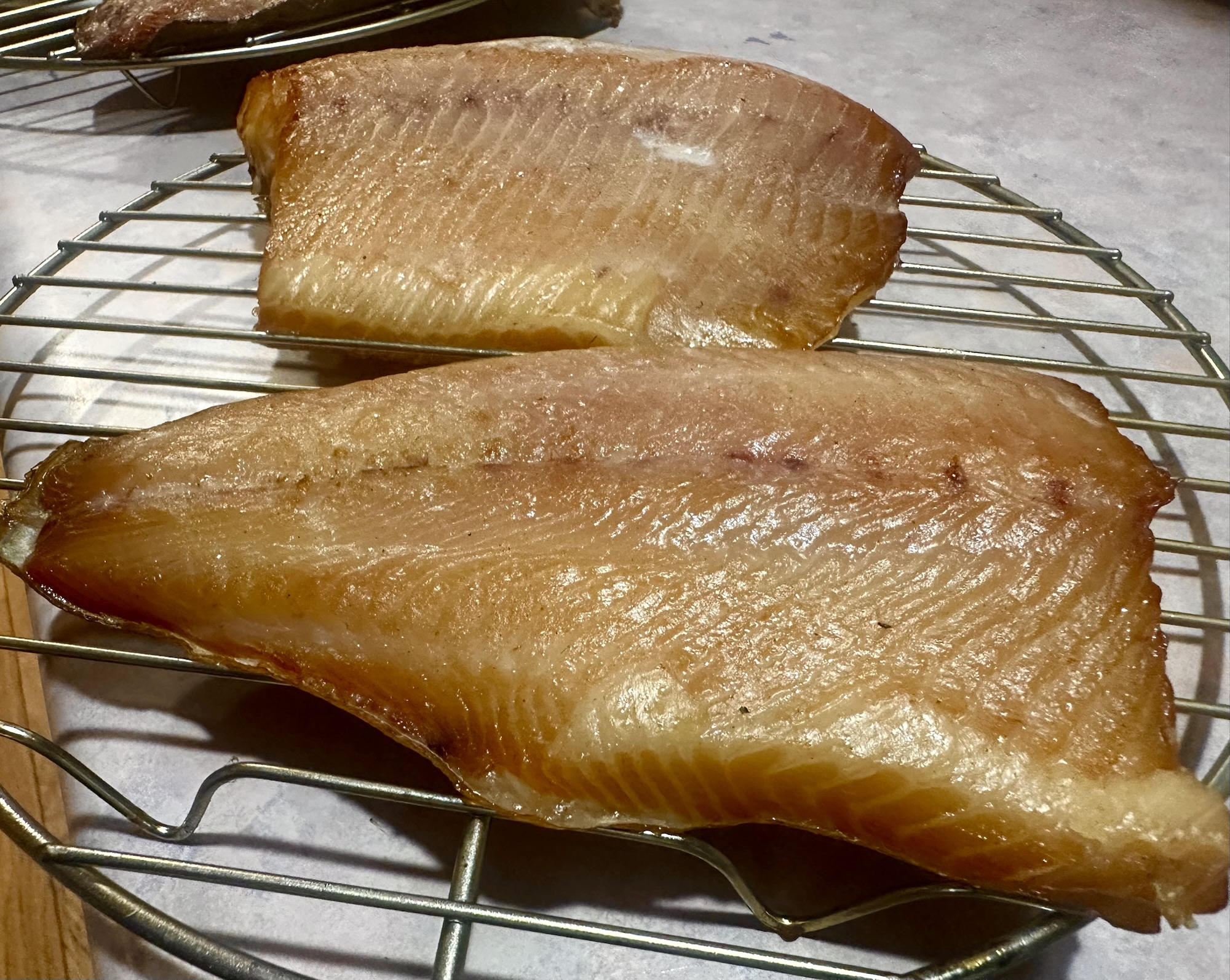
Before bed I removed them from their flavor bath, rinsed in clean water and set on wire racks in the refrigerator uncovered overnight to allow a pellicle to form on the outside of the fish.
The next morning, we started a small smoldering fire of applewood chips in the bottom of the smoker barrel, added the trout on the racks and covered the barrel.


They smoked for approximately 4 hours and looked perfect.

However, since I wouldn’t be able to use it for awhile, I tossed them in the freezer.
Pasta with Smoked Trout Cream Sauce

Since my homemade smoker did not have temperature control, I was concerned about food safety.
Once thawed, I decided to bake the smoked trout in the oven at 450°F for 15 minutes.
It was delicious on crusty bread with cream cheese and capers.
The smoked trout also went into this pasta dish by Andy Nabreski but asparagus was substituted for peas. However, I do wish the cream sauce was a little lighter and would recommend adding some vegetable broth or pasta water.


References
Fishmasters. (2025). The 14 types of trout species. https://fishmasters.com/types-of-trout/#lake
Lake trout. (2025, June 3). In Wikipedia. https://en.wikipedia.org/wiki/Lake_trout
Marine Life Identification. (n.d.). Lake trout (Salvelinus namaycush). https://www.marinelifeid.com/identification/lake-trout-salvelinus-namaycush/
Michigan Department of Natural Resources. (n.d.). Lake trout. https://www.michigan.gov/dnr/education/michigan-species/fish-species/lake-trout
U.S. Fish & Wildlife Service. (n.d.). Lake trout. https://www.fws.gov/species/lake-trout-salvelinus-namaycush
Wisconsin Department of Natural Resources. (n.d.). Fishing Lake Michigan trout and salmon?https://dnr.wisconsin.gov/topic/Fishing/questions/lakemichtroutsalmon.html
Subscribe and get wild foods . . .
Straight to your inbox!
Disclaimer: Information contained on this website should not be considered as a recommendation or an endorsement. This information is intended for educational purposes only, and is strictly and categorically intended as a reference to be used in conjunction with plant experts in your area. Roaming Roots accepts no liability for the use or misuse of information contained in this website. Consumption of plants and fungi is at the reader’s own risk and discretion.


Leave a Reply