
Chinese magnolia, saucer magnolia, tulip magnolia
I’m getting to know the land on which our new home is situated. When spring arrived I began poking around in the mud to see what plants I might have inherited – some kind of wildly overgrown grape vine, a couple of mulberries, a baby butternut tree, and a beautiful Chinese magnolia that the previous occupant planted in honor of his deceased wife.
Magnolia trees are one of the most ancient lineages of flowering plants, first appearing some 95 million years ago in the Cretaceous period (M. acuminata).
They evolved before bees, and it is hypothesized that they were pollinated by prehistoric beetles.


The magnolia’s natural range consists of two distinct, geographically separate locations. The main center is in Southeastern Asia where magnolia trees have been cultivated in Buddhist temple gardens since 650 CE.
The secondary center is in eastern North America and Central America.
Between these two regions there are literally hundreds of magnolia varieties.
Our particular hybrid (M. denudata × M. liliiflora) was named for its European creator, Étienne Soulange-Bodin (1774–1846), a retired cavalry officer from Napoleon’s army turned horticulturalist.
BOTANICAL DESCRIPTION
This perennial, woody shrub or small tree has simple, alternate, and oblong to obovate leaves 3 to 6 inches long. The upper side is dark green, while the underside is velutinous (soft and hairy). In autumn, the leaves turn a charming shade of golden-brown.
Large, showy flowers that can span 8-10 inches in diameter bloom in early to mid-spring before the foliage emerges. These cup-shaped flowers have vivid pink-purple exterior petals with dramatically white interiors. The blooms are often solitary, terminal, and possess a delicate fragrance.


After the flowers fade, fuzzy, reddish cone-shaped fruits appear. The cones mature as fall approaches and open to reveal numerous bright red-orange seeds.

The seeds have an extremely high fat content (twice that of avocados) and are a favorite snack of birds and other wildlife.
In North and Central America, magnolia leaves are a choice food for the larvae of the giant leopard moth.

HERBAL AND TRADITIONAL USES
Medicinal Uses: Magnolia has been used in Traditional Chinese Medicine since since 100 CE to treat a variety of ailments including anxiety, asthma, depression, gastrointestinal disorders, headaches, coughs, congestion and fever.
The bark (Hou Po) is used to manage anxiety, obesity, and to treat peri-menopausal symptoms such as mood swings, insomnia and hot flashes. It is also a popular skincare ingredient due to the anti-inflammatory and antioxidant properties of two phytochemicals called honokiol and magnolol. Additionally, there has been research into its potential to support cognitive function and reduce the risk of Alzheimer’s disease.

In Korea and Brazil it has been used to treat diabetes.
There is also contemporary research showing a promising therapeutic benefit in reducing tremors in Parkinson’s patients, and in treating cardiovascular diseases via its anti-atherosclerosis and anti-platelet activity.
Of note, there are currently several Chinese and Japanese patented drugs sourced from magnolia.
Magnolia bark should be used with caution as it can cause drowsiness and dizziness. As with all plant and herbal remedies, it’s recommended to consult with a healthcare provider before using if you are pregnant, nursing, or taking other medications.
Culinary Uses: Hoba miso is a regional Japanese dish where miso paste is served grilled on a magnolia leaf.
The flowers can be used to add their delicate fragrance, unique flavor and visual appeal. In addition to adding fresh petals to salads and as a garnish, they may be:
- Pickled or steamed as part of springtime dishes
- Infused into teas, broths, syrups or liqueurs for a floral note
- Used in desserts like flower cakes or rice-based sweets
RECIPES
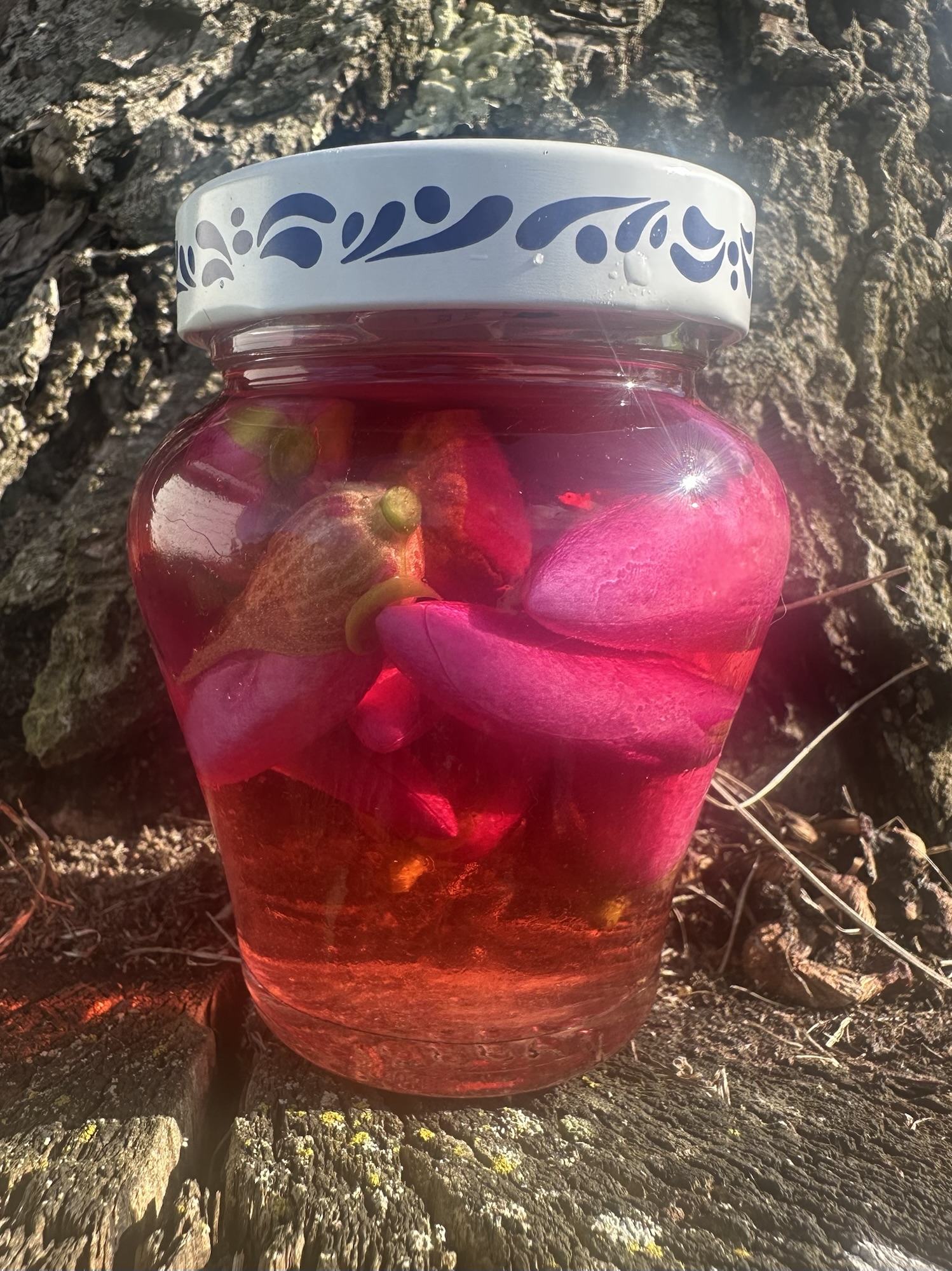
Pickled Magnolia Buds
- 1 cup rice, white wine or plain vinegar
- 1/4 cup of white sugar
- 1 tsp salt
- Magnolia buds
Add magnolia buds to a clean glass jar.
Heat vinegar with sugar and salt to simmer and sugar/salt is dissolved, stirring as needing.
Pour hot brine over petals. They will want to float so use a weight to keep them submerged in the brine. Cover with lid, allow to come to room temperature, then refrigerate. Minimum brining time before eating is 24 hours.

I let these marinate for several days before adding to a springtime chopped salad of cucumber, mandarin oranges, blanched asparagus, feta, and almonds in a simple champagne vinegar and olive oil dressing.

The chopped pickled magnolia buds definitely added a refreshing zing to the salad!
The petals can also be dried and used as a spice.
The flavor is very reminiscent of ground ginger but I also noted a faint bitterness.

Kim Walker and Harriet Gendall performed a comprehensive taste test of numerious magnolia species and found that “stronger flavours on the spectrum are associated with deeper pinkness, but too pink and the taste becomes bitter and overwhelming.”
They also shared a lovely video capturing the traditional Chinese process of harvesting and preparing magnolia flowers for culinary use. You can check it out at the end of this post right before the references section!
I used my magnolia petal powder in the recipe below which is loosely based off this ginger sugar cookie recipe. However, I doubled the amount of magnolia petal powder that replaced the ground ginger as it is said to be a more subtle flavor. I also frequently half or reduce recipes because I am cooking only for a family of two.
Magnolia Petal Pies with Ginger Whipped Cream
Crust
- 1 stick butter
- 1 cup powdered sugar
- 1 cup flour
- 2 tsp powdered magnolia petals
- 1/2 tsp vanilla extract
Cream Filling
- 1/2 cup heavy whipping cream
- Candied ginger syrup to taste
Instructions
Cream butter and powdered sugar. Add rest of ingredients. Place dough on wax paper and shape into a log approximately 3 inches across. Freeze for 45 minutes.
Preheat oven to 350 degrees.
Remove dough from freezer and slice into 1 inch disks. Place each disk in a muffin tin (they should be slightly larger than the bottom of the muffin cup base). As the dough bakes, it will soften and take the shape of the muffin tin.
Bake for 15 minutes until golden and crispy. Let rest for 5 minutes and then remove from muffin tin. The shortbread will be shaped like a mini pie crust.
Combine heavy cream with ginger syrup to taste. Whip until medium peaks form, about 3–4 minutes.
Spoon whipped ginger cream into magnolia petal cookie crusts.

The ginger spice flavor of the magnolia petals in the cookie crust was very nuanced, but I would be hesitant to add too much more magnolia petal powder for fear of introducing bitterness.
If you had candied ginger or a smear of apricot jam, either would be lovely additions.
References
Christenson, A. (n.d). Magnolia tree (Huo Po). White Rabbit Institute of Healing. https://www.whiterabbitinstituteofhealing.com/herbs/magnolia-tree/
Handmade Apothecary. (2019, March 20). Magnolia madness: Which blooms are the tastiest? https://www.handmadeapothecary.co.uk/blog/2019/3/16/magnolia-a-foraged-spice-cupboard#:~:text=The%20white%20and%20light%20varieties%20of%20flower,are%20a%20single%20tone%20mid%2Dlight%20pink%20throughout.
Magnolia × soulangeana. (2023, July 4). Wikipedia. https://en.wikipedia.org/wiki/Magnolia_%C3%97_soulangeana
Missouri Botanical Garden. (n.d.) Magnolia × soulangeana. https://www.missouribotanicalgarden.org/PlantFinder/PlantFinderDetails.aspx?kempercode=a885
Plantids. (n.d.). Magnolia x soulangeana. https://plantids.com/1968-magnolia-x-soulangeana.html
Poivre, M. & Duez, P. (2017). Biological activity and toxicity of the Chinese herb Magnolia officinalis (Houpo) and its constituents. Journal of Zhejiang University, 18(3),194-214. https://pmc.ncbi.nlm.nih.gov/articles/PMC5365644/
Popova, M. (2023). Magnolias and the meaning of life: Science, poetry, existentialism. The Marginalian. https://www.themarginalian.org/2023/04/13/magnolias/
Subscribe and get wild foods . . .
Straight to your inbox!
Disclaimer: Information contained on this website should not be considered as a recommendation or an endorsement. This information is intended for educational purposes only, and is strictly and categorically intended as a reference to be used in conjunction with plant experts in your area. Roaming Roots accepts no liability for the use or misuse of information contained in this website. Consumption of plants and fungi is at the reader’s own risk and discretion.


Leave a Reply