
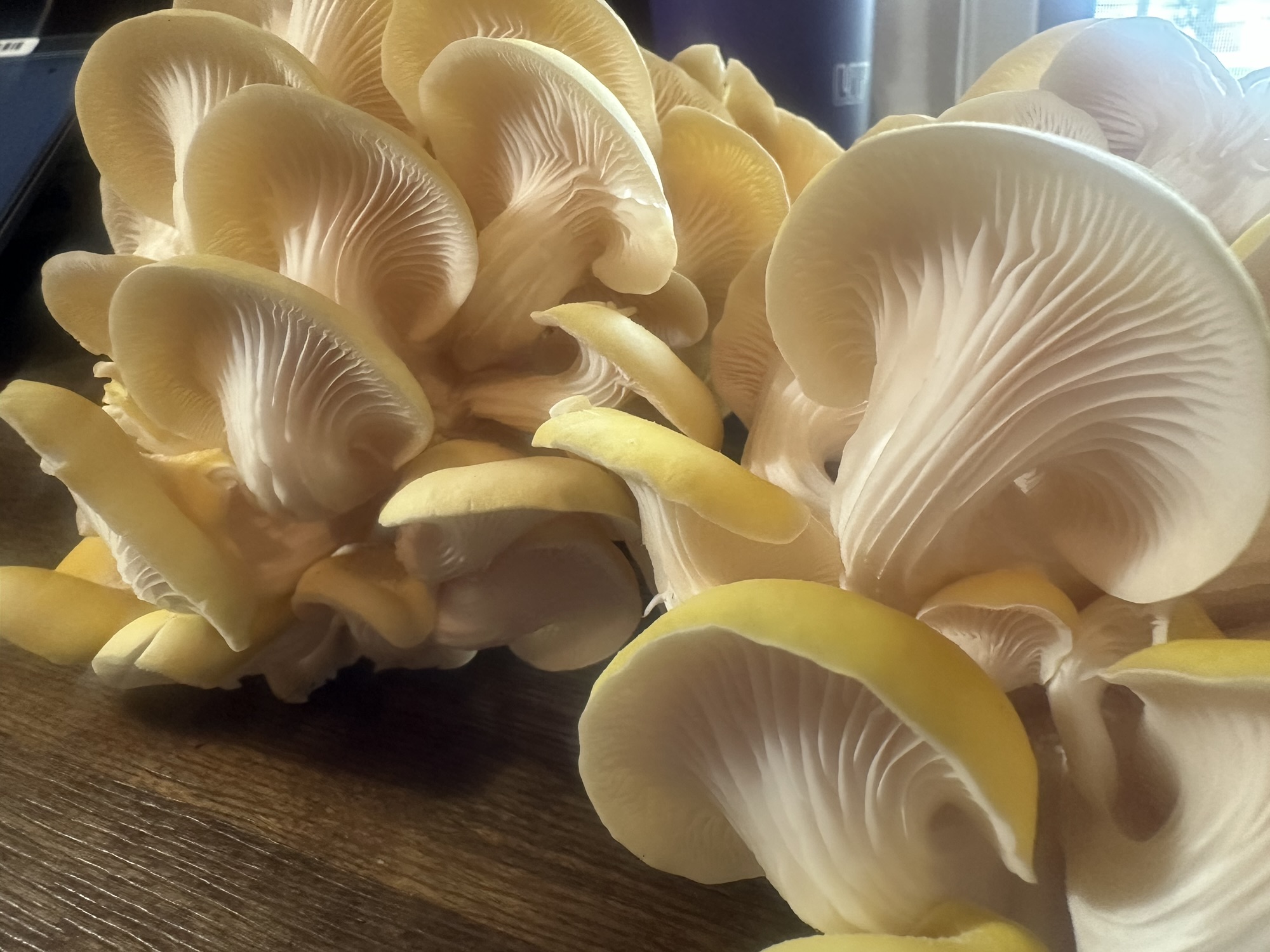
Golden oyster mushrooms, Tamgitake (Japanese), Il’mak (Russian), Hao gu (Chinese)
The golden oyster mushroom is native to eastern Russia, northern China, and Japan. Like others in its genus, golden oysters are wood-decomposing saprobes and are found in deciduous hardwood forests, commonly on elm or beech trees. In Wisconsin, they begin to fruit in mid-May through the fall.

Golden oysters first appeared in North American forests around 2012. How they escaped cultivation is not known, but A. Bruce’s research found very little genetic variability between samples of wild golden oysters from several geographically distant locations. This homogeneity points to one or few commercial strains as the source, and this same strain has been re-introduced repeatedly across America.

Because they are not native and spreading throughout the Midwest and Northeast, some in the foraging community consider them invasive. While not legally categorized as such, golden oysters do compete with native mushrooms for resources. They also fruit in substantial quantities, a pattern that more resembles a pathogenic fungus, and has the potential to alter forest ecosystems.
But these delicious golden snacks are not the only invasive species in today’s story. How I was to be gifted two beautiful lemon-colored fungal clusters is connected to an interesting ornithological narrative.
THE PLIGHT OF EASTERN BLUEBIRDS

In the mid-twentieth century, eastern bluebirds (Sialia sialis) experienced a dramatic population decline that brought them to near extinction.
The cause was multifactorial, and included increased usage of insecticides decimating their primary food source, habitat loss from human development and deforestation practices, and the loss of nesting sites due to competition from invasive European starlings (Sturnus vulgaris) and house sparrows (Passer domesticus).
The Origin Story
Both starlings and sparrows were intentionally introduced to New York City in the late 19th century when a “great importing mania swept the eastern seaboard” as recent immigrants became nostalgic for reminders of their homelands.
Simultaneously an outbreak of elm spanworm caterpillars in 1841 decimated vegetation across the city and generally made themselves an incredible nuisance.

“[I]t is painful to see the ladies . . . quitting the cover of the trees and seeking the hottest blaze of the noon-tide sun, to escape these worms” – Brooklyn Evening Star
“Men who wear a mustache have even this year shuddered to find occasionally that the brown wretches [caterpillars] were dangling from their cherished ornaments.” – New York Times (1859)
The proposed solution was to import the house sparrow from England, a species well acclimated to urban life and, though technically omnivorous, known to eat insects. From 1850-1851, Nicholas Pike, Director of the Brooklyn Institute, made several purchases of breeding pairs that were released in various locations throughout the city.

In 1871, the American Acclimatization Society was founded to promote the introduction of European flora and fauna into North America. One member of the society, a man named Eugene Schieffelin, was responsible for the presence of European starlings in America after he released a cageful of the birds in Central Park on March 6, 1890.
The situation in New York was not an isolated phenomenon. This movement to introduce various European birds (as well as animals and plants) continued in cities across the nation. However, in a few short decades the house sparrow had already become a problem.
“The little sparrow has been declared an outlaw by legislative enactment and they can be killed at any time. They were imported into this country from Europe some years ago as a destroyer of insects, but it has been found they are not insectivorous. Besides they drive away all our native song birds and give no equivalent. Let them all be killed.” – Indiana Weekly Messenger (1884)
“The different county treasurers of Illinois have paid out in round figures $8,000 as bounty money under a law allowing 2 cents for the head of each sparrow killed during December, January and February in that State. This shows that about 450,000 sparrows were killed, but the frisky bird seems more numerous than ever.” – an Indiana, PA newspaper (March 16, 1892)

In 1910, the USDA published “How to Destroy House Sparrows” in the Farmer’s Bulletin #383.
Bulletin #493 (1912, updated 1917) included “The English Sparrow As a Pest” that reported they eat more than half their own weight in grain or other food a day. Interestingly, it is reported to contain a house sparrow recipe!
Apparently, prior to the modern era, sparrow was a common dish in Britain. Elizabeth Raffald’s 1769 book “The Experienced English Housekeeper” provides the following instructions to make sparrow dumplings:
Mix half a pint of good milk with three eggs, a little salt, and as much flour as will make a thick batter. Put a lump of butter rolled in pepper and salt in every sparrow, mix them in the batter and tie them in a cloth, boil them one hour and a half. pour melted butter over them and serve it up.
By the early 20th century, the New York Times was also promoting sparrow for supper: Hundreds of them are now caught by enterprising people for sale to certain restaurants where reed birds are in demand. A German woman on Third Avenue has three traps set every day, and she catches probably seventy five a week. . . This German woman bastes them, leaving the little wooden skewer in the bird when served. They are cooked with a bit of bacon. . . soon as it becomes known that the Sparrow is a table bird their number will rapidly grow less. . . Sparrow pie is a delicacy fit to set before a king.
Impact of the Invasion
Bluebirds, starlings and sparrows are all considered secondary cavity nesters because they are unable to excavate their own tree cavities. Instead, they must rely on abandoned cavities created by other birds, other natural cavities, birdhouses, and nest boxes.
European starlings and house sparrows are significantly more aggressive, and will evict nesting bluebirds, destroy their eggs, and kill young chicks to take over the nesting site.
By the 1980s, only 600 nesting pairs were detected in Wisconsin. Alarmed, conservationists began organizing to promote the recovery of bluebirds. A key strategy is the development and maintenance of nesting boxes.

My oldest and dearest friend, Erika, and her husband, Tom, own a local Wild Birds Unlimited store. As part of their community outreach and conservation work, they partner with the Bluebird Restoration Association of Wisconsin (BRAW) to maintain 10 nest boxes along a designated bluebird trail in Minooka Park.

This involves not only building and managing the boxes, but also regularly collecting and reporting data. They go every week to check the boxes, count eggs and fledglings, and remove invasive birds. The day after my birthday, Tom spotted these beauties along the trail!

GOLDEN OYSTER IDENTIFICATION GUIDE
Cap: Sunny yellow, oyster-shaped, initially convex before becoming flat or funnel shaped with age; surface dry, smooth and velvety; typically measures 2-10 inches
Gills: Deeply decurrent, closely spaced and white
Stem: White, noticeably curved with no rings around the stem and no sack around the base
Flesh: White
Odor: Earthy, some report fruity or anise undertones
Taste: Sweet and nutty when cooked
Spore print: White (note the white spores dusting the tops of the caps in the images below)
Growth form: Gregarious, fruit in clusters or shelves often with overlapping caps


Oyster mushrooms are notorious for being wormy. I was extremely lucky that these were completely bug-free!

RECIPE #1
With the first cluster, I made Skate with Wild Mushrooms in Pearl Sauce, with a few substitutions due to an incomplete pantry because we are still remodeling our new house.
Ingredients:
For Sauce
- 1 green onion (white and green parts), chopped
- 1 Tbsp olive oil
- 1 medium carrot, chopped
- 1/2 medium onion, chopped
- 1 garlic clove
- 2 cups chicken broth
- 1 tsp soy sauce
- 1 tsp dried thyme
- 1 bay leaf
- 1/2 tsp cornstarch + 1/4 cup water
For Mushroom Sauté
- 1/2 Tbsp butter
- 1/2 Tbsp duck fat
- 6-8 oz golden oysters
- 1/4 tsp salt
- 1/8 tsp black pepper
- 1 celery rib, thinly sliced diagonally
For Skate
- 1 1/2 tablespoons all-purpose flour
- 1/4 tsp curry powder
- 2 (5- to 6-oz) pieces skate fillet
- 1/2 tsp salt
- 1/8 tsp black pepper
- 1 1/2 Tbsp butter
Preparation
Make broth:
Heat oil in a heavy saucepan over moderately high heat and sauté the carrot, onions, and garlic clove until vegetables are soft and well browned, about 10 minutes. Deglaze saucepan with 1/2 cup of chicken broth while scraping up any brown bits.
Add rest of the chicken broth, soy sauce, thyme, and bay leaf, and simmer, uncovered, until liquid is reduced to 3/4 cup, about 25 minutes. Pour through a fine-mesh sieve into a glass measure, lightly pressing on and then discarding solids. Transfer to a small saucepan. If you have more than 3/4 cup, boil strained liquid a few minutes to reduce.
Sauté fresh mushrooms:
Heat duck fat and oil in a heavy skillet, then sauté mushrooms with salt and pepper. (Note: the recipe states until just tender and golden brown, about 4 minutes, but I prefer my mushrooms crispier.)

Add celery and sauté until bright green and crisp-tender, about 2 minutes. Remove from heat and keep warm, covered with foil.
Sauté skate and finish sauce:
Stir together flour and curry powder in a shallow bowl. Pat fish dry and sprinkle with salt and pepper, then dredge in flour mixture, shaking off excess and transferring to a plate as dredged.
Heat butter in a heavy skillet over moderately high heat until foam subsides, then sauté fish, turning over once, until golden brown and just cooked through, about 5 minutes total.
Bring broth to a simmer and stir cornstarch and water mixture. Cook until slightly thickened.
I served the skate and mushrooms over barley seasoned with (leftover) duck confit jelly. This recipe could be considered putzy by some because of the many steps, but the sauce was amazing and the curry on the skate a surprising twist. As far as the star of the dish, I’m not sure I’ll ever want to eat oyster mushrooms without celery again! It was so good.


RECIPE #2

I used Alan Bergo’s recipe for Crispy Baked Oyster Mushrooms to create salad croutons from the main stalk.


RECIPE #3
I saved the best for last – a savory Dutch Baby! Also known as a German pancake, these large, fluffy, golden concoctions take me right back to my childhood on our family farm. On special occasions, my Aunt Lorna would serve one with homemade cinnamon syrup for breakfast.
Inspired by Food and Wine’s Wild Mushroom-and-Swiss Dutch Baby recipe, but once again limited by my pantry, I made some significant deviations. This was so delicious, and would be as fabulous for brunch as it was for dinner.
Ingredients:
For Dutch Baby
- 6 eggs
- 1 cup milk
- 1 cup flour
- Pinch of salt
- 5 Tbsp butter
For Mushroom Topping
- 2 Tbsp olive oil
- 1 andouille sausage, chopped
- Golden oyster mushroom
- Roasted red peppers, cut into strips (I used a fresh roasted pepper, but you could use jarred peppers)
- Parsley, minced
- 1/4 cup grated Gruyère cheese
Preparation
- Place the butter in a baking pan in the oven and preheat to 450°F.
- In a blender, mix the Dutch Baby batter ingredients until smooth.
- Once the butter is melted, pour the batter into the pan and bake until puffed and brown around edges, 20 to 25 minutes.
- Heat olive oil in a heavy skillet, then sauté sausage, oyster mushrooms, and red peppers. Once cooked, toss with parsley and set aside.
- Remove Dutch Baby from oven. Spoon mushroom mixture into center and sprinkle with cheese. Cut into wedges and serve immediately.

HISTORY AND USE IN NATURAL MEDICINE
Nutritionally, golden oysters are higher in protein than some other mushroom species. They are also high in antioxidants and the following micronutrients: potassium, zinc, protein, fiber, vitamin B5, niacin, choline, phosphorus, vitamin D, and selenium.
Structurally, all fungi contain a compound called chitin that provides shape and integrity to their cell walls. Chitin is also found in the exoskeletons of insects and in the shells of crustaceans such as crabs. Recent research using mouse models has found that chitin consumption triggers an immune and metabolic response in the gut which improved insulin sensitivity and decreased body fat.
Oyster mushrooms in general have been used in traditional medicine to treat high cholesterol, blood pressure, and diabetes. Scientific studies specific to golden oysters are finding evidence to support this application, as well as newly identified antifungal, antimicrobial and antitumor properties.
MAGICKAL USES
There is more to be said about mushrooms and spirituality than I can do justice here. In general, mushrooms are seen as enchanting and mysterious.
“Mushrooms are the tricksters of our forests. One minute they are there, the next they disappear.” – Shelley Forging Magic
As an organism that lives off of dead or decaying organic material., mushrooms are generally associated with the continuous cycle of life, death, and renewal seen in nature. Because their fruiting bodies emerge from a frequently invisible mycelium, mushrooms can also be applied as symbols of fertility, or personal and spiritual transformation. In addition, with this hidden and complex mycelium network, mushrooms can be used in works intending to harness this interconnected essence.
Mushrooms are incorporated into altars or feasts to celebrate the autumnal pagan holidays Lughnasadh, Mabon and Samhain.

There was little on the utilization of oyster mushrooms specifically, but one practitioner recommends them for healing, protection, and emotional balance.
FINAL NOTES
As one of nature’s decomposers, oyster mushrooms have significant potential for mycoremediation – the use of fungi to remove waste and contamination from the environment.
Below are actual examples using pearl oyster mushrooms that give me hope for the future.
- Amended soil contaminated with heavy metals and petroleum (such as bitumen mine waste)
- Cleaned contaminated water (such as removing e. coli from the Chicago River and clearing toxic wildfire ash from California waters)
- Degraded plastic waste (such as oxo-biodegradable (D2W) plastic used to make shopping bags)
References
Bergo, A. (2024, May 30). Golden oyster mushrooms. Forager Chef. https://foragerchef.com/foraging-golden-oyster-mushrooms-pleurotus-citrinopileatus/
British Food: A History. (2011, August 25). Forgotten foods #1: The house sparrow. https://britishfoodhistory.com/2011/08/
Bruce, A. (n.d.). Tracing the naturalization of golden oysters in the United States. https://andibruce.wordpress.com/golden-oysters/
Chilton, S. (2025, May 21). Mycoremediation: 8 ways that mushrooms destroy pollution. Real Mushrooms. https://www.realmushrooms.com/mycoremediation-mushrooms-pollution/#:~:text=4%20Fungi%20Types%20for%20Plastic-Related%20Pollutant%20Cleanup%201,3.%20Shiitake%20…%204%204.%20White-Rot%20Fungus%20
Dickinson, A. (2023, November 28). The complete guide to golden oyster mushrooms. The Shroomer. https://www.shroomer.com/golden-oyster-mushrooms/
Doctrow, B. (2023, September 26). Immune response to eating chitin linked to better health. NIH Research Matters. https://www.nih.gov/news-events/nih-research-matters/immune-response-eating-chitin-linked-better-health
Lamb, J. (2016, June 9). What if we had all the birds from Shakespeare in Central Park? JSTOR Daily. https://daily.jstor.org/all-the-birds-from-shakespeare-in-central-park/
Mosco, R. (2023, April 5). Meet the little brown bird that holds a mirror up to humanity. Audubon. https://www.audubon.org/news/meet-little-brown-bird-holds-mirror-humanity
Pleurotus citrinopileatus: Golden oyster benefits & identification. (n.d.). Healing Mushrooms. https://healing-mushrooms.net/golden-oyster
Shelley Forging Magic. (2023, September 17). The magical and mystical mushroom. Forging Magic. https://forgingmagic.com/magic-mystical-mushroom/
The Forest Preserve District of Will County. (2023, May 5). Bluebirds are back from the brink thanks to human interventions. The Buzz. https://www.reconnectwithnature.org/news-events/the-buzz/bluebirds-saved-from-extinction/
Wills, M. (2016, June 23). The great sparrow war of the 1870s. JSTOR Daily. https://daily.jstor.org/the-great-sparrow-war-of-the-1870s/
Wind Moon Magic. (n.d.). 12 magical mushrooms every modern witch needs to know. https://www.windmoonmagic.com/notes-from-wind-moon/12-magical-mushrooms-every-modern-witch-needs-to-know#:~:text=There%20are%20many%20different%20meanings,connections%2C%20healing%2C%20and%20nature.
Zimmerman Smith, E. (n.d.). House sparrow history. Sialis. https://www.sialis.org/hosphistory/
Subscribe and get wild foods . . .
Straight to your inbox!
Disclaimer: Information contained on this website should not be considered as a recommendation or an endorsement. This information is intended for educational purposes only, and is strictly and categorically intended as a reference to be used in conjunction with plant experts in your area. Roaming Roots accepts no liability for the use or misuse of information contained in this website. Consumption of plants and fungi is at the reader’s own risk and discretion.


Leave a Reply