
Eastern Redbud, American Redbud, Redbud, Spicewood Tree, American Judas Tree
BOTANICAL DESCRIPTION
Deciduous, ornamental tree of the Fabaceae or pea family that is native to eastern North America.
Bark is dark brown to black on the outside with orange inner bark. Smooth when young, it develops long, narrow plates that separate into scales with age.

In early spring, before the leaves appear, vivid flower buds pop up along the bare branches. These buds open into showy pea-shaped flowers that range from bright pink to red to purple.


Approximately 3-5 inches long and wide, the leaves are simple, alternate and heart-shaped with smooth margins. Green throughout the summer, they turn an attractive yellow color in autumn.

The fruit of the redbud is a long, thin leguminous pod containing several seeds.
In the fall, the pods ripen to a dark brown color and have a winged edge that helps them to disperse in the wind.

It is thought that this pea-pod shape provided inspiration for the genus’ name Cercis, which is derived from the Greek word κερκις or kerkis. Kerkis can be translated to “weaver’s shuttle” or “pin beater,” an ovate-shaped tool that tapers to a point at both ends and used when weaving on an upright loom.

It is said that the ancient Greek philosopher and naturalist Theophrastos used the term kerkis to describe the dry seed pod of Cercis siliquastrum (the Mediterranean redbud) and Carl Linnaeus later applied it in his taxonomy.
HERBAL AND TRADITIONAL USES
The Cherokee traditionally brewed a bark infusion as a remedy for whooping cough, or pertussis. Likewise, the Delaware tribes also used it for respiratory congestion and to treat fever and vomiting. Phytochemical analysis of the bark found high levels of lupeol, a chemical with anti-inflammatory properties similar to the NSAID indomethacin. Lupeol also has been shown to have antioxidant and anti-cancer qualities. The essential oil of the bark is also anti-inflammatory, as well as antibacterial, antifungal and antiviral.
The redbud tree is also a hardwood and can be used for smaller woodcrafts. Its twigs produce a yellow dye when boiled in water. In Appalachia, green twigs are used as seasoning for wild game like venison and opossum. generating one of its common names, the spicewood tree.
The redbud has been widely planted as an ornamental throughout the history of the United States. George Washington planted redbuds around his plantation, Mt. Vernon, as did Thomas Jefferson at Monticello. In 1781 Jefferson wrote of redbuds being an “esculent,” or edible, tree in his Notes on the State of Virginia.

The flowers are high in vitamin C and are edible raw or cooked. They can be used to make tea, jelly, syrup, or in salads or as simple fresh garnishes. It is also said that the young green pods can be steamed, and that mature seeds can be either roasted or cooked like dried beans.
Analysis of nutritional components in edible parts of eastern redbud reported that the flower extract contains antioxidant anthocyanins and the green seeds contain omega-6 fatty acids.

However, it is important to consume redbud in moderation as it is high in saponins. These contribute to its antioxidant and anti-inflammatory effects, but can be toxic if consumed in high quantities.
Saponins get their name from their tendency to form soap-like foam in water. The Latin word for soap is sapo. It is the saponins that are responsible for the foamy substance that occurs when soaking beans.
RECIPE
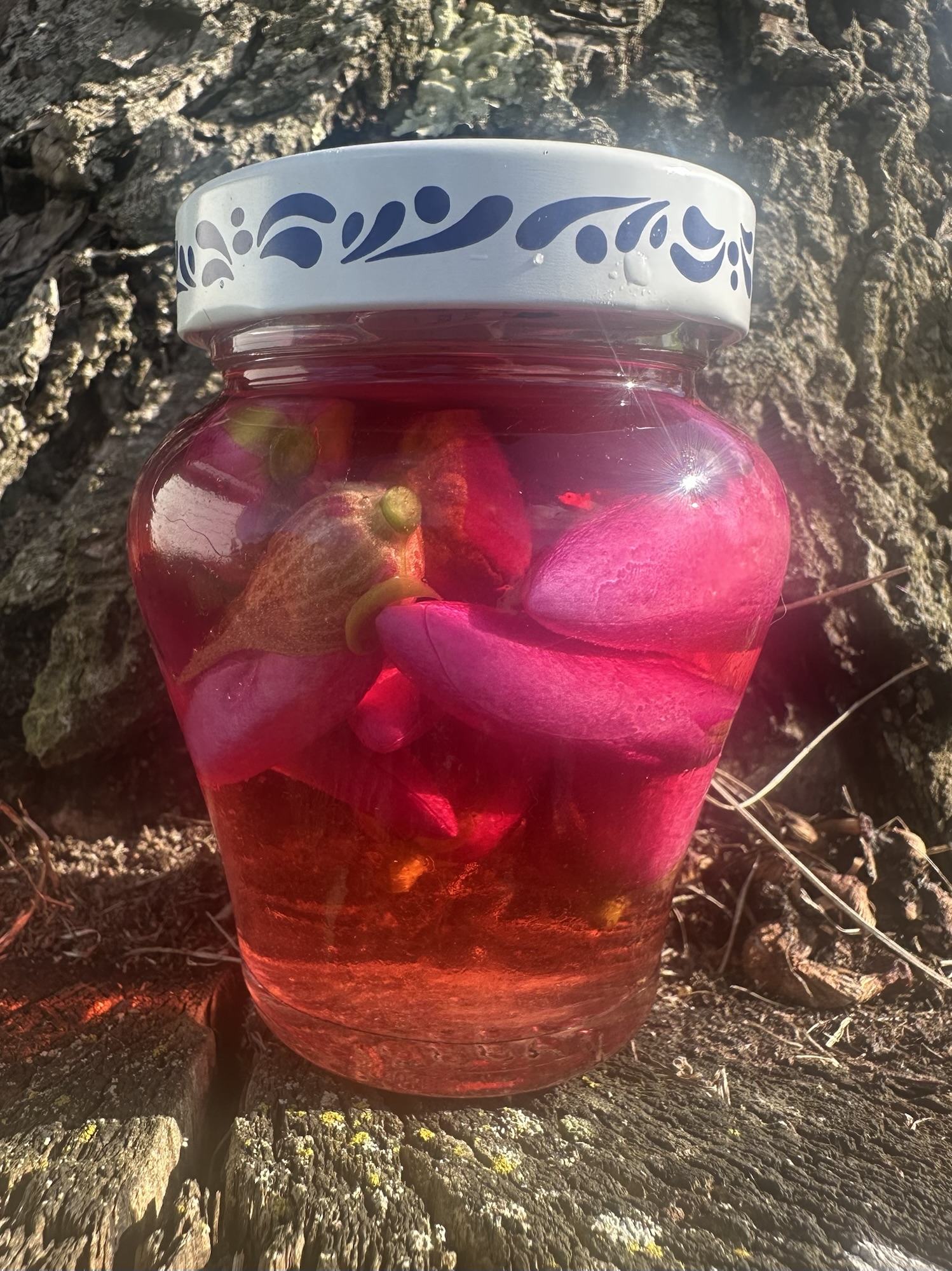
I used Mary Anne Mohanraj’s recipe for Pickled Redbud Flowers, just scaled down for the quantity I had.


As she explains, these can be used as a colorful caper substitute!
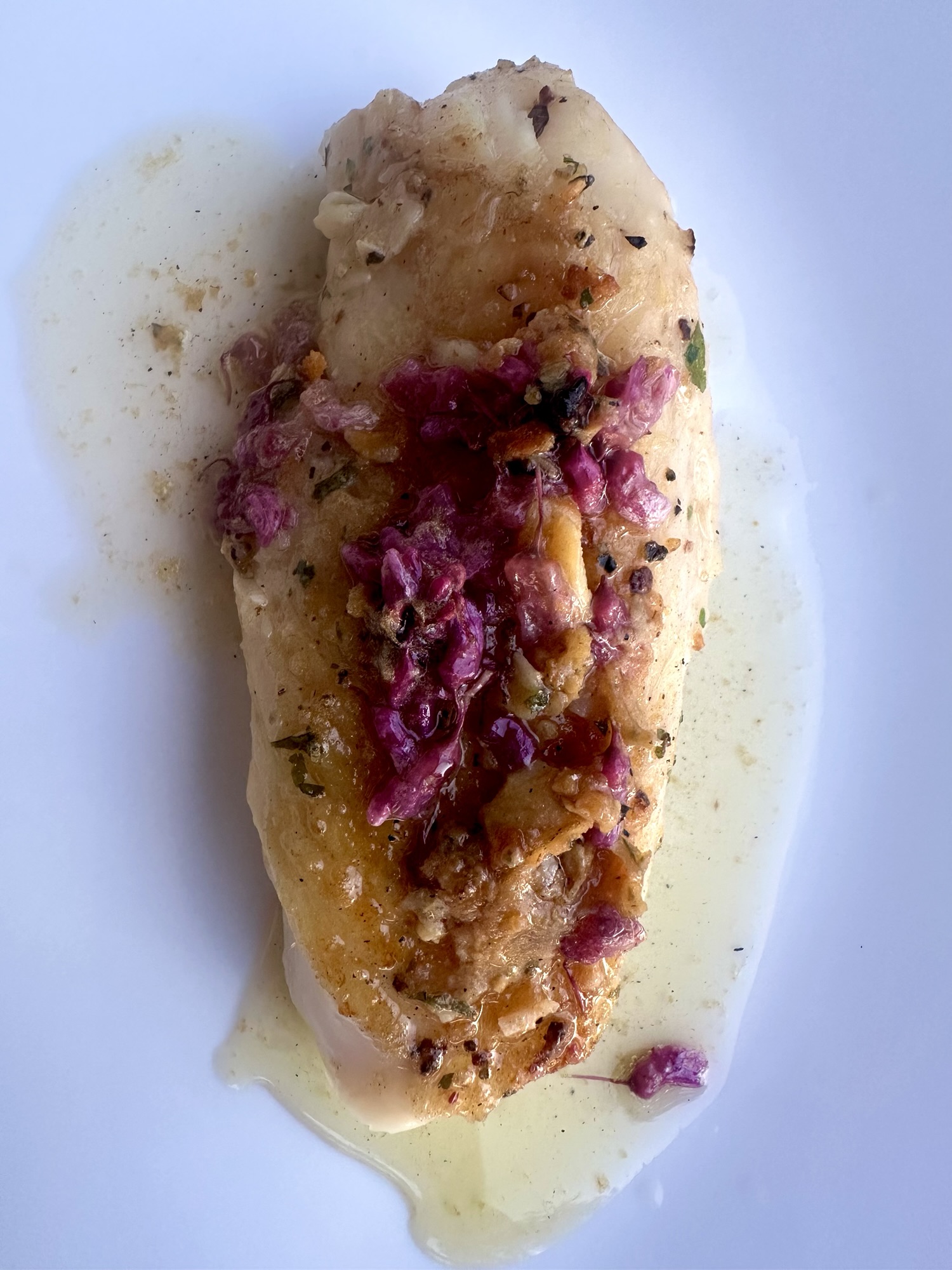
I stored them in the refrigerator for a week before using them in a traditional lemon “caper” butter sauce over cod. These were delightful and I am pleased I have enough for one more dish.

References
Adamant, A. (2024, April 5). Foraging eastern redbud (Cercis canadensis). Practical Self-Reliance. https://practicalselfreliance.com/eastern-redbud/
Cercis canadensis. (2025, April 9). In Wikipedia. https://en.wikipedia.org/wiki/Cercis_canadensis
Nagy, G. (2016, January 7). Weaving while singing Sappho’s songs in Epigram 55 of Posidippus. Center for Hellenic Studies: Harvard University. https://classical-inquiries.chs.harvard.edu/weaving-while-singing-sapphos-songs-in-epigram-55-of-posidippus/
North Carolina Extension Gardener Plant Toolbox. (n.d.). Cercis canadensis. https://plants.ces.ncsu.edu/plants/cercis-canadensis/
Rachel of the Woods. (2025, January 3). Eastern redbud – Cercis ranadensis: Edible & medicinal uses of the prettiest understory tree. https://www.songofthewoods.com/eastern-redbud-cercis-canadensis/
Steinberg, K.M. (2017). A chemical foundation for Native American use of Cercis canadensis and Zanthoxylum clava-herculis (Publication No. 10937262) [Master’s thesis, University of Alabama]. ProQuest Dissertations and Theses Global. https://www.proquest.com/docview/2176070370?pq-origsite=gscholar&fromopenview=true&sourcetype=Dissertations%20&%20Theses
The Thomas Jefferson Foundation. (n.d.). Eastern redbud: Cercis canadensis. The Jefferson Monticello. https://www.monticello.org/house-gardens/in-bloom-at-monticello/eastern-redbud/
Subscribe and get wild foods . . .
Straight to your inbox!
Disclaimer: Information contained on this website should not be considered as a recommendation or an endorsement. This information is intended for educational purposes only, and is strictly and categorically intended as a reference to be used in conjunction with plant experts in your area. Roaming Roots accepts no liability for the use or misuse of information contained in this website. Consumption of plants and fungi is at the reader’s own risk and discretion.



Leave a Reply