
Common bamboo
Perennial, rhizomatic grass originally native to China and Japan before spreading to India and the rest of Southeast Asia. Belongs to the family Poaceae, along with other domesticated cereal crops such as corn, wheat, rice, oats, barley, and millet.
BOTANICAL DESCRIPTION
Leaves are lanceolate and dark green.
Cylindrical, hollow stems, called culms, are woody with distinctive rings or segments, called nodes, from which branches, leaves, and roots emerge. Culms are commonly yellow with green stripes, but there are also exotic color variations like purple-black or blue-grey.

Depending on the species, the diameter of the culms can range from 0.4 inches to 12 inches.
Height can range from only 1.5-5 feet among dwarf varieties up to 100-130 feet.
Culms grow in branching clusters from a thick underground rhizome. The resultant asexual propagation of these rhizomes is the primary system of growth in bamboos, as most species only flower and produce seeds once in their lifetime and only after 12–120 years’ growth.
New culms rise from the ground in what is known as the shooting phase. After this the culm progressed into the maturation phase where it hardens over time. Typically fast-growing, some species growing as much as 1 foot per day.


There are over 1,200 – 1,500 different bamboo species across 60 to 70 genera. Bamboo is typically categorized as either “clumping” and “running.”
- Clumping bamboo has a pachymorph rhizome system which stays close to the main plant. These rhizomes are short, thick, curve upward, and produce culms only at the tip of the rhizome.
- Running bamboo has a leptomorph rhizome system, whose long, thin rhizomes branch away from the main plant and culms grow at nodes along the rhizome. The running bamboo varieties can become invasive, particularly in warm climates, and are challenging to remove once established.
CULTURAL SIGNIFICANCE & COMMON USES
Bamboo is integral to Chinese culture from ancient times to today. Neolithic pottery with pictographs of bamboo from approximately 12,000 years ago was unearthed during the archeological excavation of Banpo Village, Xi’an.

Bamboo is a traditional subject in Chinese art.
All Chinese names for bamboo contain the character “竹” (zhu) whose shape is reminiscent of two twigs of bamboo with leaves. This character can be used alone to simply mean “bamboo,” but it is also found in hundreds of other Chinese words and phrases.
“Every day our written language reminds us of the antiquity of China’s partnership with bamboo.”
Dr. W. Y. Hsiung
Building Material
Bamboo is composed primarily of cellulose, hemicellulose, fiber, and lignin making it incredibly flexible and strong. In fact, it has a higher tensile strength (up to 28,000 pounds psi) than many steel alloys and has a higher compressive strength than wood, brick, or concrete.
In China it was historically used to make a wide range of products:
- Weapons such as arrowheads and the barrels of early guns
- Early firecrackers (gunpowder packed into hollow bamboo)
- Kitchenware, steamers, baskets and utensils
- Writing scrolls, paper and pens
- Boats and rafts
- Clothing like hats and shoes
- Construction including bridges, houses, roofing, scaffolding (Note: Its inherent flexibility and strength make it earthquake-resistant)
- Furniture
- Musical instruments such as drums and woodwind instruments
William Edgar Geil wrote in his 1904 book A Yankee on The Yangtze,
“A man can sit in a bamboo house under a bamboo roof, on a bamboo chair at a bamboo table, with a bamboo hat on his head and bamboo sandals on his feet. He can at the same time hold in one hand a bamboo bowl, in the other hand bamboo chopsticks and eat bamboo sprouts. When through with his meal, which has been cooked over a bamboo fire, the table may be washed with a bamboo cloth, and he can fan himself with a bamboo fan, take a siesta on a bamboo bed, lying on a bamboo mat with his head resting on a bamboo pillow…He might then take a walk over a bamboo suspension bridge, drink water from a bamboo ladle, and scrape himself with a bamboo scraper.”
Many of these uses continue today.


With its rapid growth and ability to regenerate after being harvested without needing replantation, bamboo is a more sustainable building material than trees. Additionally, bamboo’s dense root systems also help control soil erosion, and as a carbon sink, it removes harmful carbon dioxide while releasing oxygen into the atmosphere.
Panda Conservation

Because bamboo is one of their main sources of food, pandas are sometimes referred to as 竹熊 (zhúxióng; bamboo bear).
As of 2023, there were 1,864 giant pandas living in the wild.
Pandas consume an average of 30 pounds of bamboo a day and thus, conservation of bamboo forests is critical to increasing the population of wild pandas.
Medicinal
Traditional Chinese Medicine (TCM) is a healing system over 2,000 years old based on maintaining or repairing yin/yang balance.

In TCM, bamboo is considered cooling, calming, and phlegm resolving. The young shoots, the sap, and the leaves are all of medicinal value and are used in traditional formulations to treat:
- Fevers
- Stomach heat syndromes that produce “upflowing qi from the stomach” causing nausea, loss of appetite, hiccups or vomiting
- “Phlegm mist affecting the brain” which can present as insomnia, strokes, convulsions, irritability, or restlessness
- Cough with sputum
- Labor pain and the expulsion of the placenta
- Wounds and infections
Li Shizhen, a famous Chinese acupuncturist, herbalist, naturalist, pharmacologist, physician, and writer from the Ming dynasty (1368 – 1644) wrote of the great medical value of bamboo in his 53-volume manuscript, Ben Cao Gang Mu, or Compendium of Materia Medica.
Contemporary phytochemical research has identified that bamboo leaf contains a variety of bioactive components, including flavonoids, polysaccharides, amino acids, and phenolic acids. Leaf extracts have shown anti-oxidative, anti-inflammatory, anti-osteoporotic, antiviral, antimicrobial, hypoglycemic, anticholesterolemic, hepatoprotective, cardioprotective, antihypertensive, and anti-fatigue effects.
Bamboo also has oddly high levels of acetylcholine, which acts as a neurotransmitter in mammals. This may be beneficial in treating neurological disorders or cognitive deficits.
Of note, ingesting certain bamboo species can decrease thyroid function, and there is evidence of anti-fertility activity, which may or may not be desired.
Culinary
Bamboo shoots are a traditional delicacy in many Asian countries and are consumed raw, canned, boiled, marinated, fermented, frozen, or in liquid forms.
The nutritious shoots are low fat, high fiber, contain vitamins B1, B2, B6, E, K, and important minerals such as copper, potassium, phosphorus, and iron. They are also a good source of plant protein. Depending on the species, the protein content of bamboo shoots is typically between 1.5% to 4.0% and comprised of different types of amino acids.
- Of these, tyrosine is the most abundant amino acid (57-67%).
- When metabolized, tyrosine becomes tyramine, an amino acid that is known to help regulate blood pressure.
ALERT
Fresh bamboo shoots have high amounts of toxic cyanogenic glycosides and must be cooked to remove the toxic (and bitter) compounds prior to consumption.

RECIPE
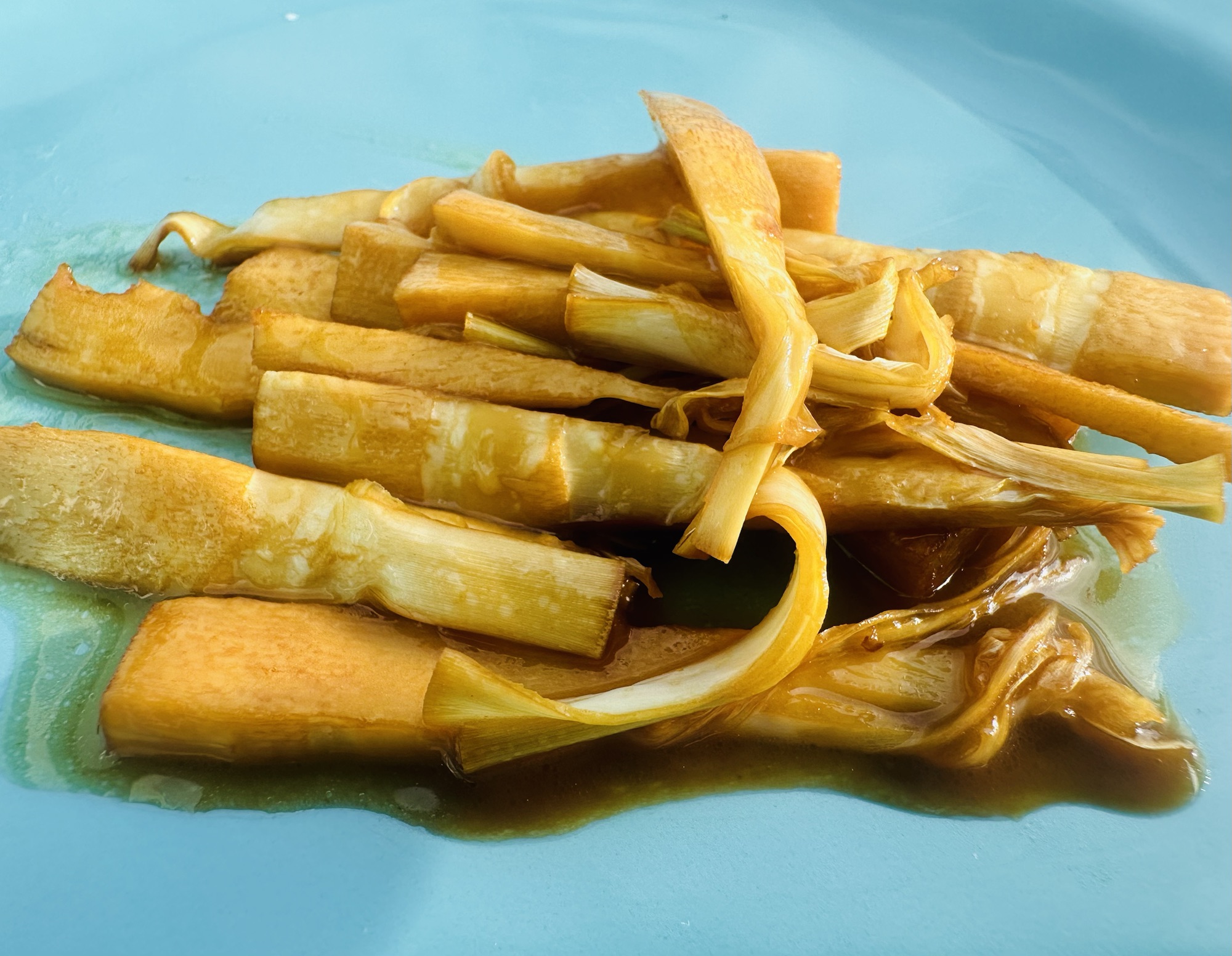
Sautéed Bamboo Shoots
- Boiled bamboo shoots, cut in fourths lengthwise
- 1 Tbsp unsalted butter
- 1 tsp usukuchi (light color) soy sauce
- 1 tsp aonori (dried seaweed flakes)
- 2 tsp vegetable oil
- Sea salt

Prepare the freshly harvested bamboo shoots by peeling off the outside layer to expose the pale inner core and removing the tip and the fibrous base.

Slice into sticks, cubes or slices.

Next, boil the shoots in water for 20-30 minutes until tender and no longer bitter, changing the water once or twice. This process removes the toxic hydrocyanic acid.

Preheat pan and oil over medium-high heat. Add bamboo shoots and sauté over low heat for about 3 minutes or until lightly browned.
Toss bamboo shoots and add butter, basting the the bamboo shoots with the melted butter for another 3 minutes.
Add soy sauce and seaweed and stir to combine. Sprinkle with salt and serve.


I had to substitute tamari for the usukuchi, but otherwise was true to Vermicular’s recipe. I also found a couple of ends slightly woody and will be more careful when peeling and slicing the shoots in the future. Despite this, it was super easy side dish with a delicious umami flavor and delightful crunchy texture.
References
Britannica, T. Editors of Encyclopaedia (2024, August 14). bamboo. Encyclopedia Britannica. https://www.britannica.com/plant/bamboo
Bambusa vulgaris. (2024, June 19). In Wikipedia. https://en.wikipedia.org/wiki/Bambusa_vulgaris
Cheng, Y., Wan, S., Yao, L., Lin, D., Wu, T., Chen, Y., Zhang, A. & Lu, C. (2023, April 24). Bamboo leaf: A review of traditional medicinal property, phytochemistry, pharmacology, and purification technology. Journal of Ethnopharmacology, 306, 116166. https://doi.org/10.1016/j.jep.2023.116166
China Culture. (2024, August 16). Chinese bamboo culture. http://en.chinaculture.org/chineseway/2011-01/04/content_402902_6.htm
Dharmananda, S. (2004, December). Bamboo as medicine. Institute for Traditional Medicine. http://www.itmonline.org/arts/bamboo.htm
Dlamini, L. C., Fakudze, S., Makombe, G. G., Muse, S., and Zhu, J. (2022). Bamboo as a valuable resource and its utilization in historical and modern-day China. BioResources, 17(1), 1926-1938. https://bioresources.cnr.ncsu.edu/resources/bamboo-as-a-valuable-resource-and-its-utilization-in-historical-and-modern-day-china/
List of bamboo species. (2024, March 12). In Wikipedia. https://en.wikipedia.org/wiki/List_of_bamboo_species
Panee, J. (2015, June). Potential medicinal application and toxicity evaluation of extracts from bamboo plants. Journal of Medicinal Plant Research, 9(23), 681-692. doi: 10.5897/jmpr2014.5657. https://www.ncbi.nlm.nih.gov/pmc/articles/PMC4659479/
Sangeetha, R., Idea, Y.K.T., Chaitra, C., Malvi, P.G. & Shinomol, G.K. (2015). The amazing bamboo: A review on its medicinal and pharmacological potential. Indian Journal of Nutrition, 2(1), 106. https://www.opensciencepublications.com/wp-content/uploads/IJN-2395-2326-2-106.pdf#:~:text=Bamboo%20leaves%20have%20been%20used%20in%20traditional%20Chinese,anti-fatigue%2C%20anti-bacterial%2C%20anti-viral%2C%20and%20prevention%20of%20cardiovascular%20diseases.
The anatomy of bamboos: Understanding rhizomes, nodes and culms. (August 22, 2023). Bamboo Bioproducts. Retrieved August 16, 2024 from https://www.bamboobioproducts.com/post/bamboo-anatomy
Yeromiyan, T. (2023, December 13). The culture and history of Chinese bamboo. Chinese Language Institute. https://studycli.org/chinese-culture/chinese-bamboo/
Subscribe and get wild foods . . .
Straight to your inbox!
Disclaimer: Information contained on this website should not be considered as a recommendation or an endorsement. This information is intended for educational purposes only, and is strictly and categorically intended as a reference to be used in conjunction with plant experts in your area. Roaming Roots accepts no liability for the use or misuse of information contained in this website. Consumption of plants and fungi is at the reader’s own risk and discretion.


Leave a Reply