

Eastern white cedar, American arborvitae, eastern arborvitae, northern white cedar, arbor vitae, tree of life, swamp cedar, yellow cedar
The Wheel of the Year turns and, once again, it is time to visit Joe’s family in Wisconsin. We stayed in Milwaukee for a week visiting friends and took a ghost tour at Shaker’s Cigar Bar where I learned how to use dowsing rods. This was particularly interesting to me because family lore is that my Grandpa Archie was a water witch and used dowsing to identify the site where my parent’s drilled their well on the farm where I grew up.

We camped in St. Germain and I returned to location where I found Chicken of the Woods (Laetiporus sulphureus) mushroom last year and was rewarded once again!


I spent one day hiking around Copper Falls State Park with Joe’s brother, Jeff, and his girlfriend, Dawn.


In our wandering, we happened across some Eastern white cedar.
BOTANICAL DESCRIPTION
Dense, conical to pyramidal, evergreen coniferous tree indigenous to eastern and central Canada and northeastern United States.
Despite the word “cedar” in its common name, this tree is not actually a true cedar but rather belongs to the cypress family, Cupressaceae.
When the 16th century French explorer Jacques Cartier learned from the Native Americans how to use the tree’s foliage to treat scurvy, he gave it the Latin name arborvitae, or “tree of life,” and brought samples back, making it the first North American tree introduced in Europe.
A slow-growing tree that usually grows to a height of 20-30 feet but it can reach 60 feet in the wild. The width of this often single-trunked tree is typically 10-15 feet.

The reddish-brown bark turns gray with age and is characterized by shallow furrows and a tendency to peel in narrow, vertical strips.

The scale-like leaves of this plant form flat, fan-shaped clusters, are green to yellowish-green in color, and aromatic with resin glands on the underside.
As a monoecious species, both the male and female flowers occur on the same tree but on separate branchlets. Both are small and cone-shaped; female flowers are pinkish and occur at the tips of the branchlets whereas male flowers are yellowish and appear near the base. Ripe cones are reddish-brown, oblong, 0.3 to 0.5 inches long and contain about eight seeds each.

One famous white cedar known as the Witch Tree, or Manidoo-giizhikens (Little Cedar Spirit Tree), grows out of a cliff face on Lake Superior in Cook County, Minnesota. Sacred to the Ojibwe, offerings of tobacco are given to ensure a safe journey on Lake Superior. This same tree was described by French explorer Sieur de la Verendrye in 1731 as a mature tree, making it over 300 years old. However, the oldest known living white cedar tree is an astonishing 1072 years old, and there is a dead specimen with 1,653 growth rings.
TRADITIONAL USES AND HERBAL BENEFITS
The Abnaki, Algonquin, Cree, Innu (Montagnais), Iroquois, Menominee, Mi’kmaq, Ojibwa (Chippewa), Penobscot, Potawatomi and Wolastoqiyik (Malecite/Maliseet) tribes all used white cedar.
Some used it ceremonially as incense or in sweat lodges. Other tribes used the wood to when constructing canoes and arrow shafts, while the bark was woven into baskets, rolled into torches for night hunting or used when tanning hides. The tree also had numerous traditional medicinal applications:
- Antipyretic and diaphoretic
- Diuretic and to treat cystitis
- As a cough remedy for bronchitis and tuberculosis
- To treat gastrointestinal disorders from liver diseases to diarrhea and constipation
- For gynecological concerns such as amenorrhea, uterine carcinomas, and as an abortifacient
- Decoctions and the sap were used as an analgesic, specifically noted for headaches and toothaches
- Poultices were applied to skin rashes, psoriasis, wounds and sprains
- A fermented compound decoction was taken as a blood purifier
Biological activities of Thuja occidentalis from contemporary in vitro and in vivo animal studies have identified antioxidant, anti-inflammatory, antibacterial, antifungal, antiviral, antitumoral, anticholesterolemic, antipyretic, hypoglycemic, gastroprotective, immunostimulant, and radioprotective effects.
Esberitox, a European herbal compound of Thuja occidentalis, Baptisia tinctoria, and Echinacea purpurea used to treat the common cold, has been on the market since 1928.
The main chemical component of white cedar essential oil is thujone, a GABA antagonist and stimulant, best known as a compound in the spirit absinthe.
RECIPE
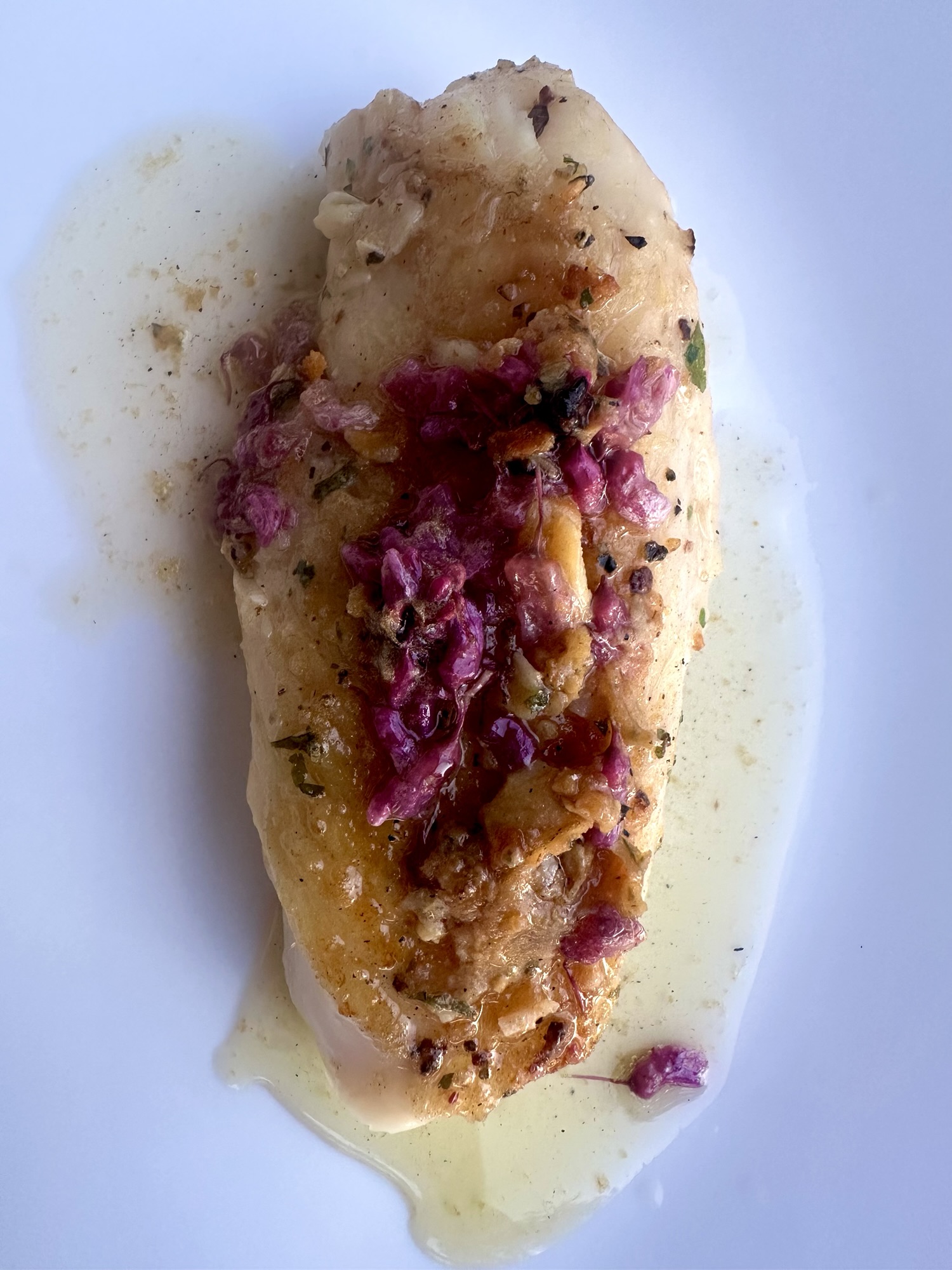
I decided to make two recipes. The first is Cedar Bud Compound Butter from Les Stroud and Chef Paul Rogalski’s Wild Harvest television show.
Shown below on some delicious homemade sourdough toast. The butter has a slightly sweet, citrusy note. However, its delicate flavor was sadly overpowered by the tangy sourdough. I will have to try it on some nice, mild dinner rolls instead.


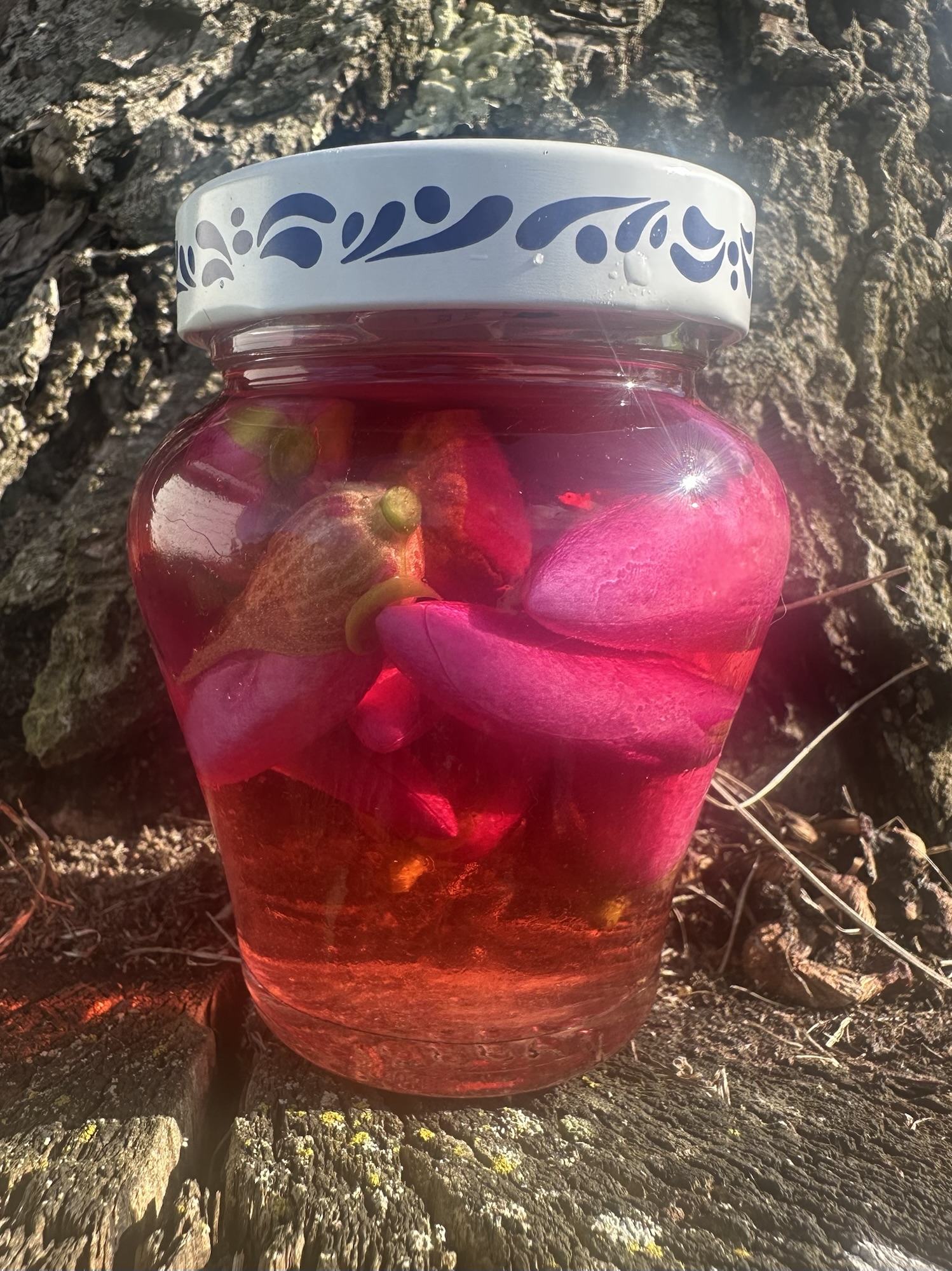
The second recipe is a cedar-bud derivation of the James Beard Award-winning Forager Chef, Alan Bergo’s mugolio, or pine cone syrup.

It’s fermenting in a dark cool place and it will be months before I have any results.
References
Ana. (2022, July 22). Thuja occidentalis: Identification and edible uses. Foraging Guru. https://foragingguru.com/thuja-occidentalis/
Caruntu, S., Ciceu, A., Olah, N.K., Don, I., Hermenean, A. & Cotoraci, C. (2020) Thuja occidentalis L. (Cupressaceae): Ethnobotany, phytochemistry and biological activity. Molecules 25, 5416. https://doi.org/10.3390/molecules25225416
Missouri Botanical Garden. (n.d.). Thuja occidentalis. https://www.missouribotanicalgarden.org/PlantFinder/PlantFinderDetails.aspx?kempercode=c246#:~:text=Thuja%20occidentalis%2C%20commonly%20known%20as%20American%20arborvitae%2C%20Eastern,further%20south%20in%20the%20Appalachians%20to%20North%20Carolina.
Naser, B., Bodinet, C., Tegtmeier, M. & Lindequist, U. (2005, March). Thuja occidentalis (Arbor vitae): A review of its pharmaceutical, pharmacological and clinical properties. Evidence Based Complementary Alternative Medicine, 2(1), 69-78. https://www.ncbi.nlm.nih.gov/pmc/articles/PMC1062158/
Thuja occidentalis L. (n.d.) Native American Ethnobotany Database. http://naeb.brit.org/uses/species/3950/
Rachel of the Woods. (2027, April 17). Eastern white cedar – Thuja occidentalis: Edible & medicinal uses of the tree of life of wild plants. Song of the woods. https://www.songofthewoods.com/eastern-white-cedar-thuja-occidentalis/
The Gymnosperm Database. (2023, February 26). Thuja occidentalis. C. J. Earle (Ed.). https://www.conifers.org/cu/Thuja_occidentalis.php
Thuja occidentalis. (2024, January 7). In Wikipedia. https://en.wikipedia.org/wiki/Thuja_occidentalis
USDA Forest Service. (n.d.). Thuja occidentalis L. https://www.srs.fs.usda.gov/pubs/misc/ag_654/volume_1/thuja/occidentalis.htm
Witch tree. (2024, January 28). In Wikipedia. https://en.wikipedia.org/wiki/Witch_Tree
Subscribe and get wild foods . . .
Straight to your inbox!
Disclaimer: Information contained on this website should not be considered as a recommendation or an endorsement. This information is intended for educational purposes only, and is strictly and categorically intended as a reference to be used in conjunction with plant experts in your area. Roaming Roots accepts no liability for the use or misuse of information contained in this website. Consumption of plants and fungi is at the reader’s own risk and discretion.


Leave a Reply