

Chicken of the Woods, Sulphur Shelf, Chicken Mushroom, Chicken Fungus
Since moving to southern Florida, I really look forward to our annual trip back to Wisconsin to do some mushroom hunting. Below are some of our finds.

Amanita muscaria var. guessowii
[Poisonous, Intoxicating]

Fomitopsis betulina, formerly Piptoporus betulinus
[Medicinal]

Hygrocybe miniata
[Edible but not recommended]
Once again, we were blessed to see several stands of Monotropa uniflora, also known as ghost plant, ghost pipe, or Indian pipe. This flowering perennial plant of the blueberry and heath family is unique because it is non-photosynthetic (i.e., heterotrophic) and the absence of chlorophyll results in its ghostly white color. A mycoparasitic plant, they parasitize fungi to obtain their nutrition.


I have been searching for Chicken of the Woods mushroom for two years and on our first morning walking the dog by the lake, we spotted a chicken mushroom 30 feet up in a tree.
Chicken of the Woods mushroom is a member of the Laetiporus genus of which there are seven species in North America. Of those, Laetiporus sulphureus is a prized edible mushroom with a delicious meaty texture and taste.

Even though, this mushroom was too high to harvest, I knew my luck had changed.

And two days later, the chicken was captured!
MUSHROOM IDENTIFICATION
Laetiporus sulphureus is a parasitic and saprobic fungus on living and dead oaks east of the Rocky Mountains.
Fruits in summer and fall and are comprised of several thick, overlapping, fan-shaped or semicircular brackets attached to wood. The cap is 2-10 inches across, up to 8 inches deep, up to 1 inch thick, and bright yellow-orange with a paler, undulating margin. Very young specimens may appear as blob-like buds


The upper surface can be either smooth or finely wrinkled and has a suede-like texture. As a polypore, it has no gills. Rather the underside is covered with yellow pores.
The flesh is thick, soft, fibrous and watery when young and smells distinctly mushroomy. With age, the flesh fades to white and becomes brittle and chalky.
Spore print is white but can be difficult to obtain based on cap shape.
RELATED SPECIES
Laetiporus cincinnatus is also found in eastern hardwood forests but has a white pore surface and is found on the base or roots of the tree.
Laetiporus huroniensis grows on conifer wood in the Great Lakes area and is reported to cause more allergic reactions.
warning
NEVER eat an unfamiliar mushroom until it’s been identified by an expert.
All wild mushrooms must be cooked thoroughly before consuming.
Only eat a small portion of a new fungus the first time you snack on it.

Some people have reported intestinal issues after consuming Laetiporus, especially if they ate it while they were drinking alcohol, or if the fungus was harvested from a conifer.
NOT SO ALIKE LOOK-ALIKES
Chicken of the Woods is easy to identify as there are no true look-alikes.
Despite this, there are a few mushrooms that sometimes get confused with Chicken of the Woods.
- The chanterelle (Cantharellus spp.), another choice edible, is occassioanally mistaken for CoW are also yellow or orange, but unlike Chicken of the Woods, are mycorrhizal and thus found in the soil near the roots of trees. Other differentiating features of chanterelles are a fruity aroma and funnel-shaped caps under which are gill-like, forking ridges that extend down the stipe.

The toxic Jack-O’-Lantern mushroom (Omphalotus olearius) is also orange and grows on decaying wood. However, it has delicate, distinct gills, rather than pores, and is bio-luminescent in the dark.


Another polypore known as velvet-top fungus (Phaeolus schweinitzii) grows in similar conditions with similar coloring but can be differentiated from Chicken of the Woods by the thick, brown, velvety texture on its surface.
Finally, Maitake, or Hen of the Woods, (Grifola frondose) is sometimes confused with Chicken of the Woods, not because of its appearance, but because of its common name.

RECIPE
Sautéed Chicken of the Woods
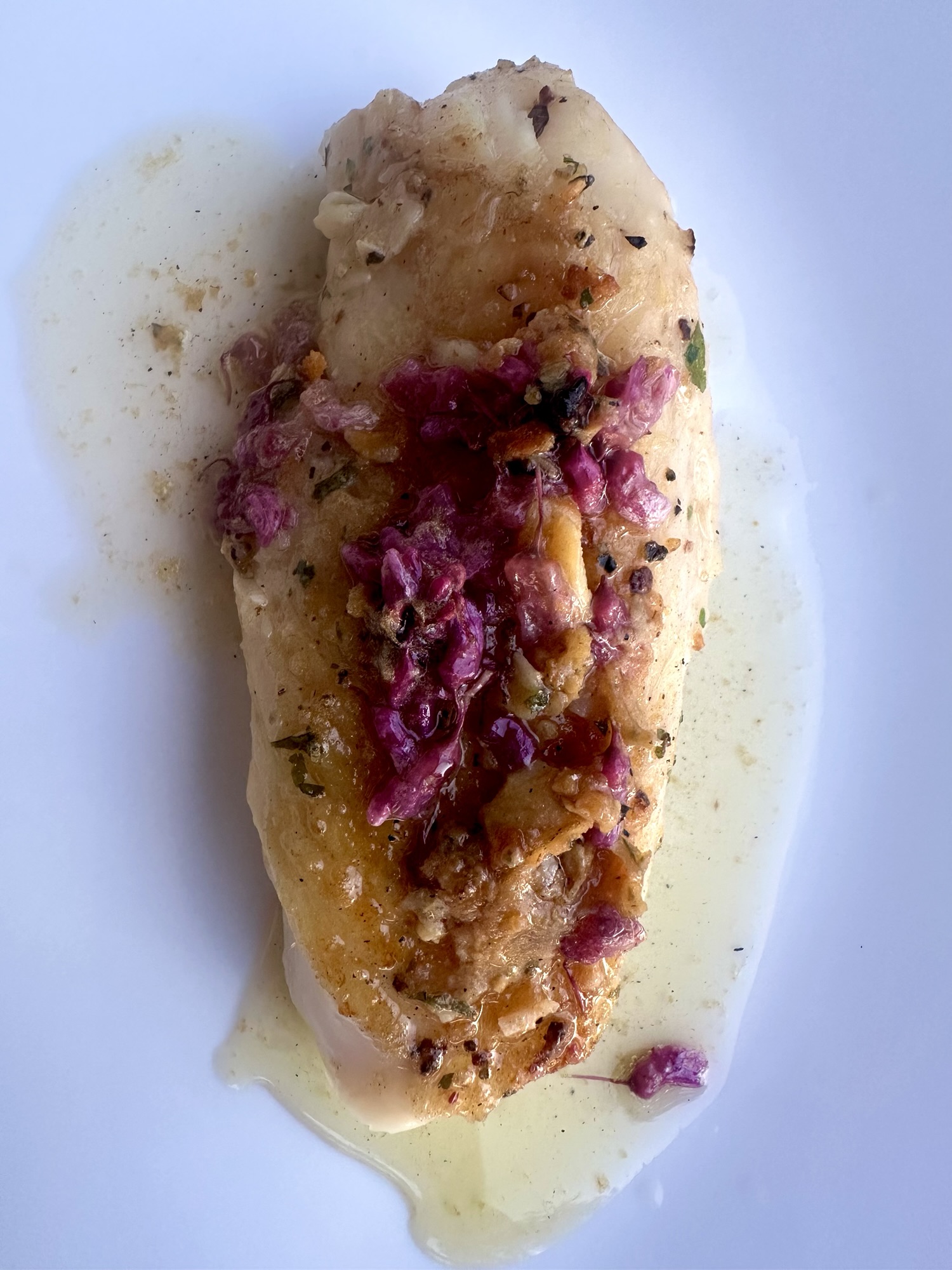
Sauté chopped chicken of the woods in butter about 5 minutes until they start to turn a golden brown. Add minced garlic, salt and pepper to taste and sauté another 5 minutes. Deglazing the pan with dry white wine and simmer until most of the wine has been absorbed into the mushrooms.
OMG! The best mushrooms I have ever eaten. Anywhere!


References
Carlin, O. (2022, July 11). Chicken of the Woods Mushroom Identification and Poisonous Look Alikes. Curative Mushrooms LLC. https://blog.curativemushrooms.com/chicken-of-the-woods-identification-look-alike#3_Velvet_Top_Fungus
Edible Wild Food. (n.d.). Chicken of the woods: Laetiporus sulphureus. https://www.ediblewildfood.com/chicken-of-the-woods.aspx\
Kuo, M. (2017, November). Laetiporus sulphureus. http://www.mushroomexpert.com/laetiporus_sulphureus.html
Mushroom Appreciation LLC. (2023, May 5). Chasing the Chicken of the Woods (Facts, identification, and recipes). https://www.mushroom-appreciation.com/chicken-of-the-woods.html#the-seven-north-american-chicken-of-the-woods-species
Subscribe and get wild foods . . .
Straight to your inbox!
Disclaimer: Information contained on this website should not be considered as a recommendation or an endorsement. This information is intended for educational purposes only, and is strictly and categorically intended as a reference to be used in conjunction with plant experts in your area. Roaming Roots accepts no liability for the use or misuse of information contained in this website. Consumption of plants and fungi is at the reader’s own risk and discretion.




Leave a Reply