
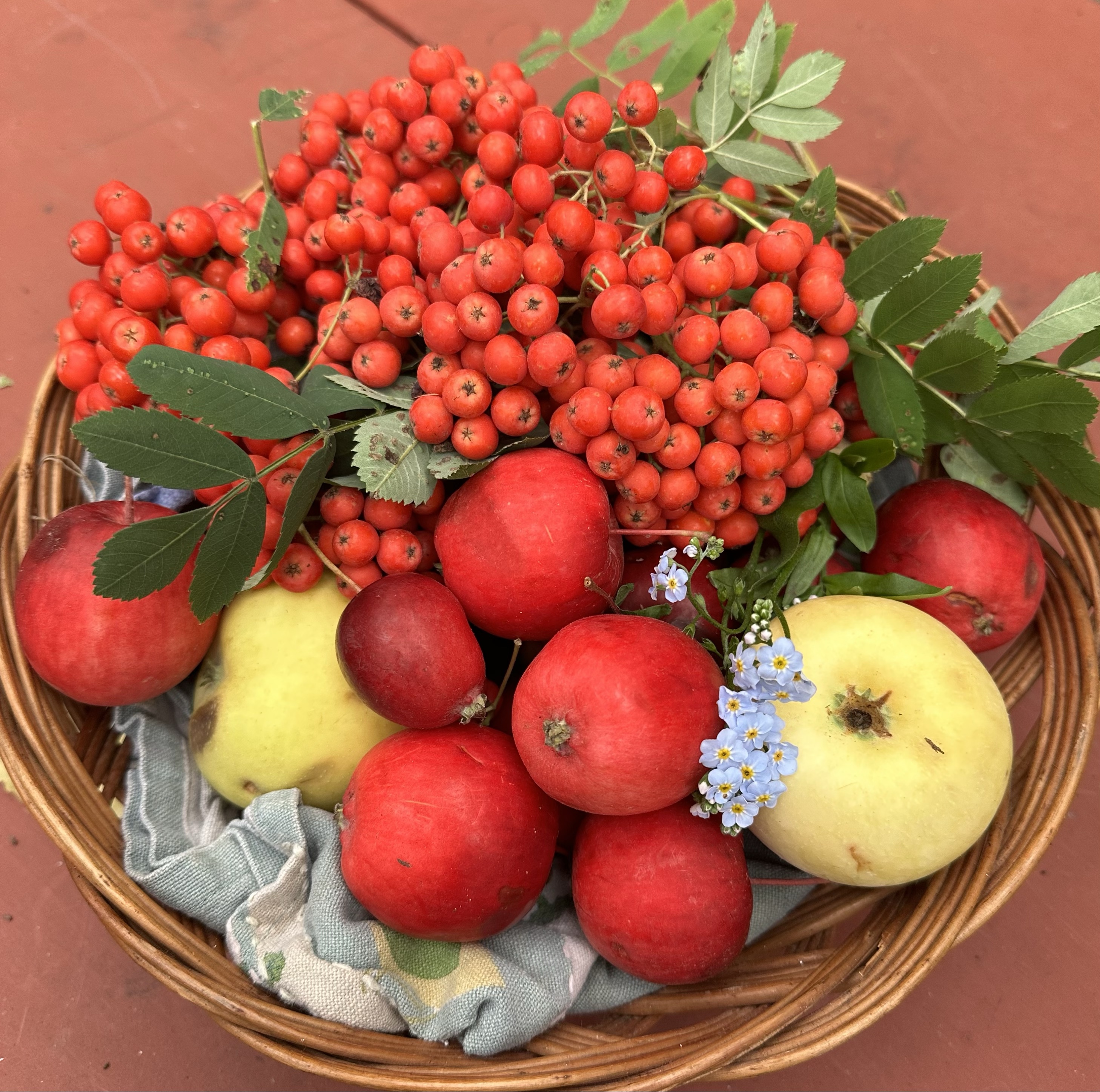
Rowanberry, Mountain Ash, Quicken Tree, Witch Tree
We are in Wisconsin for Joe’s annual family vacation in the north woods. The forest was lush, green and full of wildlife – we saw bald eagles, hawks, herons, loons, deer, muskrats, and a MINK!


BOTANICAL DESCRIPTION
The rowan is a deciduous tree of the rose family, that can reach heights of 20 to 40 feet, often grows multiple trunks and has an oval to round-shaped crown. When young, the bark is smooth, shiny and yellowish gray, but with age it darkens to a grey-black and develops lengthwise cracks, or lenticels.
Leaves are compound and pinnate with 6-8 pairs of leaflets on either side, arranged alternatively. Leaflets are elongated-lanceolate in shape with serrated edges. Leaves are dark green on the surface, blue- or green-gray on the underside, and turn yellow and red in the fall.

In May to June, numerous yellowish, white, 5-petaled flowers bloom from broad, flat panicles. In late summer, flowers give way to pendant clusters of orange-red berry-like pomes. At the base of each ripe fruit, the flower sepals transform into a small, black, five-pointed star.
MYTHOLOGY
Rowan trees are featured in numerous legends and folk traditions.
The Ancient Greeks
In Hellenistic paganism, Hebe was the goddess of youth and served the Olympian gods and goddesses nectar and ambrosia from a magical chalice to keep them eternally young. When her chalice was stolen by demons, an eagle was sent to recover it. During the ferocious fight, eagle feathers and blood fell to the earth and a rowan tree sprouted wherever they landed, and this is why the rowan leaves look like feathers and the berries are blood-red.
The Sami of Northern Scandinavia
In Lappish mythology, rowanberries are sacred to the goddess Ravdna/Raudna/Rauni, the wife of the thunder god, Horagalles/Hora Galles/Thora Galles.
The Norse
According to the Norse creation myth, the first woman was made from a rowan tree and the first man from an ash tree.
The rowan is also featured in the Prose Edda, an ancient Icelandic text and primary source of modern knowledge of pre-Christian Germanic mythology. Legend tells that, Thor, the god of lightning, thunder, storms, agriculture, fertility, and strength, was battling with frost giants when he was swept away in an immense, swiftly flowing river. Fortunately, he was able to grab ahold of a rowan branch and safely return to dry land.
The Celts
In Celtic mythology, the rowan tree was known as the “Tree of Life” and was frequently planted in Scotland, Ireland and Wales as a protection against witches, evil spirits, and mischievous fairies. Rowan was one of the nine sacred trees burned in Beltane fires celebrating the beginning of summer, new growth, and fertility. It was forbidden to cut a one down and strict guidelines surrounded their harvest and use.

In the ancient Celtic alphabet, the Ogham, the rowan tree is associated with its second consonant, ‘Luis’ which is derived from either from lus “herb” or from luise “flame.”
It is also the tree for the second month of the Celtic tree calendar.
The scarlet color and the black pentagram on each berry was thought to be protective against magic and misfortune.

Crosses made from rowan twigs and bound with red thread were carried in pockets, sewn into the lining of jackets, fastened to livestock, or hung over the hearth or doorways.
“Rowan tree and red thread / make the witches tine (meaning ‘to lose’) their speed”.
Traditional rhyme
Rowan was associated with Brìghde/Brìde/Brede/Brigit, the Celtic goddess of the arts, wisdom, healing, livestock, smithing and weaving. She later became Christianized into Saint Brigid and retained many of her associations and the tradition of crafting protective crosses.
TRADITIONAL & HERBAL USES
Rowanberries contain high levels of vitamin C and have been used to prevent or treat scurvy. The fruit also contains powerful antioxidants such as flavonoids, carotenoids, tocopherols, and tannins and the minerals iron, potassium, and magnesium.
Rowanberries have been traditional diuretic, vasodilatory, anti-inflammatory, and gastrointestinal remedies.
The berries are very tart and should not be eaten raw. They are used in pressed juices, alcoholic beverages, jams, jellies, marmalades, vinegars, confectionery, ketchup, pies and soups.
RECIPE
Fallen Apple & Rowanberry Chutney
We found several apple trees near the rowan grove and were able to pick up a several windfall apples in good shape to add to the chutney.


Ingredients
- 1 sweet onion – chopped
- 2 cups chopped fallen apples
- 2 cups cleaned & washed rowanberries
- 4 gloves garlic – crushed
- 3 Tbsp honey
- 1 tsp Turkish oregano
- 1 tsp tarragon
- 1 tsp ras el hanout
- 2 tsp garam masala
- 2 tsp Chinese five spice
- 2 tsp smoked paprika
- 1 Tbsp ground long pepper (may substitute black pepper)
- 1 Tbsp turmeric
- 1 Tbsp cumin
- Pinch of crushed red pepper flakes
- ¼ orange blossom champagne vinegar
- ½ cup water
Instructions
In olive oil, caramelize the onions about 30 minutes until golden brown. Add the rest of the ingredients and simmer on low until soft.

I read varying things about the safety of ingesting rowanberry seeds as they are thought to contain hydrogen cyanide. Many people reported eating whole cooked berries with no ill effect. However, Joe and I had just eaten at Rasika, an amazing Indian restaurant in Washington, D.C. and all their chutneys were smooth and silky. I decided to blend mine and then push the contents through a sieve to remove the seeds. Shown below with my sad attempt at papadum (chickpea crackers with cumin seeds)

References
Live Native. (n.d.). Rowan berry – characteristics, cultivation and use. https://www.live-native.com/rowan-berry/
Harford, R. (2023). Rowan (mountain ash). https://www.eatweeds.co.uk/rowan-sorbus-aucuparia
Luis (letter). (2022, April 16). In Wikipedia. https://en.wikipedia.org/wiki/Luis_(letter)
Moonwood. (n.d.). Celtic tree wisdom. The rowan tree: Luis. https://www.moonwood.ie/single-post/celtic-tree-wisdom-the-rowan-tree-luis
Rowan. (2023, August 18). In Wikipedia. https://en.wikipedia.org/wiki/Rowan
Sorbus aucuparia. (2023, August 23). In Wikipedia. https://en.wikipedia.org/wiki/Sorbus_aucuparia
Sarv, V., Venskutonis, P.R. & Bhat, R. (2020, September 1) . The Sorbus spp.-Underutilised plants for foods and nutraceuticals: Review on polyphenolic phytochemicals and antioxidant potential. Antioxidants (Basel), 9(9), 813. doi: 10.3390/antiox9090813.
Trees for Life. (2023). Rowan mythology and folklore. https://treesforlife.org.uk/into-the-forest/trees-plants-animals/trees/rowan/rowan-mythology-and-folklore/
Woodland Trust. (n.d.). Rowan (Sorbus aucuparia). https://www.woodlandtrust.org.uk/trees-woods-and-wildlife/british-trees/a-z-of-british-trees/rowan/
Subscribe and get wild foods . . .
Straight to your inbox!
Disclaimer: Information contained on this website should not be considered as a recommendation or an endorsement. This information is intended for educational purposes only, and is strictly and categorically intended as a reference to be used in conjunction with plant experts in your area. Roaming Roots accepts no liability for the use or misuse of information contained in this website. Consumption of plants and fungi is at the reader’s own risk and discretion.




Leave a Reply