
COCONUT PALM, COCONUT
The coconut palm has been called the “Tree of Life” because every part is useful and it can provide many of people’s basic necessities such as food, drink, fiber, fuel, and shelter. We are blessed to have neighbors that don’t mind sharing.

BOTANICAL DESCRIPTION
Cocos nucifera is a tall tree that is native to the western Pacific region. This iconic palm is seen throughout South Florida and can live up to 100 years in the wild.
A canopy palm with a smooth, erect, solitary, and light greyish-brown trunk that grows to 60-100 feet tall. The coconut palm is topped with a verdant crown of pinnate leaves 13–20 feet long. Each leaf is composed of 200–250 tapering leaflets approximately 2–3 feet in length. Typically, the crown has 15 open leaves and 15 younger leaves in different stages of development.
The inflorescence consists of a spike produced at the leaf axil with 20–60 branches, and each branch has a large, yellow or greenish female flower at the base and numerous cream-colored male flowers at the distal end. Flowering occurs continuously and, with the help of the insects and wind, the male flowers pollinate the female flowers.

Once the female flowers are pollinated, they become coconuts after a period of 10-12 months. Fruits are rounded to triangular, 8-12 inches long, with three indentations. The name coconut is derived from the 16th century Portuguese word coco, meaning ‘head’ or ‘skull’ because it was thought that those indentations resembled facial features. Like other fruits, the coconut has three layers: the exocarp, mesocarp, and endocarp
- The exocarp is the smooth, glossy, outer skin, usually yellow-green to yellow-brown in color.
- The next layer is the mesocarp and composed of a fiber called coir.
- The endocarp is a hard woody layer. Generally, when you buy a coconut at the supermarket you only see the endocarp because the exocarp and the mesocarp are removed prior to shipping to reduce weight and space for transport. The hollow endocarp is initially filled with coconut water, but as the fruit develops, this replaced with coconut meat.

TRADITIONAL USES AND HERBAL BENEFITS
Coconut meat and coconut water have numerous medicinal properties such as antibacterial, antifungal, antiviral, antiparasitic, antidermatophytic, antioxidant, hypoglycemic, hepatoprotective, immunostimulant.

FUN FACT!!
During World War II in the South Pacific, coconut water was used to give emergency plasma transfusions to wounded soldiers when saline was unavailable.
RECIPE
Harvesting fresh coconut is no easy chore! I had watched several video tutorials where the shell opened easily with several carefully placed whacks with a knife. In the end, I went to the garage to get a proper saw.
Supposedly, harvesting a coconut at different times can provide different ratios of coconut water to meat. I’m not sure if this is due how abnormally dry this summer has been in Florida, but I harvested five coconuts at varying stages of maturity and none had any coconut water.
But I did get some coconut meat!!!

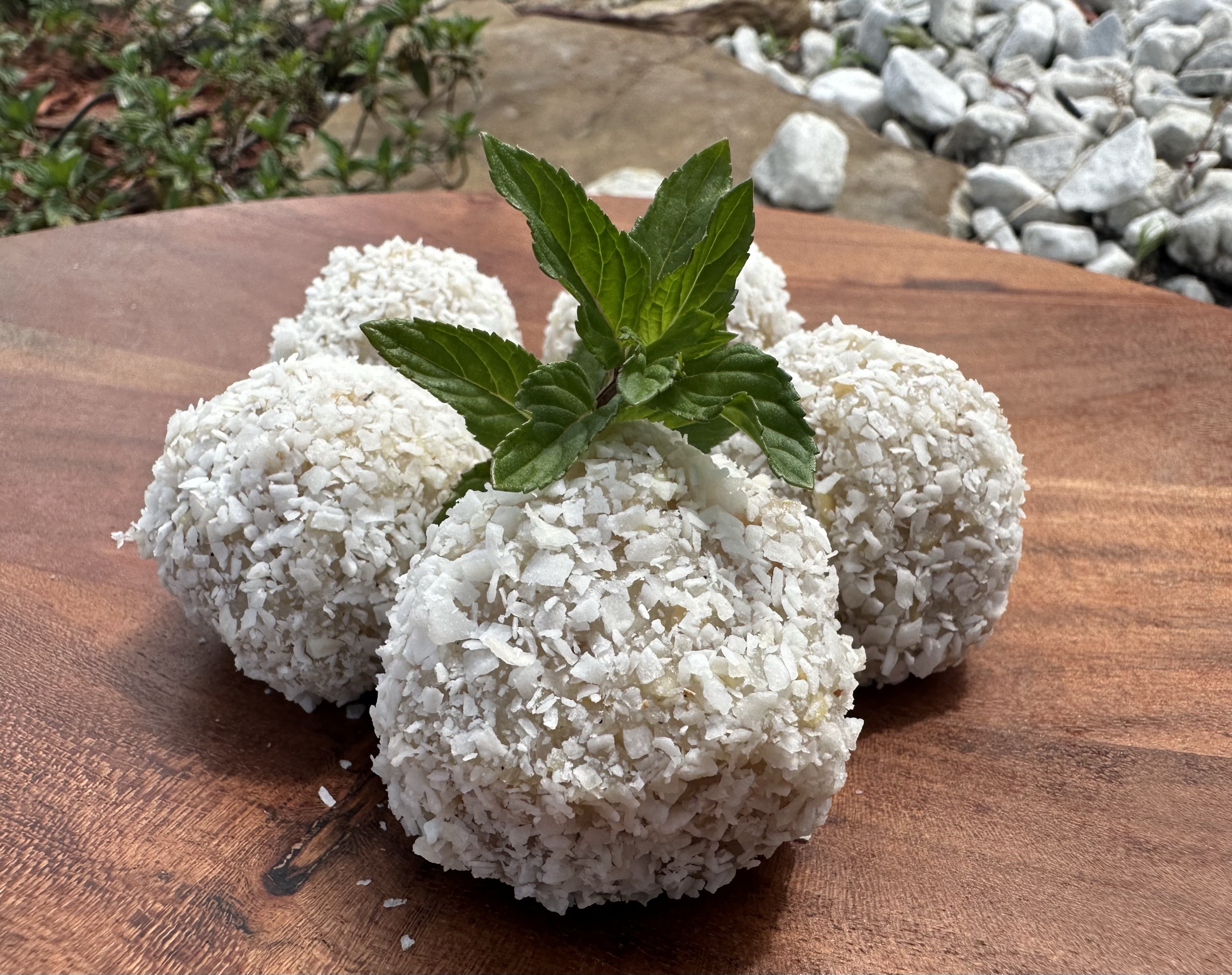
COCONUT LADOO (Nariyal ke Laddu)
Coconut laddo are Indian bite-sized dessert balls made from coconut, sweetener, cardamom, and sometimes milk. Nuts or raisins may also be added. According to Swasthi’s recipe I used, fresh coconut must finely processed or the ladoo won’t bind well.
- 2 cups coconut
- 3/4 cup sugar
- 1/2 cup milk
- 10-12 roasted cashews
- 1/4 teaspoon cardamom

Add coconut, sugar, cardamom and milk to a heavy pan and cook on the stovetop over medium heat stirring frequently so the coconut doesn’t burn or discolor. The sugar will dissolve and become syrupy. Continue to cook and stir frequently until the moisture has evaporated, the coconut is softened, and the mixture is sticky.
Add ground nuts and let cool. While still warm and moist, begin forming the balls. Roll balls in desiccated coconut.
These are delicious!


References
Broschat, T.K. & Crane, J.H. (2021, March 6). The coconut palm in Florida. University of Florida Institute of Food and Agriculture Science Extension. Retrieved from https://edis.ifas.ufl.edu/publication/MG043
Coconut. (2023, July 22). In Wikipedia. Retrieved from https://en.wikipedia.org/wiki/Coconut
DebMandal, M. & Mandal, S. (2011, March). Coconut (Cocos nucifera L.: Arecaceae): In health promotion and disease prevention. Asian Pacific Journal of Tropical Medicine, 4(3), 241-247. doi: 10.1016/S1995-7645(11)60078-3. Retrieved from https://www.sciencedirect.com/science/article/pii/S1995764511600783?via%3Dihub
Royal Botanic Gardens, Kew. (n.d.). Cocos nucifera: Coconut palm. Retrieved from https://www.kew.org/plants/coconut-palm#:~:text=Coconut%20palm%20is%20a%20tree,found%20on%20the%20same%20inflorescence
Science Reference Section, Library of Congress. (2019, November 19). Is a coconut a fruit, nut or seed? Retrieved from https://www.loc.gov/everyday-mysteries/agriculture/item/is-a-coconut-a-fruit-nut-or-seed/
Tamil Nadu Agricultural University. (2014). Coconut botany. Retrieved from https://agritech.tnau.ac.in/horticulture/horti_pcrops_coconut_botany.html
Subscribe and get wild foods . . .
Straight to your inbox!
Disclaimer: Information contained on this website should not be considered as a recommendation or an endorsement. This information is intended for educational purposes only, and is strictly and categorically intended as a reference to be used in conjunction with plant experts in your area. Roaming Roots accepts no liability for the use or misuse of information contained in this website. Consumption of plants and fungi is at the reader’s own risk and discretion.




Leave a Reply