
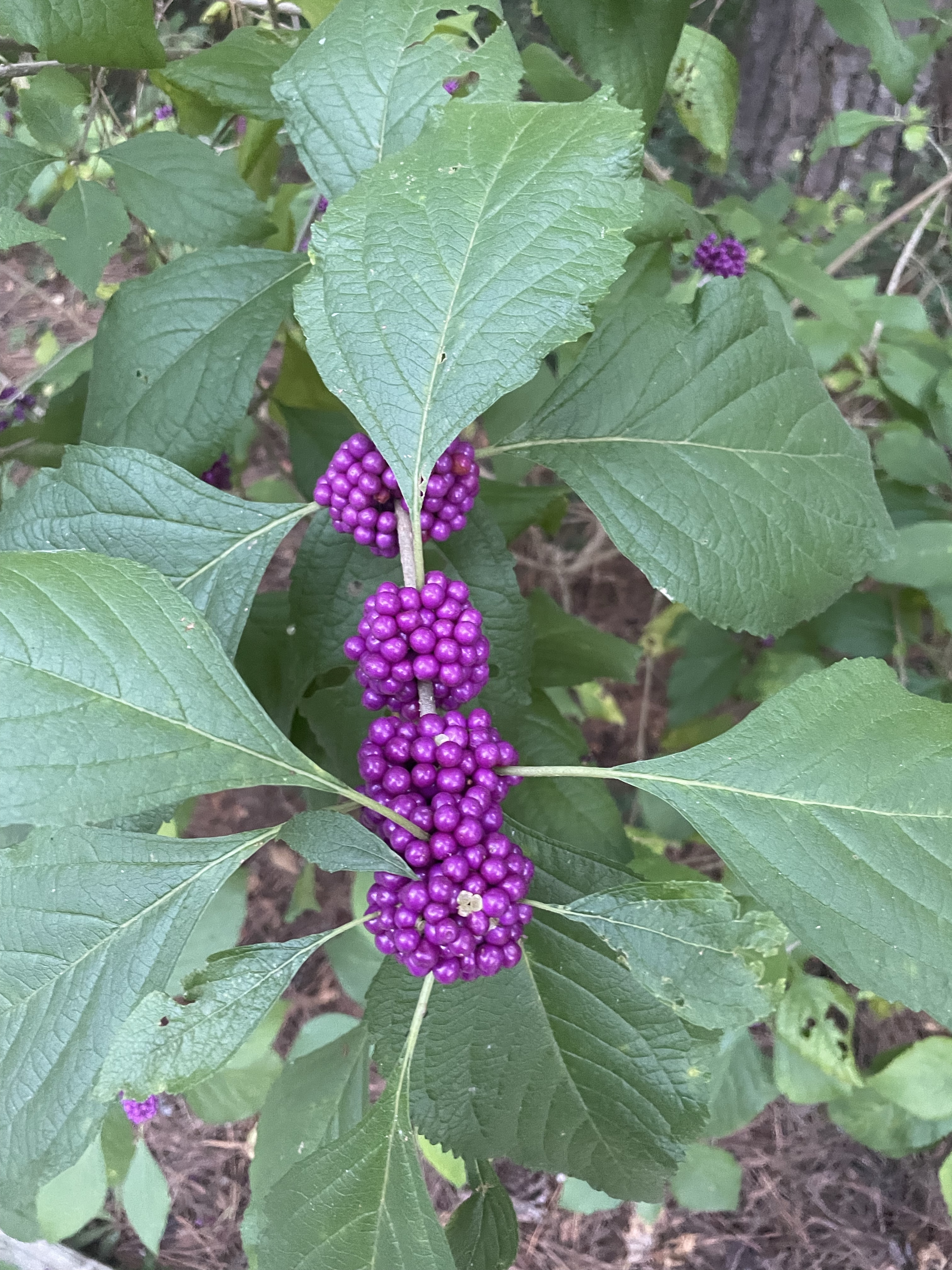
AMERICAN BEAUTYBERRY, BEAUTYBUSH
Our first stop in South Carolina was Myrtle Beach. The boardwalk is unpleasantly touristy but the beach is beautiful.


In Charleston we visited the Magnolia Plantation and Gardens, a former slave-holding rice plantation. We did not tour the house but rather focused on the gardens. Magnolia is renowned for having the oldest and largest collection of camellias and azaleas in the United States and is considered the last large-scale Romantic-style garden.


BOTANICAL DESCRIPTION
Near our campsite we found some beautyberry bushes and the purple berries virtually glow!
A perennial, deciduous shrub native to the south and southeastern regions of the United States that typically reaches 3-6 feet in height. Leaves are large, opposite, elliptical to ovate, with serrated edges.
In late spring and early summer, tiny funnel-shaped blooms, ranging in color from white to pale pink or lilac, cluster around the leaf axils on the plant’s stems.
Fertilized flowers develop into small green berries, also clustered around the stems, that ripen to a shockingly bright magenta color. Each berry has 2 to 4 seeds that pop when you chew them.


TRADITIONAL USES AND HERBAL BENEFITS
Beautyberry’s flavor is mild, slightly sweet but very astringent when raw. Because the acerbity is alleviated when cooked, jellies and syrups are a popular use. Also, leaves are used as a natural mosquito repellent.
Historically, Native American tribes utilized the beautyberry for medicine more than nourishment. The root and its bark was used to make a decoction to treat stomach aches and diarrhea: whereas a tea of roots and berries was used for colic. Using both the root and leaves during a sweat bath alleviated arthritis and fevers.
Modern research has found the beautyberry inhibits growth of MRSA and has cytotoxic components that may have application for future cancer therapies.
RECIPE
Beautyberry Syrup
- Begin by washing and then sorting your harvest, discarding any unripe or unappealing specimens
- Combine your ripe berries with water at a 1:1 ratio in a saucepan
- Bring to a boil, reduce the heat and simmer for 15-20 minutes
- Remove from heat and pour through a mesh strainer into a bowl using a large spoon to push as much liquid through the strainer as possible
- Return the beautyberry juice to the saucepan
- Add sugar to the juice at a 2:1 ratio
- Return to a boil and continue boiling until the sugar is dissolved and the mixture reaches the desired thickness
- Refrigerate
We used our syrup over vanilla ice cream. I found the flavor to be sweet but mild with slightly floral notes.

References
Dettweiler, M., Melander, R.J., Porras, G., Risener, C., Marquez, L., Samarakoon, T., Melander, C. & Quave, C.L. (2020, July 10). A Clerodane Diterpene from Callicarpa americana resensitizes Methicillin-Resistant Staphylococcus aureus to β-Lactam Antibiotics. ACS Infectious Diseases, 6(7), 1667-1673. doi: 10.1021/acsinfecdis.0c00307.
Foraging: American Beautyberry. (n.d.). A home made from scratch. https://ahomemadefromscratch.com/foraging-american-beauty-berry/
Foraging: Identifying American beautyberry: Nature’s pop rocks! (2015, November 27). The foraged foodie. https://foragedfoodie.blogspot.com/2015/11/american-beautyberry.html
Green Deane. (n.d.). Beautyberry: Jelly on a roll. Eat the weeds. https://www.eattheweeds.com/beautyberry-jelly-on-a-roll/
Jones, W.P., Lobo-Echeverri, T., Mi, Q., Chai, H., Soejarto, D.D., Cordell, G.A., Swanson, S.M. & Kinghorn, A.D. (2007, February 7). Cytotoxic constituents from the fruiting branches of Callicarpa americana collected in southern Florida. Journal of Natural Products, 70(3), 372–377. https://doi.org/10.1021/np060534z
Subscribe and get wild foods . . .
Straight to your inbox!
Disclaimer: Information contained on this website should not be considered as a recommendation or an endorsement. This information is intended for educational purposes only, and is strictly and categorically intended as a reference to be used in conjunction with plant experts in your area. Roaming Roots accepts no liability for the use or misuse of information contained in this website. Consumption of plants and fungi is at the reader’s own risk and discretion.



Leave a Reply