
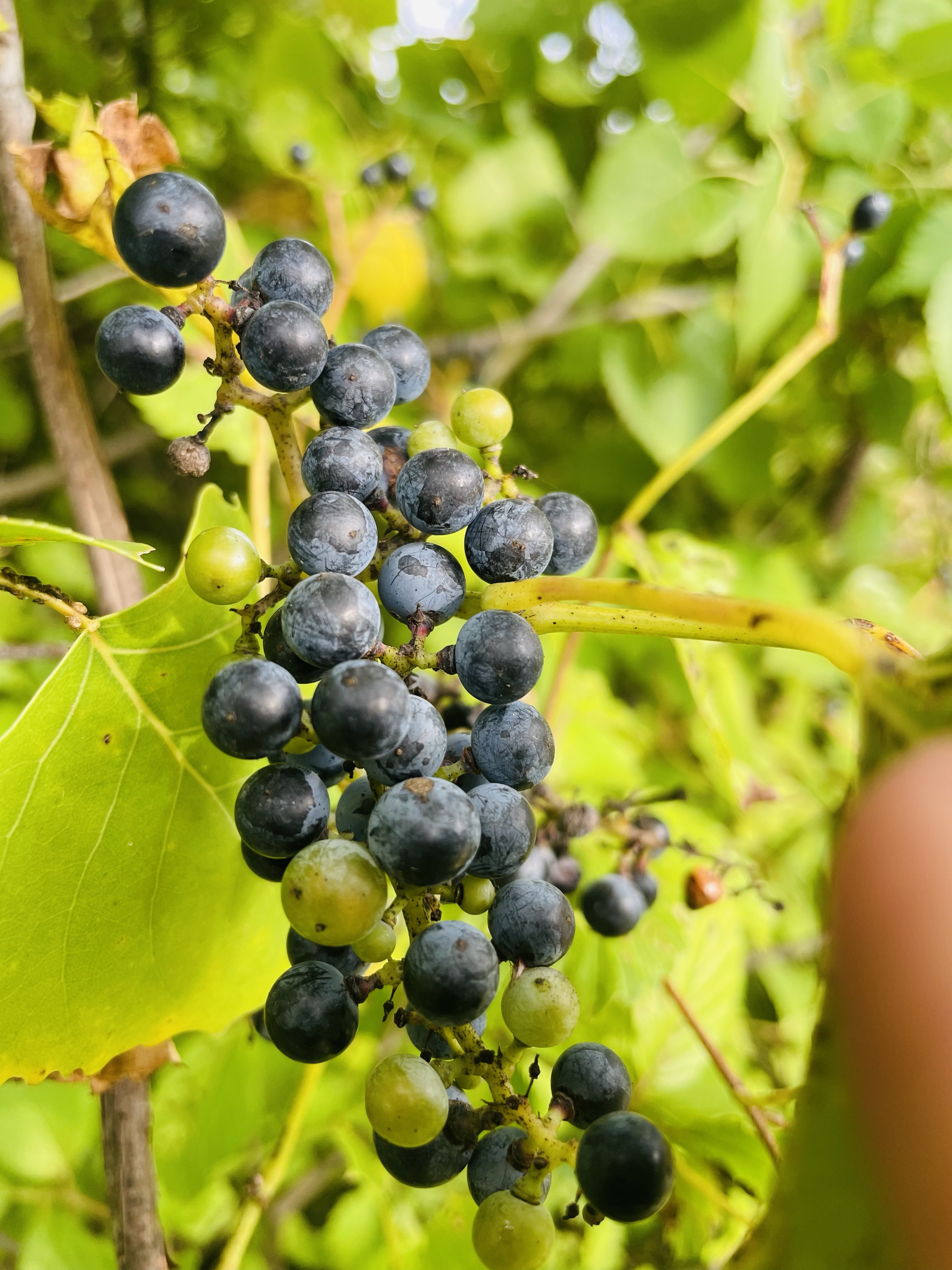
WILD GRAPE, RIVERBANK GRAPE
October 1, 2022


Another great foraging find at the Chicago nature preserve was several riverbank grape vines climbing into trees.
BOTANICAL DESCRIPTION
Perennial woody, multi-stemmed vine with forking tendrils that facilitate its ability to climb to great heights.
The leaves are cordate, or heart-shaped, with three lobes and a notch where the leaf stem meets the blade. Leaf edges are hairy with coarse teeth. Grape leaves can grow up to 6″ long and 4″ across and are alternate along the stems.
Clusters of tiny flowers bloom in the summer after which small, hard, globe-shaped green grapes develop. These pyramidal, hanging clusters ripen into blackish, dark blue, or purple fruits covered in white bloom.

TRADITIONAL USES & HERBAL BENEFITS
Wild grapes can be harvested to make wine, mead, juice, jam, and raisins. Wild grape fruits are packed with antioxidant phytonutrients including a specific polyphenol called resveratrol that is believed to reduce inflammation. They also contain vitamins B1, B6, C, manganese and potassium.
The broad leaves can also be eaten fresh, blanched, or dried. In fact, dolmas, or stuffed grape leaves are a famous Mediterranean and North African dish. A yellow dye can also be obtained from fresh or dried leaves.
RECIPE
It is said that the riverbank grapes tastes best after the first frost, but beggars can’t be choosers! The fruit is very seedy so juicing them is a natural option.
To juice, rinse the grape clusters and remove the fruit from the stems. Then place in a pot with an equal amount of water. Bring to a boil then turn stove off. Mash the berries let sit two hours and then strain.
I found the flavor sour, but complex and delicious. I did add sugar to taste before refridgerating but honey would be lovely too.
Riverbank Grape & Coconut Frappé
- 1 cup wild grape juice
- 1/4 cup coconut milk
- Ice
Blend all ingredients and serve.
We both really loved this refreshing summer drink. Enjoy!

CAUTION: IDENTIFIYING TOXIC LOOK-A-LIKES
The berries of Canadian moonseed (Menispermum canadense) and Virginia creeper (Parthenocissus quinquefolia) look very similar to wild grapes, but are toxic. Below are some key features to assist in differentiating these three vines.
CANADIAN MOONSEED
- Moonseed leaves are similar to the wild grape, but the edges are not serrated
- The leaf stem of the moonseed attaches to the leaves underside, rather than the edge.
- Moonseed fruit has one crescent-shaped seed, whereas wild grapes have two to four small egg-shaped seeds.
- Moonseed vines do not have tendrils and tend to be shorter than wild grapes.
VIRGINIA CREEPER
- Virginia creeper leave have 5 distinct saw-toothed leaflets.
- Vines do not get scruffy as they age like wild grapes do.
- The fruit is on widely-spaced, forking stems, rather than clusters with a central stem like wild grapes.
- Virginia creeper fruit stems are usually reddish-pink, whereas wild grape stems are typically green or tan-colored.
HAPPY FORAGING!
References
Edible Wild Food. (2011, October 18). Wild grape vines. https://www.ediblewildfood.com/blog/2011/10/wild-grape-vines/
Edible Wild Food. (2021). Wild grape vine: Vitis riparia. https://www.ediblewildfood.com/wild-grape-vine.aspx
Halcom, J. B. (2020, December 2). Wild grapes. Insteading. https://insteading.com/blog/wild-grapes/
Natural Medicinal Herbs. (n.d.). Herb: Riverbank grape. http://www.naturalmedicinalherbs.net/herbs/v/vitis-riparia=riverbank-grape.php
Subscribe and get wild foods . . .
Straight to your inbox!
Disclaimer: Information contained on this website should not be considered as a recommendation or an endorsement. This information is intended for educational purposes only, and is strictly and categorically intended as a reference to be used in conjunction with plant experts in your area. Roaming Roots accepts no liability for the use or misuse of information contained in this website. Consumption of plants and fungi is at the reader’s own risk and discretion.


Leave a Reply