
BLACKBERRY & ROSE
July 31, 2022
Banks of fragrant wild sweet peas sprawled across the roadside as we continued to drive north along the California coast to Mendocino.


On our way to the Redwood National Forest we stopped to see the Chandelier Drive-Through Tree, estimated to be 2400 years old, 315 ft. tall with a diameter of 21 ft.


Coast redwood trees, the tallest trees on earth, are in the same genus as sequoia trees but there are some key differences.
Another highpoint was visiting tide pools to spot sea anemones, star fish and more.


We also took many beautiful hikes in the woods with sprawling wild roses and masses of blackberry brambles bursting with ripe berries.
HIMALAYAN BLACKBERRY, EUROPEAN BLACKBERRY, ARMENIAN BLACKBERRY
BOTANICAL DESCRIPTION
The Himalayan blackberry is an invasive perennial shrub native to Eurasia that is rapidly overtaking Northern California, outcompeting its native cousins, and federally classified as a noxious weed.
Both blackberries have sprawling, woody, thorny stems with leaves that grow in clusters of three to five, are dark green, hairy, and toothed along the margins. However, the leaves of the Himalayan species are more heart shaped with more finely serrated edges and the thorns are more abundant on the non-native.

Both varieties have flowers that are white to pale pink from late summer until autumn. But the five petals of the Himalayan blackberry are generally fuller and wider than the native blackberry.

BLACKBERRIES OR BLACK RASPBERRIES???
In Mississippi we had harvested black raspberries, so I thought this would be a great opportunity to highlight those differences.
Both fruits belong to the same genus, Rubus, and share many similarities. However, the easiest way to tell them apart is by looking at the core of the berry itself.
Blackberries have a solid white center while black raspberries are hollow in the center where the berry plug remained on the stem when picked (hence the moniker “blackcap”).
In addition, blackberries generally tend to be larger in size and appear shinier and smoother. Black raspberries appear more matte from fine hairs dispersed across the berry surface.
TRADITIONAL USES & HERBAL BENEFITS
Himalayan blackberries are eaten fresh and are made into jams, jellies, syrups and a variety of desserts.
Medicinally, I was unable to find any uses specific to this species but, in general, blackberry fruits, bark and roots have been used to treat a number of ailments. Leaf poultices are used to treat skin conditions and leaf decoctions to manage diarrhea. Contemporary phytochemical analysis of blackberry plants have verified different pharmacological activities including anticancer, antimicrobial, antioxidant, antidysentery, antidiabetic, and antidiarrheal.
WILD CALIFORNIA ROSE
BOTANICAL DESCRIPTION
A thicket-forming rose native California, Oregon and the northern part of Baja Mexico. The grey-brown stems have scattered, broad-based, curved thorns and the leaves have rounded tips with toothed margins.
Fragrant flowers may grow singly or in inflorescences of several blooms. Each rose blossom is open-faced and generally flat, with five petals in any shade of pink from almost white to deep magenta. It produces smooth, ovoid-shaped rose hips.

Identification of this species of rose was aided by this amazing comparative table from U.C. Berkeley.
TRADITIONAL USES & HERBAL BENEFITS
Roses of all species have been used for centuries for food and medicine.
- Rose water has been used in perfumes, cosmetics, to treat inflamed and irritate skin, and as a flavoring in Middle Eastern desserts.
- Teas are made from the leaves, petals and hips to support the gastrointestinal, pulmonary and immune systems.
- Jams and jellies are made from rose petals and hips (rose hips, or seedpods, are very high in vitamin C).
- Rose oil is a powerful aromatherapy ally also possessing antiseptic, antispasmodic, antiviral, anti-bacterial, antifungal, diuretic, aphrodisiac, detoxifying, wound healing, emmenagogic, and sedative effects.
Historically, this specific species, Rosa californica, was used by the women of the Chumash tribe for infant care. Dried petals were finely ground to create an aromatherapeutic baby powder and a decoction of fresh petals was rubbed on the gums of teething or colicky babies.
RECIPE
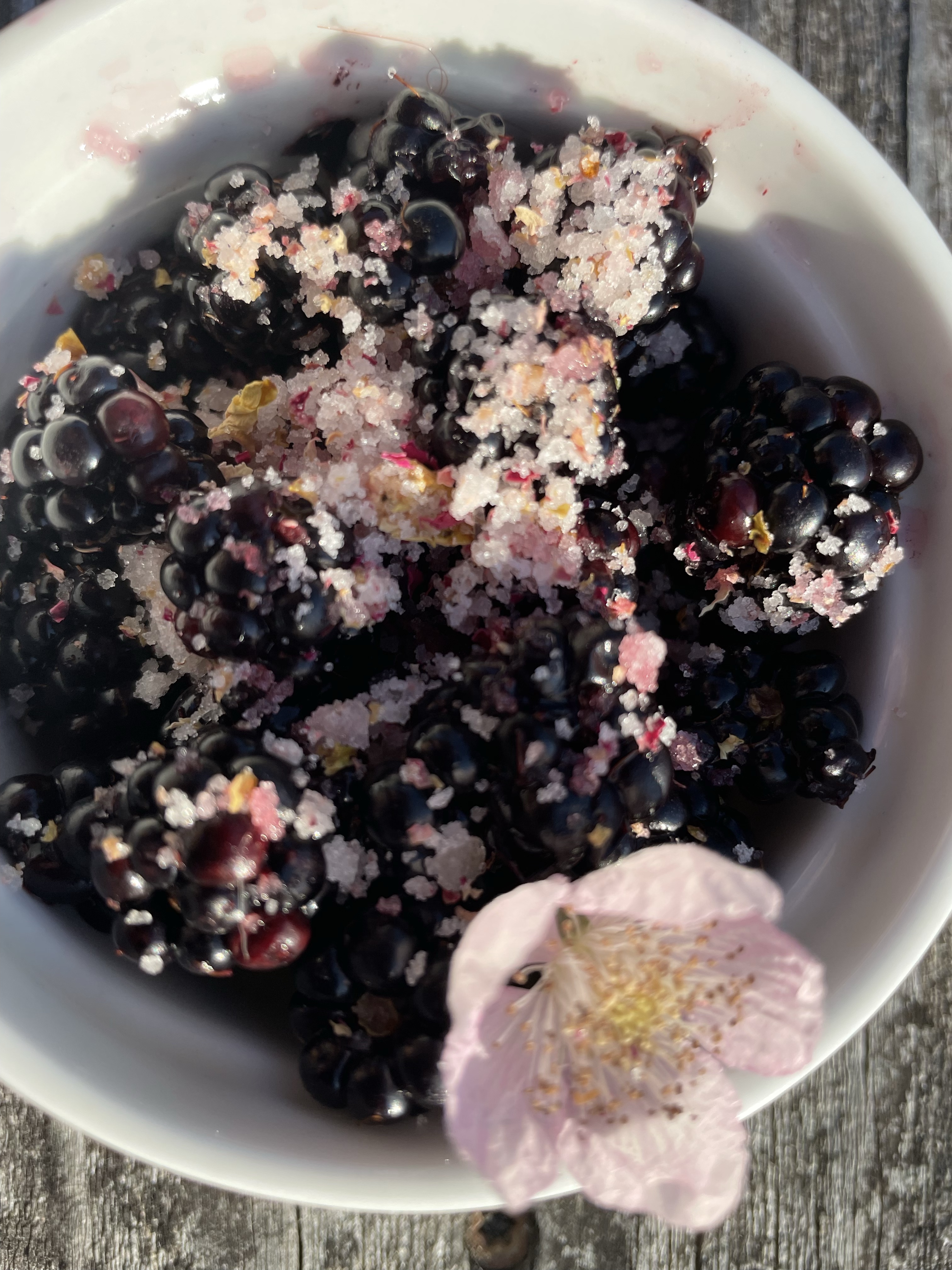
With beautiful berries such as these and no oven in the camper to make a pie, I decided to keep it simple.
Fresh Blackberries with Rose-Scented Sugar
Floral sugars can be made with any edible, fragrant flower (or herb for that matter). Besides roses, options can include lavender, violet, hibiscus, jasmine, or borage blossoms.
Simply blend petals with granulated sugar in a spice grinder.
Then sprinkle on freshly foraged and washed blackberries for a delicious snack!

References
Adams, J. & Garcia, C. (2006, February). Women’s health among the Chumash. eCAM, 3(1), 125–131. https://downloads.hindawi.com/journals/ecam/2006/403838.pdf
Bertucci, A.K. (2017, January 5). Native plants: Blackberries: The good, bad and thorny. Redding record searchlight. https://www.redding.com/story/life/2017/01/05/native-plants-blackberries-good-bad-and-thorny/96204578/
Brennan, D. (2021, October 25). Black raspberry vs blackberry: How are they different? Nourish WebMD. https://www.webmd.com/diet/difference-between-black-raspberry-and-blackberry
Ertter, B. (2001). Native California roses. https://ucjeps.berkeley.edu/ina/roses/roses.html
Health from Nature. (n.d.). Blackberry: Rubus fruticosus. https://health-from-nature.net/Blackberry.htm
Kumari, S. & Choudhury, A.D. Medicinal uses of rose. Vigyan Varta, 2(3). 49-51. https://www.vigyanvarta.com/adminpanel/upload_doc/VV_0321_11.pdf
Verma, R., Gangrade, T., Punasiya, R & Ghulaxe, C. (2014). Rubus fruticosus (blackberry) use as an herbal medicine. Pharmacognosy Review, 8(16),101–104. https://www.ncbi.nlm.nih.gov/pmc/articles/PMC4127818/
Subscribe and get wild foods . . .
Straight to your inbox!
Disclaimer: Information contained on this website should not be considered as a recommendation or an endorsement. This information is intended for educational purposes only, and is strictly and categorically intended as a reference to be used in conjunction with plant experts in your area. Roaming Roots accepts no liability for the use or misuse of information contained in this website. Consumption of plants and fungi is at the reader’s own risk and discretion.


Leave a Reply