
TULIP PRICKLY PEAR, MOJAVE PRICKLY PEAR, DESERT PRICKLY PEAR
July 24, 2022
We stayed at Lopez Lake near San Luis Obispo and the area was full of wildlife – deer, wild turkeys, turkey vultures, sea lions, otters, and seals.

However, it was shocking to see the effect of the extended California drought there. Lopez Lake levels have dropped to 28% of its capacity and the shoreline receded to the point that the docks rest on dry land. It was here that we found our next foraged food, the tulip prickly pear cactus.


But in the time between harvesting and preparing our cactus, we continued to travel up the coast of California having lunch in Solvang, a charming village with old-fashioned Danish windmills and European-style shops and restaurants.


BOTANICAL DESCRIPTION
There are numerous species of prickly pear cactus in the United States. However, with the assistance of the California Native Plant Society, I feel fairly confident our dinner consisted of the abundant tulip prickly pear cactus.
Tulip prickly pear is a segmented cactus found across the southwestern United States, lower Great Plains, and northern Mexico. It generally occurs in low-growing, dense clumps no more than 2-3 feet in height with a sprawling, not ascending, growth habit.
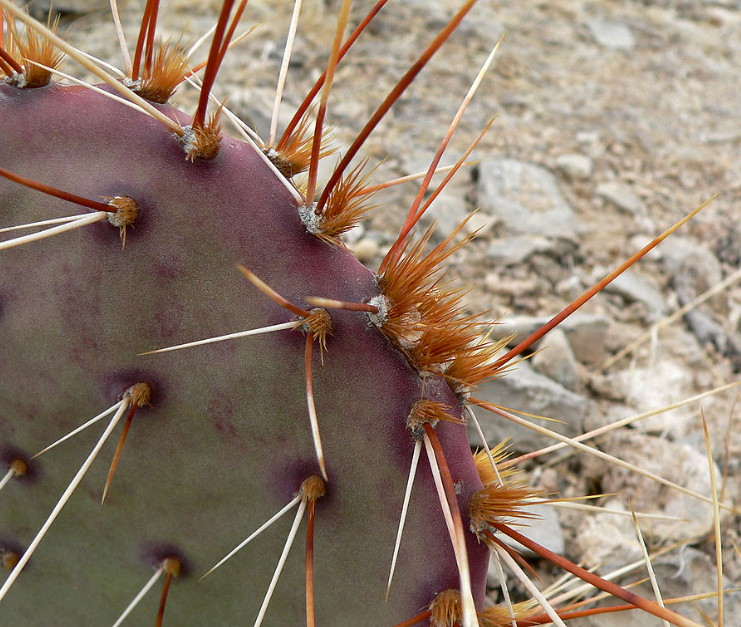
The flat green pads, or cladodes, can develop a purple tinge during periods of drought or cold. They bear clusters of white or reddish-brown spines and small, hair-like prickles called glochids that readily adhere to skin or hair. Spines in this prickly pear are typically more prevalent on the upper three-fourths to one-half of the pad.

Flowers are typically yellow with either an orange-red or pale green center which develop into reddish-purple fruit. However, the tulip prickly pear is prone to hybridization and can display different spine and flower color.
HISTORY
Archeologists have uncovered evidence that prickly pear cactus was used as a food in prehistoric Mesoamerica dating as far back as 12,000 years ago. In the 1300s, the Aztecs acknowledged the cultural significance of this cactus by giving it a central role in the mythology describing the founding of their capital city, Tenochtitlan. According to the legend, the Nahua people were commanded by the god of Sun and War, Huitzilopochtli, to leave their homeland and begin traveling in search of a new land where they would build a powerful empire. They would know they had reached this place when they saw an eagle perched on a prickly pear cactus, devouring a snake.

Today, cactus paddles, called nopales, are still a common ingredient in contemporary Latin cuisine and they remain connected to their pre-Columbian history through their name. The word nopales is a derivation of the Nahuatl, or Aztec, word for the pads, nōpalli, which translates to “fruit of the Earth,”
HARVESTING
When foraging I only harvest what I will use, and since it is just the two of us, I collected a single cactus paddle. You should have seen Joe’s face when I pulled the kitchen tongs out of my foraging bag on our hike!
I had read that you could use a vegetable peeler to remove the spines. However, once I brought the paddle back to the campsite and laid it on the picnic table, I became less convinced that this was a safe approach since I only had a small portable peeler with no handle.
I tried using Joe’s pliers to remove the spines, but this did not remove the glochids, so I transitioned to tweezers. After I had completely tweezed the cactus paddle of spines and glochids, I ran a flame over the surface to singe off any remaining hairs.

Despite my care, I did end up with some glochids on my clothes, which then transferred to my body and one to Joe’s foot, a somewhat unpleasant experience. I was able to remove them but, moral of the story, wear gloves and an apron when working with cactus paddles!
RECIPE
Summer Nopales and Corn Sauté
I have seen the spineless, cultivated type in the grocery store before, but never worked with nopales before. I had read that they could be slimy and Hank Shaw described it like “okra with a runny nose.” After reviewing his article on different ways to remove slime when cooking nopales, I elected to grill the paddle on an open flame on our camper stove (campfires are prohibited in California due to high wildfire risk).
After letting it cool, I chopped the cactus into small chunks but, there still seemed to be some mucus oozing, so I tossed the chunks into a pan with a little olive oil and sautéed them until it seemed that all slime had seeped out and cooked away. Then I added fresh corn and chopped tomato, garlic, oregano, salt and smoked paprika.

The nopales’ flavor was reminiscent of a citrusy green bean and went well with the smoky, sweet taste of the vegetable sauté. The texture reminded me of a bell pepper, albeit a little chewier.
There could be a number of reasons for my tough cactus – the drought, the age of the paddle, my lack of experience preparing them.
Nevertheless, the flavor is pleasing enough I will definitely be working with this vegetable again.
TRADITIONAL USES & HERBAL BENEFITS
The cactus paddles, fruits, blossoms and seeds are all edible and very nutritious. The viscous liquid from the pads has anti-inflammatory properties and a long history of usage to treat wounds, cuts and burns. More recently, the juice is used to manage type 2 diabetes. Contemporary research has confirmed that nopales and their fruits are associated with anticancer, antiulcer, anti-allergenic, anti-diabetic, and anti-dementia properties.
References
Angulo-Bejarano, P.I., Martínez-Cruz, O. & Paredes-López, O. (2014). Phytochemical content, nutraceutical potential and biotechnological applications of an ancient mexican plant: Nopal (Opuntia ficus-indica). Current Nutrition & Food Science, 10, 196-217. Angulo_2014-with-cover-page-v2.pdf (d1wqtxts1xzle7.cloudfront.net)
California Native Plant Society. (n.d.). Tulip prickly pear: Opuntia phaeacantha. Calscape. https://calscape.org/Opuntia-phaeacantha-(Tulip-Pricklypear)?srchcr=sc62da2cdbe09e7
Grant, B. (2019, August 8). Prickly pear historical uses – learn about prickly pear cactus. Gardening know how. https://blog.gardeningknowhow.com/tbt/history-of-prickly-pear-use/
Griffith, M.P. (2004). The origins of an important cactus crop, Opuntia ficus-indica (Cactaceae): New molecular evidence. American Journal of Botany 91, 1915–1921. https://pubmed.ncbi.nlm.nih.gov/21652337/
Herz. M. (2020, May 28). The legend of the foundation of Tenochtitlan. Inside Mexico. https://www.inside-mexico.com/the-legend-of-tenochtitlan/
Opuntia phaeacantha. (2022, May 28). In Wikipedia. https://en.wikipedia.org/wiki/Opuntia_phaeacantha#:~:text=Opuntia%20phaeacantha%20is%20a%20species%20of%20prickly%20pear,Mexico.%20The%20plant%20forms%20dense%20but%20localized%20thickets.
Opuntia Web. (n.d.). Opuntia phaeacantha. https://www.opuntiads.com/opuntia-phaeacantha/
The American Southwest. (n.d.). Opuntia phaeacantha. https://www.americansouthwest.net/plants/cacti/opuntia-phaeacantha.html
Subscribe and get wild foods . . .
Straight to your inbox!
Disclaimer: Information contained on this website should not be considered as a recommendation or an endorsement. This information is intended for educational purposes only, and is strictly and categorically intended as a reference to be used in conjunction with plant experts in your area. Roaming Roots accepts no liability for the use or misuse of information contained in this website. Consumption of plants and fungi is at the reader’s own risk and discretion.


Leave a Reply