
WAX APPLE, WATER APPLE, ROSE APPLE, JAVA APPLE, WAX JAMBU
June 6, 2022
Before leaving on our “official” trip, we took a short drive down to the Florida Keys for a test run in the camper with all the critters. I had been researching edible wild foods in season and was on the lookout for natal plums, coconut sprouts, tamarind, breadfruit or sapodilla. But none of those were in the cards.
On our second day, we stopped at Higgs Beach to tour one of our favorite gardens at the West Martello Tower, part of a former Civil War fort. The West Martello Gardens consist of numerous different areas including an extensive orchid area, and prehistoric, butterfly, native, waterfall, perfume, and cactus gardens. Maintained by volunteers of the Key West Garden Club, this lovely tropical garden provides a lush green break from the heat with no admission fee (donations are welcome).


It was here that we met the wax apple for the first time.
BOTANICAL DESCRIPTION
Syzygium samarangense, also called the wax apple, water apple, rose apple, Java apple or wax jambu, is a tropical tree native to South Asia that can grow nearly 40 feet. It has evergreen leaves elliptical in shape but rounded at the base that are aromatic when crushed. The bark is pinkish-gray in color, and flakes readily.
Wax apples are oblong, bell-shaped berries averaging 2.5 inches in length with a bulbous, blossom end that slightly puckers in the center. The fruit has thin, waxy skin that can be greenish-white, pink, red, maroon or dark purple. There is a large seed cavity in the center that houses a large dark brown seed nestled in wispy material reminiscent of spider silk. The flesh is white, slightly crunchy and juicy.
The wax apple tree is considered a heavy producer and we saw an abundance of fallen fruit that volunteers graciously allowed us to collect.

RECIPE
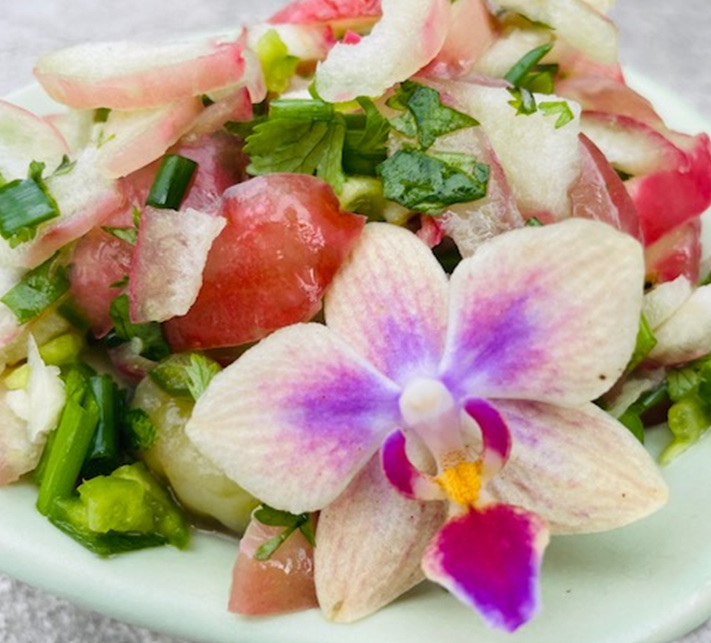
I looked for a recipe that didn’t require a lot of cooking (it’s hot in Florida in June) and came across Suwannee Rose’s recipe for Jambu Salad. We needed to make some adjustments as we didn’t collect 5 cups of wax apples, and were unable to find Thai chilis at the store. Below is our version:
Ingredients
- 1 cup thinly sliced wax apples
There is no need to peel the skin – it is thin, nutritious, and provides a pop of color. You do need to remove the seed and I used a spoon to scrape the fuzzy material from the seed cavity. The flesh discolors quickly so I found it helpful to toss the slices with some additional lime juice to prevent browning.
- 4 tablespoons sliced green onions
- Handful fresh cilantro leaves (can also use basil or mint).
For the dressing
- Juice of 1 lime
- 1 tsp fish sauce
- 1 tsp sugar (to taste)
- 1 garlic clove, minced
- ½ jalapeño, thinly sliced
Whisk the lime juice, fish sauce, and sugar until the sugar dissolves. Add the garlic and jalapeño. Toss with the wax apples, green onions and fresh herb.
Suwannee Rose’s recipe also calls for toasted chopped cashews, but I completely forgot to add (even though we had some in the pantry). I’m sure it would add additional texture and complexity to the recipe. I found the flavor of the wax apples light and sweet, similar to an Asian pear. This was an excellent side-dish that would go well with grilled fish.


TRADITIONAL USES & HERBAL BENEFITS
Wax apples are primarily consumed fresh but there are other culinary preparations including wines, liquors, vinegars, sauces, desserts, jams and jellies.
In South Asia the leaves, bark and roots are used medicinally for a variety of ailments ranging from fevers, cough, pruritis, and edema to amenorrhea, abortion and diarrhea.
Shü, Shiesh, and Lin (as cited in Tarigan, Pramastya, Insanu and Fidrianny, 2022) found that phytochemical associated with various parts of the wax apple are “reported to have several pharmacological actions with prospective medical benefits such as antioxidant, antimicrobial (especially against herpes virus), analgesic, anti-inflammatory, antihypertensive, antihyperglycemic, anticonvulsant, sedative, astringent, spasmolytic, inhibitor of histamine release, potential inhibitor on peripheral blood mononuclear cells, cytotoxic activity, immunomodulator, diabetes or glucose tolerance impairment, skin diseases, tuberculosis, diarrhea, stomach, and respiratory complaints management” (p. 2093-4).
References
Rare Fruit Club. (n.d.). Wax apple, Wax jambu, Java apple. Wax Apple (rarefruitclub.org.au)
Tarigan, C., Pramastya, H., Insanu, M. & Fidrianny, I. (2022). Syzygium samarangense: Review of phytochemical compounds and pharmacological activities. Biointerface Research in Applied Chemistry, 12(2), 2084 – 2107. 20695837122.20842107.pdf (biointerfaceresearch.com)
Subscribe and get wild foods . . .
Straight to your inbox!
Disclaimer: Information contained on this website should not be considered as a recommendation or an endorsement. This information is intended for educational purposes only, and is strictly and categorically intended as a reference to be used in conjunction with plant experts in your area. Roaming Roots accepts no liability for the use or misuse of information contained in this website. Consumption of plants and fungi is at the reader’s own risk and discretion.


Leave a Reply